This is Mom and Dad back in the day at 409 Edgecombe Avenue. The year is 1977.
My Dad is Burdette Ringgold. My mother Faith and he were married in 1962. In 1963, we all moved from the Bronx to 145th Street, where for the first time we had enough rooms for one of them to be devoted to a studio for my Mom's art work. Barbara and I shared the largest bedroom which had its own toilet attached, separate from the larger master bathroom.
My sister and I switched that fall from Our Savior Lutheran School in the Bronx to New Lincoln School on 110th Street and Central Park North. And what a switch that was.
First, a new Dad. Then a new school and a new neighborhood. I was definitely reeling from the culture shock, thoroughly intimidated by my new surroundings.
And then in November of 1963, while Barbara and I were still scrambling to adjust to New Lincoln's distinctly secular and progressive approach to education in which, for example, we called our teachers by their first names, something truly awful happened, something I can no longer really imagine but rather can only recollect based upon previous recollections ad infinitum.
I suppose the best thing about it was that I was a child and therefore had nothing to compare it to. But I can still remember something of the physical landscape of that day, that it was in the fall and I recall, the leaves were already turning.
When 9-11 happened in 2001, as it happened I was again living in the same building on 145th Street in Harlem where we had lived then. I thought of that previous day when President Kennedy had been shot and idly wondered if the experiences of school children were anything like the way it was for us. I hoped that it was because I remember only that I felt very protected when Kennedy was shot, not at all in any kind of personal danger. But then Jack Kennedy had been shot in Dallas, Texas which from my point-of-view at that time might as well have been Oz for all I knew about its connection to the part of the United States in which I was living.
The school day ceased to progress in a manner that was then entirely invisible to me but which I would always recognize from then on in times of emergency in educational settings. The announcement was made in a quiet and dignified way that the President, John F. Kennedy was shot, and I had occasion to recall this in particular recently when reading a reminiscence of that very same day written by my former 7th grade teacher, Helen Myers. It was good to learn that even though I had been only 11 years old that I had still gotten the essentials right.
I can't remember then how long it was from the announcement of his shooting to the announcement of his death, or whether I received any further information until I was actually with my parents but I remember that the next order of business was getting us home as quickly as possible where my family (and I guess I would assume all the other children's families) remained glued to our black and white television sets and the two or three television stations we then had for the duration, which I would guess extended over a period of days.
In the Christian tradition, getting a head of state properly buried, particularly if it also happens that he was assassinated while in office, was I would guess a protracted process, not a simple matter. And children are easily amazed at how long adults can take to do such things at such times. I think I can recall some aspects of the processional apparently patterned after that of Abraham Lincoln as called for by his widow, Jacqueline Kennedy.
I don't know if I actually remember seeing John John saluting his father's coffin that day or whether it is all the times I have seen it replayed in various forms. What stands out in my mind since then is that he wore those short pants that little boys up to a certain age were sometimes dressed in, and that that same boy became a man who died only a year after his own mother died of cancer.
From 1963 to 1977 was not such a very long time. Malcolm X was shot in 1965 and that was a highly personal occasion because it happened in Harlem and my family lived in Harlem. My parents and everybody I knew were deeply affected by his death. His processional, viewing and funeral all took place in Harlem. Then Robert F. Kennedy was shot in 1968, and this isn't to say that a great many other things didn't happen in between these dates, including the murder of Martin Luther King, Jr. as well but I run the chronology through my mind if not daily, certainly often enough just so I won't ever forget the order in which things happened.
I asked my Dad whether he was sent home on that day, whether they closed the line down at General Motors in Tarrytown when John F. Kennedy got killed. He said they did. I asked because I know they rarely closed the line down and his coming home from work without completing his day was something that only happened on fewer days than I can count on one hand during the time he worked there. He then mentioned, as well, that he had come home early on the day that Martin Luther King, Jr. was shot but this time without authorization from the bureaucracy. I gather the black workers, including him, refused to work. His punishment was a 3 day suspension. So much for the widespread love and respect for MLK in 1968. But he says they didn't close the line down for Robert Kennedy either. What a crazy time.
Then I graduated from high school in 1969, went to Mexico during the first half of the summer, did not want to ever return to the United States but had to anyway, then spent the second half of the summer in the Sisters of the Good Sheppard Residence for girls in need of supervision across the street from Beth Israel Hospital in 17th Street.
Then I went to Howard University for one semester in the fall of 1969, personally delivered by my Mom with a suitcase full of new clothes and brand new bank account at the Howard University's campus bank. Dad came to visit me sometime in the fall, was shocked at the free floating cattle market on display on the campus green right outside my dorm, which had just started to allow boys to visit on weekends, and advised Mom to bring me home immediately.
I was back in New York at the City College of New York by February of 1970, working as an account adjuster at Best & Company during the day and attending night school. I truly loved that job at Best & Company but they soon went out of business forever. In 1974, I graduated from the City College of New York with a major in English and Creative Writing, under the careful tutelage of my mentor Mark Mirksy, now my colleague.
The summer of my graduation, the same summer in which Richard Nixon was impeached, I was working as a secretary in the office of the Editor-in-Chief of Random House at an exciting new job. The world seemed to pass through that office. I served coffee and did all the dictaphone typing.
In the fall of 1974 I had moved on to a job I liked even better on most days because I was no longer a typist and a server of coffee but a "research assistant" in the Book Review Department at Newsweek Magazine. Even more of the world flowed through these offices, which was known as "The Back of the Book," with Jack Kroll in charge. It was during the two and a half years that I was employed by Newsweek that I met the people and made the connections that would lead to my free lance writing career at The Village Voice, a literary agent and a book contract at McGraw Hill for an as yet untitled book on the sexual politics of black women and black men.
At the birthday party for my Dad, and his sister Gloria in September of 1977, at which this picture was taken, I was presumably then engaged in writing the manuscript that would become Black Macho and The Myth of the Superwoman in 1979. The contract money had already run out and I had just begun to work full time in the position of Lecturer in the Journalism Program at New York University. I was living at Washington Square Village, NYU housing. I had moved from 345 early in the summer of 1976 upon the occasion of the massively successful Sojourner Truth Festival of the Arts, which was given by a committee composed of Margo Jefferson, Pat Jones, Monica Freeman and myself at the Women's Interarts Center on the Westside.
See more of these pictures at http://www.flickr.com/photos/mjsoulpictures/sets/
Wednesday

Thursday

Mme. Willi Posey in her Prime 1950s

Absolutely in her prime in a black suit designed by her posing for the camera at 363 Edgecombe Avenue in 1954, the day Barbara and I and Mom came to live with her. MJ was 49 years old. Always looking up. Photographer TBA.


Photo Collection: MJ with Her Favorite Model Anne Porter1950s

In the 50s, MJ had a particular favorite among her models. This was Anne Porter. The two of them sitting in the livingroom at 363 Edgecombe Avenue. Photographer TBA.
Photo Collection: MJ and Me on The Beach at Setauket 1980s

These were good times, the summer of 1980 or so with Momma Jones (MJ) and Pop-Pop on the Beach at Setauket. MJ married Pop-Pop, her teenage sweetheart, in the late 70s perhaps because her cataracts made her feel as though she needed a shoulder to lean on. I am 28 and the author of Black Macho and the Myth of the Superwoman. My sister Barbara, I suspect, is the photographer in this case. By this time, MJ had begun to wear a blonde wig, much to the consternation of her daughter Faith.
Monday
Chronologies and Documents: Hartford Insurance Fire Company

Policy Number 4043 Stock Policy
In Consideration of the Stipulations herein named and of eight and zero dollars premium does insure B.B. Posey for the term of 3 years from the 1st day of August 1, 1906 at noon to the 1st day of August 1909, at noon, against all direct loss or damage by fire, except as hereinafter provided, To an amount not exceeding Three Hundred, Fifty and zero Dollars, to the following described property while located and contained as described herein, and not elsewhere, to wit:
Dwelling Form$350 on the one story frame, shingle roof building and additions thereto, and fixtures for heating and lighting, as part of the building while occupied as a dwelling situate on west side of Peck Street at No. 203, Block 58, Sheet 13, of Sanborn's 1903 Insurance Map of Palatka, Florida. Loss, if any, payable to East Florida Savings & Trust Company, Mortgages, as their interest may appear.To comply with the Act of the Legislature of the State of Florida regulating the issue of policies by Fire Insurance Companies, approved May 31, 1899, the insurable values of the buildings herein described are fixed at the following amounts: $350.00.Lightning Clause. Electric Light Permit. Kerosene Oil Stove Permit.G. Loper Bailey & Co.Fire Insurance.Palatka, Florida.In Witness Whereof, this Company has executed and attested these presents this 30th day of July 1906. This Policy shall not be valid until Countersigned by the duly authorized Agent of the Company at Palatka, Florida. Geo. L. Chase, President.
Thursday
Sonny's Blues

- In connection with Sonny Rollins' receipt of an honorary Doctorate of Music at Rutger's University, Sonny Rollins joined Faith at her 50 Year Retrospective at the Mason Gross School of Art. Faith received her 21st honorary doctorate as well, and we celebrated with Rollins playing at her exhibition in front of her image of Sonny Rollins practicing on the Williamsburg Bridge.
Photo Essay: Sonny Rollins Plays At Faith Ringgold's Retrospective

Dr. Phillip G Zimbardo, Faith Ringgold, Prof. Abenia Busia, Sonny Rollins and Burdette Ringgold at Rutger's University, 2009


Sonny Rollins and Faith Ringgold, childhood friends from Edgecombe Avenue on Sugar Hill together again. And how sweet it is. Aside from my Dad, Burdette Ringgold, these pictures include Sonny Rollins, the great musician, Faith Ringgold, the great artist, and Dr. Phillip G. Zimbardo, distinguished professor of psychology at Stanford who is perhaps best known for the 1971 Stanford Prison Experiment in which the innate corruptibility of situational dominance is explored. All three New York City bred. New York's Finest you might say.


Photos taken by Faith Wallace-Gadsden (copyright 2009)
Sonny Rollins and Faith Ringgold, childhood friends from Edgecombe Avenue on Sugar Hill together again. And how sweet it is. Aside from my Dad, Burdette Ringgold, these pictures include Sonny Rollins, the great musician, Faith Ringgold, the great artist, and Dr. Phillip G. Zimbardo, distinguished professor of psychology at Stanford who is perhaps best known for the 1971 Stanford Prison Experiment in which the innate corruptibility of situational dominance is explored. All three New York City bred. New York's Finest you might say.
Tuesday
Photo-Essay: Who's Afraid of Aunt Jemima? I Don't Know!

This is a wonderful wonderful picture of the two Faiths at the Gala at Mason Gross. They are both exquisite 78 and 27. I just love this little grown up girl.
Who's Afraid of Aunt Jemima dates from 1981 and belongs to a Private Collector.
Meanwhile in front of the picture-- and I never realized it could be so much fun to have people juxtaposed with images--is Grandma Faith and Baby Faith. She was then 1 year old and now 27. The two Faiths. Who is afraid of Aunt Jemima? Not me!
Monday
Photo Essay: Coming To Jones Road

This is myself and Barbara standing before one of the key images of Coming to Jones Road, a theme extensively represented in the exhibition. Mom did the series Coming to Jones Road to commemorate the awful difficulty she had in getting to build the studio she wanted on the Jones Road property she purchased in 1992. Her white neighbors banded together and hired a lawyer to try to prevent her from completing her plan of adding a studio to her acre large property on the hill in Englewood, New Jersey. The subsequent struggle, which did not result in the building and modifications of the property until 1999, inspired her to return to the issue of how black people had escaped slavery--sometimes leaving in large groups and taking back roads to their destination and freedom.
New Jersey continued to have slavery right up until the end of the Civil War but much of it was rural and it probably always had pockets of resistance and refuge for slaves who had escaped the South. Sometimes this is called the Underground Railroad, which became all the more a necessity as the Supreme Court upheld Fugitive Slave Laws and the awful Dred Scott decision, whereupon fleeing slaves might stop briefly in a remote location and then continue on toward Canada where they might be free. In Coming to Jones Road, Mom has explored ad infinitum the theme of resistance with your feet headed toward freedom in a rural America.
Englewood is really no longer a rural idyll although sometimes it can look like one. There are lots of places that are still almost wild.
Photo-Essay: The Gala at New Brunswick

This is me and the prodigal son, Curlee Holton. It was also an exhibition for him as well as Mom since he is Mom's Master Printmaker and was closely involved with the production of the print/lithographs illustrating the Declaration of Independence. The wall text included a statement by Faith and one from him.
I was supposed to write for their book but I couldn't quite make their deadline although I have an essay for them now. The Declaration of Independence book is a very limited edition, maybe 1000 or so and very expensive so I wasn't particularly eager to be included in such a book. Moreover, for me the issue of the Declaration of Independence is a question of how things were in the 18th century, not my favorite century. Nonetheless, I wrote the essay and have included on this blog above.
I was fascinated by the difficulties Thomas Jefferson, Phylis Wheatley, David Walker and Maria Stewart all present to the visualization of issues intersecting race, gender and American Independence. These four would be my favorite subjects in 18th century America along with John Adams and his wife Abigail Adams from the standpoint of someone who loves to read about history and to read literature.
Sunday
Photo Collection: Mom at the Gala

Photograph taken by Anthony C. Dominiczak. All images property of the Institute for Women and Art, Rutgers.
These photos belong to IWA.

Saturday
Photo-Essay: Once in Awhile

http://www.amazon.com/gp/mpd/permalink/m1LFIKVV2ZC2AL
The Man of the Moment--1963
It is the upcoming graduation ceremony at which both the master jazz artist Sonny Rollins and my Mom Faith Ringgold will be presented with honorary doctorates. This event will take place next week. Sonny Rollins, my Mom and my stepdad all knew one another as children and teenagers who hailed from Edgecombe Avenue and St. Nicholas Place.
To give this a musical hook, I would direct your attention to the release of the Jazz Icon DVD of Sonny Rollins playing in Denmark in 1963 and 1965. He performs several of his classics, most majestically for me the fabulous St. Thomas, which he could probably continue to play for hours and hours. He does a fabulous job here. So cool. So right. So perfect.
It has autobiography (Soul Pictures), stunning pictures (Talking in Pictures) film (Michele's Movie Talk), the drama of African American culture unfolding in the course of the 20th century (Blues People Curriculum) and great blues people inspired music (Blues People-The Music). Actually Sonny Rollins as well as Arthur Taylor both played for Aunt Barbara's wedding, the event that anchors this blog. It doesn't get any better than this.
Enjoy and remember! http://jazzicons.com/vid_rollins.html
Friday
Photo Collection: Michele on the Last Day of School
Stacy took pictures yesterday on one of our terraces at CCNY. He asked me to show the disapproval I felt when a student had said something ridiculous. I don't know whether this was one of those but in any case, this is me with my hair blowing in the wind in May of 2009 at the ripe old age of 57.

Critical Essay: The Final Stage Approaches
The Final Stage of Soul Pictures--translating the amorphous process of scanning pictures, tracking events, photographers, proper names and dates for the lives of the women in my family into a series of specific, finite projects which may, in turn, become a chapter or chapters or even book projects of their own--will be protracted. I don't know how long it will take, except that I would like to finish at least one book project from it during my sabbatical, just because that's the measure of a successful sabbatical. If you come out of it with a book ready to deliver to the publishers, you had a good one.
It's been a few weeks since school more or less ended (it never really ends) and I have begun to imagine completing the book faster than I had once imagined it. My sense is that it could consist of a series of chapters as follows:
The Introduction will be devoted to Dr. Baby Faith, my neice, her birth in 1982 and the series of paintings Mom did in her honor: Willi and Baby Faith, a series of lovely abstractions. This section will be composed of the photographs of Baby Faith, her photographs and Faith's art in this period, including the Dah Series and Emanon--all abstract paintings on canvas.
In each section of the book, the overarching theme will be provided by a particular set of Faith's art work. In this section the rubric will be provided by We Came To Jones Road.
Chapter One will be devoted to Faith and Burdette's experience purchasing a home in Englewood and their struggle to build a suitable studio combination house for herself. In 1999, Faith also initiated the activities of the Any One Can Fly Foundation, including the Garden Party, the Lifetime Achievement Awards and the Scholars Grants.
Chapter Two will look at the origins of the Posey family in Rocky Grove, SC.
Right now the way I am thinking is in terms of a set of discreet projects named after the focus of research and the available documents. Each has to do with questions I wish to pose to the sources. Most would focus on African American family life in a series of locations:
Rocky Grove, SC Project: Apparently, my great-great grandfather, the grandfather of my mother's grandfather was named Free Posey. He is named the head of the family in the 1880 Census, born about 1813, which would make him 67. His wife Matilda was born in 1830, making her about 50. There may have been another wife before her since Free Posey apparently had so many children, maybe 22, quite a few of them older than my great-grandfather Professor Benjamin Bunyon Posey.
Hampton/Tuskegee Project. As part of this project, I would like to go to Tuskegee just to get a better understanding of the role of these two institutions in the development of the struggle of HBCUs for self-definition. Of course, there were many other schools--Spelman, Atlanta, Morehouse, Fisk and Lincoln--which were very different from Hampton and Tuskegree but I am interested in the geography and the landscape of such places since their patterns must have impacted all the rest, regardless of whether the pattern was followed. The idea of an educational system having to be formed under such prohibitive constraints as segregation and apartheid is deeply intriquing to me. I have no ancestral links there so far as I know, only that B.B Posey and all the other Posey probably admired Booker T. Washington's work there.
Palatka/Jacksonville, Florida Project--These two places are the starting points for a substantial portion of family history in the 20th century, in particular the Poseys, who lived in the little town of Palatka, which my grandmother MJ remembers and describes so well in my interviews with her, and Jacksonville, the place of the Binghams, the family into which B.B. Posey married. There were also other Poseys and Binghams who were not my direct ancestors. Both places had racial segregation and yet MJ seems either unaware of it or very reluctant to talk about any firsthand experience of it.
the Addiction Project--my Dad, my Uncle Andrew and my cousin Jimmy died of drug overdoses of heroine all in the 60s before any insight into the treatment of addictions had come. The family assumption has always been that racism killed them but with all this work on genes, I am beginning to wonder if there might not be some insight there. Afterall the death rate in the family has been truly astounding. It includes my paternal grandfather and my Aunt's deaths related to alcoholism.
the CCNY Project--Mother went to CCNY, Grandpa Bob briefly taught chemistry there, and Barbara, myself and my former husband attended their as undergrads. I now teach there and have done so for almost 20 years. Have been asked to supervise the writing of the formal history of the English Department, which should allow me to master the history of the school, some of which would be relevant to Soul Pictures. I am curious about the link between Max Bond, Keith and Mamie Clarke (who were responsible for the research which contributed to the defeat of the Separate But Equal decision), the Northside Center and New Lincoln where I went to school.
the New Lincoln School Project--both Barbara and I went to school here from 1963 through 1970. The impact on my life is incalculable. Also, my neice Faith went their briefly when they incorporated with Walden.
the Public Schools in New York Project--mother taught in the public schools of New York for 17 years while I was growing up in the 50s and 60s. Aunt Barbara also taught. MJ attended Wadleigh High School in the early 20s. Mom and Aunt Barbara went to P.S. 136, Stitt and Morris High School in the 30s and 40s. Uncle Andrew went to the same schools. Dad went to George Washington High School in the 40s. My sister Barbara taught in the public schools for a number of years. I, myself, never attended or taught in a public school. As such, I find them fascinating to consider. Most schools have rich histories which are largely neglected.
NAAFAD Project: National Association of Fashion and Accessories Designers
the Black Feminism Project
I am currently working with a chronology encompassing all relevant events in which the main women in my line have been engaged from roughly 1900 to 2000. Both of my grandmothers were born in 1903. Both grandfathers were born slightly earlier, which gives me a nice frame for the century, and the story their lives and the lives of their descendants can tell about the culture and civilization in which we participated. A major theme is the Great Migration and its outcomes.
A major focus of the project is to render most things in a visual form and to search for language that can further assist the images in characterizing the times for a book reading public. The blog form, as far as my concerned, is a means through which to endlessly explore possibilities for the book. This book will also be for me my first, most sincerely intend book with its own structure of self-sufficient narratives.
Right now the way I am thinking is in terms of a set of discreet projects named after the focus of research and the available documents. Each has to do with questions I wish to pose to the sources. Most would focus on African American family life in a series of locations:
Rocky Grove, SC Project: Apparently, my great-great grandfather, the grandfather of my mother's grandfather was named Free Posey. He is named the head of the family in the 1880 Census, born about 1813, which would make him 67. His wife Matilda was born in 1830, making her about 50. There may have been another wife before her since Free Posey apparently had so many children, maybe 22, quite a few of them older than my great-grandfather Professor Benjamin Bunyon Posey.
I am assuming that both of them were former slaves, and guessing as well that they are living not too far from the location of their enslavement. A brief period of researching the Posey name in cemetaries in that county would seem to indicate that Posey was a very strong and widespread name both among whites and blacks in that particular location and that a site visit would be likely to render some insight into how this name functioned locally.
It looks as though Rocky Grove has experienced a county name change but that it remains a fairly small community, which should be good for tracking ancestral history, and getting a sense of what it was like from 100 to 200 years ago.
I have gathered the names and locations of the various Posey siblings, their spouses and from subsequent papers, letters written on the occasion of the death of Lawrence O. Posey, who was living in Washington D.C. early in the 20th century. Also apparently Benjamin Bunyon Posey, Mom's grandfather, were among those former slaves and their children who were most eager for education and opportunity and travelled in search of it. So this story should be an adventure I think, another chance to explore the mysteries of the rural South and how my ancestors fared in this strange place. I love South Carolina anyway because of its rich history as the earliest states where slaves outnumbered free, also the state that was the first to succeed from the union and to join the confederacy. They were instigators and a place where they liberally continued to import slaves from Africa long after it was illegal to do so in the entire U.S. It may be possible that Free was an African. What a name.
Washington, D.C. Project: A branch of the Posey family settled in Washington D.C. Benjamin Bunyon Posey (my great-grandfather, MJ's father) lived with a branch of this family in order to pursue the education that prepared him to be a teacher and to start schools in Palatka, and other places in the South. I would like to track the fortunes of the Poseys in Washington D.C. after the Civil War, and the manner in which D.C. became the hub of Reconstruction and the first place in the country to see widespread efforts to educate the former slaves.
Washington, D.C. Project: A branch of the Posey family settled in Washington D.C. Benjamin Bunyon Posey (my great-grandfather, MJ's father) lived with a branch of this family in order to pursue the education that prepared him to be a teacher and to start schools in Palatka, and other places in the South. I would like to track the fortunes of the Poseys in Washington D.C. after the Civil War, and the manner in which D.C. became the hub of Reconstruction and the first place in the country to see widespread efforts to educate the former slaves.
When I was a little girl, Mom took Barbara and I to visit Lottie Bell and Junior who had moved their from Atlantic City. We spent perhaps a month with them on a quiet little residential street when we were 5 and 4 I think. It's the first trip I can remember taking in the summer. Lottie Bell, as I recall, was the very stuff of which life is made, a joy to be around. We played with lots of black kids and had a fabulous time. This would be in 1957.
I adore Washington D.C. I attended Howard there briefly in the fall of 1969 and had a completely unforgettable time. I would like to understand this very African American place's link with my family history. Who were the black people who built this magnificent city? Were some of them Poseys? It must have been a fascinating place after the war. Also, apparently my stepfather's grandfather also named Ringgold was in Washington D.C. after the war, possibly a soldier in the Civil War. I had thought before of Washington D.C. being a transitional space in the fortunes of African Americans but I think it probably was crucial.
Hampton/Tuskegee Project. As part of this project, I would like to go to Tuskegee just to get a better understanding of the role of these two institutions in the development of the struggle of HBCUs for self-definition. Of course, there were many other schools--Spelman, Atlanta, Morehouse, Fisk and Lincoln--which were very different from Hampton and Tuskegree but I am interested in the geography and the landscape of such places since their patterns must have impacted all the rest, regardless of whether the pattern was followed. The idea of an educational system having to be formed under such prohibitive constraints as segregation and apartheid is deeply intriquing to me. I have no ancestral links there so far as I know, only that B.B Posey and all the other Posey probably admired Booker T. Washington's work there.
Mother often mentions that Uncle Cardoza Posey, MJ's oldest brother was a Republican. He graduated from the Florida Baptist Academy in 1915, three years after the death of his father BB. Posey, and he often participated in reunions there.
He moved to Orange New Jersey as a young man and proudly participated in the 369th in France during WWI, emerging from the military with the rank of sargent. Born in 1892, he was active in the NAACP and a number of other organizations, including the Masons. He worked in the Post Office all of his life, maintained a vigorous correspondence with family and friends, and spent his vacations hunting down Poseys across the country. My Mom has inherited his papers and his photographs. His role in the family that Mom grew up in is as chief advisor and patriarchal figure to his sister's children. He never had any children of his own although he was married three times. The home he lived in when he died in 1968 is still there and occupied his stepdaughter by marriage who is a teacher. Been meaning to get over there to Hempstead to see what she's got for at least a decade. The last time I spoke to her, she said there wasn't much left. Mea culpa.
Provincetown/Martha's Vineyard Project--Almost every summer from 1957 until 1966 my Mom sister and I spent in Provincetown as part of the artist colony there or in Martha's Vineyard with the Goldsberry family. The Cape Cod summers were a crucial aspect of my life growing up.
Camp Craigmeade Project--Every other summer we spent at Camp Craigmeade and all black, very rustic camp in the Catskill Mountains run by a lady name Helen Meade with her husband and her two older sisters. We called all of them Aunts and we had so much fun that usually we didn't want to go home. Mom would come up and spend a long weekend with us up there along with the other parents. She painted many beautiful paintings of the landscape around Camp Craigmeade. I long to relocate this camp and the family who started it. This all black camp gave me great strength and resilience throughout my life in integrated schools where being black was never the best thing to be.
Palatka/Jacksonville, Florida Project--These two places are the starting points for a substantial portion of family history in the 20th century, in particular the Poseys, who lived in the little town of Palatka, which my grandmother MJ remembers and describes so well in my interviews with her, and Jacksonville, the place of the Binghams, the family into which B.B. Posey married. There were also other Poseys and Binghams who were not my direct ancestors. Both places had racial segregation and yet MJ seems either unaware of it or very reluctant to talk about any firsthand experience of it.
From the reading and map gazing I've done, it sounds as though Palatka is or was a beautiful place with a natural water link with Jacksonville. Also it is very near both historic Eatonville and Daytona Beach, as well Orlando. This will be a visit, and to some degree a search for surviving family and insight into the family's choice of location there. My husband was Naples Florida and I just love the place anyway--the swamps, the aligators, the palm trees and so forth.
Atlantic City Project: In the summer, MJ took her children to Atlantic City where there was a thriving black resort community. They watched black movies all summer and luxuriated in the black section of the boardwalk and the beach. Their visits were always with Lottie Bell, a very close friend of my grandmother's and her son Junior, who was a life of the party type. I look to visit this place and learn all I can of this lovely community and what became of it.
the Bronx Project: A few members of our family, in particular my Mom and my sister and myself lived in the East Bronx for about six years in a building known as St. Mary's Projects, Mitchell Lama housing I believe. We also attended a Lutheran School in the Bronx on Williamsbridge Road. What became of this house and of this school?
Atlantic City Project: In the summer, MJ took her children to Atlantic City where there was a thriving black resort community. They watched black movies all summer and luxuriated in the black section of the boardwalk and the beach. Their visits were always with Lottie Bell, a very close friend of my grandmother's and her son Junior, who was a life of the party type. I look to visit this place and learn all I can of this lovely community and what became of it.
the Bronx Project: A few members of our family, in particular my Mom and my sister and myself lived in the East Bronx for about six years in a building known as St. Mary's Projects, Mitchell Lama housing I believe. We also attended a Lutheran School in the Bronx on Williamsbridge Road. What became of this house and of this school?
The Harlem Project--Needless to say, this was everybody's destination on both sides of my family. And they lived within a one mile radius pretty much for the entire time of their existence, Edgecombe Avenue, St. Nicholas Avenue, and St. Nicholas Place from 145th to 155th Street. As a child to me it had all the qualities of life in a small village of black people. I loved it and miss it still.
Other Possible Location Projects:
the San Diego Project
the European Tours Project
the West Africa Project
the Brooklyn Project
the Englewood NJ Project
Also, there are some topics focused on institutions:
the European Tours Project
the West Africa Project
the Brooklyn Project
the Englewood NJ Project
Also, there are some topics focused on institutions:
WWI Project--Uncle Cardoza, Uncle Fred and probably Thomas Morrison were soldiers in WWI. This is a fascinating war from the point of view of issues of race. Black soldiers had to go through so much just to even get into the battle. The other kinds of "household" and "maintenance" services they rendered have always been belittled and dismissed, although I am not sure why. Anything anybody did in WWI automatically placed the soldier in harm's way.
WWII Project--Uncle Hilliard was a soldier in WWII and would serverely wounded, ending up with a metal plate in his head and also maintained a close relationship with the Veteran's Hospital in New Jersey for the rest of his life. Mom's Dad Andrew Jones volunteered to fight in WWII and cried when they said he was too older. Grandpa Andrew was an emotional man. It may also be that Uncle Cardoza was in the national guard or saw some kind of service in WWII. He was very patriotic.
the Addiction Project--my Dad, my Uncle Andrew and my cousin Jimmy died of drug overdoses of heroine all in the 60s before any insight into the treatment of addictions had come. The family assumption has always been that racism killed them but with all this work on genes, I am beginning to wonder if there might not be some insight there. Afterall the death rate in the family has been truly astounding. It includes my paternal grandfather and my Aunt's deaths related to alcoholism.
the CCNY Project--Mother went to CCNY, Grandpa Bob briefly taught chemistry there, and Barbara, myself and my former husband attended their as undergrads. I now teach there and have done so for almost 20 years. Have been asked to supervise the writing of the formal history of the English Department, which should allow me to master the history of the school, some of which would be relevant to Soul Pictures. I am curious about the link between Max Bond, Keith and Mamie Clarke (who were responsible for the research which contributed to the defeat of the Separate But Equal decision), the Northside Center and New Lincoln where I went to school.
the New Lincoln School Project--both Barbara and I went to school here from 1963 through 1970. The impact on my life is incalculable. Also, my neice Faith went their briefly when they incorporated with Walden.
the Public Schools in New York Project--mother taught in the public schools of New York for 17 years while I was growing up in the 50s and 60s. Aunt Barbara also taught. MJ attended Wadleigh High School in the early 20s. Mom and Aunt Barbara went to P.S. 136, Stitt and Morris High School in the 30s and 40s. Uncle Andrew went to the same schools. Dad went to George Washington High School in the 40s. My sister Barbara taught in the public schools for a number of years. I, myself, never attended or taught in a public school. As such, I find them fascinating to consider. Most schools have rich histories which are largely neglected.
The Marriage Project--the key occasions would be Aunt Bessie's marriage in Jacksonville in the teens, MJ's marriage to Andrew Jones in Harlem in 1923, Aunt Barbara's marriage to Jo Jo in 1950, my Mom's elopement with Earl (Dad) in the same year, my mother's subsequent re-marriage to Burdette Ringgold in 1962, my sister Barbara's marriage to Glen Gadsden in 1980, my marriage to Gene Nesmith in 1989. Marriages are fascinating events drawing together all sorts of people who would otherwise have nor reason to associate with one another. A wedding is the only event I have ever given where the attendance rate is very close to 100%. It was 20 below the day I got married and yet everybody I asked to come was there. It was crazy.
the Howard University Project--I attended Howard University in the fall of 1969.
My Mom received a lifetime achievement award from the Porter Colloquium there about three years ago. In 1963, James Porter, Art Historian at Howard University, was the first person to buy one of his paintings. The Bridesmaid or Bride of Martha's Vineyard was painted the summer we spent in Martha's Vineyard.
the Wallace Family Project--the topic here is the families of my father, Robert Earl Wallace, who died in 1966 of a heroine overdose. Before then, he had an interesting life. He was a master classical pianist and jazz pianist but apparently without the ambition or drive to succeed at anything. He is and was an interesting person himself, somebody whom I saw on many occasions and spoke with although I cannot say I knew him well. I was forbidden to see him but my grandmothers conspired together to make it possible for us to see one another. Afterall, my two grandmothers lived right next door on Edgecombe Avenue.
In addition to Earl himself, there is another whole cast of characters made up of my grandfather, Grandpa Bob, my grandmother, Momma T, and my step-grandfather Chiefie who was Momma T's second husband. All of these people were originally from Jamaica, W.I. although in Earl's case, he had no trace of an accent. Like his own father Grandpa Bob, he ewas a brilliant man who loved to do intellectual things. Each grandparent brings with him or her a rich array of subsidiary figures. My father's father's people are among the ones I know the best at this point. They educated people so this is extremely helpful.
NAAFAD Project: National Association of Fashion and Accessories Designers
the Black Feminism Project
The intimate memories project--this section will focus on topics related to my intimate personal life. Sex, married life, personal emotional stuff that doesn't belong anywhere else. Herein would also belong my reflections on issues of mental health and their impact on my family.
I am currently working with a chronology encompassing all relevant events in which the main women in my line have been engaged from roughly 1900 to 2000. Both of my grandmothers were born in 1903. Both grandfathers were born slightly earlier, which gives me a nice frame for the century, and the story their lives and the lives of their descendants can tell about the culture and civilization in which we participated. A major theme is the Great Migration and its outcomes.
A major focus of the project is to render most things in a visual form and to search for language that can further assist the images in characterizing the times for a book reading public. The blog form, as far as my concerned, is a means through which to endlessly explore possibilities for the book. This book will also be for me my first, most sincerely intend book with its own structure of self-sufficient narratives.
Monday
Chronologies and Documents: Family Genealogy Site
Perhaps a year or more ago I established a family tree on Ancestry.com, which I try my best to maintain and keep up. The service has been very helpful in terms of supplementing the material i Had on the members of the family I knew. Among the things made available by Ancestry.com are census figures, social security records, military records, death and birth records. It is considerably easier to track males, even if they have common names such as Jones and Wallace, as opposed to female who are expected to change their names as soon as they become adults.
In any case, as I understand it, my tree is open o the public and would appreciate any useful imput from outside.
Go to http://www.ancestry.com and then search for Benjamin Posey's family tree. This is my great grandfather and Mom's maternal grandfather. There are 89 other people in the tree, which includes Barara, my sister, my Mom and I. Earl's famly (that of my biological father and mother) and Burdettte's family (that of our adopted stepfather) are included.
In any case, as I understand it, my tree is open o the public and would appreciate any useful imput from outside.
Go to http://www.ancestry.com and then search for Benjamin Posey's family tree. This is my great grandfather and Mom's maternal grandfather. There are 89 other people in the tree, which includes Barara, my sister, my Mom and I. Earl's famly (that of my biological father and mother) and Burdettte's family (that of our adopted stepfather) are included.
Sunday
Critical Essay: This Whole Blogging Thing is Crazy
You never know whether anybody is reading this stuff or not, or whether you are just playing with yourself in public. In any case, last weekend I was honored to participate in the Porter Colloquium at Howard University. Everything about it was just a blast from the past. I saw and heard artists William T. Williams, Frank Bowling and Mel Edwards talking about and showing their own work on an artist panel. Also in attendance was Deborah Willis moderating a Collecting Panel.
I managed to completely exhaust myself by insisting upon walking from the hotel to Howard University's campus but it gave me a wonderful opportunity to reacquaint myself with a little bit of Washington, D.C., particularly that part immediately around the campus. My own presentation was called The Soul Century and was focused on pictures and stories relating to the development of the women in my family since my grandmother's birth in 1903 through the final years of the 20th century.
I tried to use my pictures on Flickr with an internet connection, hoping I would be able to set it on automatic slideshow but that was a disaster, probably because of fluctuations in the internet connection. Subsequently I was forced to narrate my images rather than reading from the text of the two chapters I have prepared on Soul Pictures. One of the texts will appear in an anthology on The Black Bougeoisie, which should be out in about a year.
This is why you have to use powerpoint when you do public lectures. Powerpoint is boring and inhibiting but it is ideally constructed for the rigors of a public lecture. So I've started rounding up my powerpoints and will begin to work on them again. Unfortunately, they take up so much space on a hard drive and I've got a lot of material. I have to get a new computer just to be able to handle it all.
I should think each chapter of Soul Century will have its own powerpoint presentation for public lectures. And that the chapters that will make up the book will be entirely different from the lectures because you can show a great many more pictures in a public lecture than you would ever want to put in a book, or that I would want to put in a book. You could have postage stamp pictures but I don't like those in books.
The reception for my work at Howard, despite my technical difficulties, seemed warm and enthusiastic and I was much heartened by the questions that were asked. They were as follows:
Does your family have re-unions. If not, you should because this is a great way to access further material. The answer to that is that we don't have family reunions because we have so little surviving family. Almost everyone is dead. It was not a prolific family so far as offspring to begin with and the death rate among the young men was high--my biological father, my Mom's oldest brother and my Mom's cousin Jimmy. Of MJ's two brothers, neither of them had children. MJ had the most children but they are all dead except Mom who has two children, my sister and I. I have no children. My sister has three children, all girls none of whom is married or who has any children.
Another question. Had I ever heard of any Posey's in Oklahoma City? No I haven't but Prof. B.B. Posey had 22 siblings and it seems as though they may have wandered far and wide so Oklahoma City would not be a surprising place for some of them to end up. It was one of the places blacks went at the turn-of-the-century in hopes of reversing their fortunes.
Another question. Am I interested in genealogies? Not so much as i am interested in learning about the pulse of our cultures and societies during the early through the middle twentieth century. The mixtures of the varieties of human personalities and how the children who are nurtured in them turn out is fascinating to me. Since I am less wedded to the precise genealogy of my family of origin, this frees me to include Burdette's (Dad) kinships and whatever else about their contemporaries that is interested in my picture of the century.
What has been happening is that I've started to get interested in Darwin's theory of evolution and the elaborate observations of plants and animals that led to them. I am interested in the human genome as well, and how surprisingly genetic variables can turn out in combination.
What happened to Earl? What happened to Andrew? They both died prematurely of drug overdoses, in 1966 and 1961 respectively.
The other thing that really struck me was how much work it would be to completely archive and digitize Faith's entire collection of family records. I am thinking perhaps it is too ambitious for me, not to mention my wallet, so I am going to stick to something I can handle--the book on the Soul Generation.
I managed to completely exhaust myself by insisting upon walking from the hotel to Howard University's campus but it gave me a wonderful opportunity to reacquaint myself with a little bit of Washington, D.C., particularly that part immediately around the campus. My own presentation was called The Soul Century and was focused on pictures and stories relating to the development of the women in my family since my grandmother's birth in 1903 through the final years of the 20th century.
I tried to use my pictures on Flickr with an internet connection, hoping I would be able to set it on automatic slideshow but that was a disaster, probably because of fluctuations in the internet connection. Subsequently I was forced to narrate my images rather than reading from the text of the two chapters I have prepared on Soul Pictures. One of the texts will appear in an anthology on The Black Bougeoisie, which should be out in about a year.
This is why you have to use powerpoint when you do public lectures. Powerpoint is boring and inhibiting but it is ideally constructed for the rigors of a public lecture. So I've started rounding up my powerpoints and will begin to work on them again. Unfortunately, they take up so much space on a hard drive and I've got a lot of material. I have to get a new computer just to be able to handle it all.
I should think each chapter of Soul Century will have its own powerpoint presentation for public lectures. And that the chapters that will make up the book will be entirely different from the lectures because you can show a great many more pictures in a public lecture than you would ever want to put in a book, or that I would want to put in a book. You could have postage stamp pictures but I don't like those in books.
The reception for my work at Howard, despite my technical difficulties, seemed warm and enthusiastic and I was much heartened by the questions that were asked. They were as follows:
Does your family have re-unions. If not, you should because this is a great way to access further material. The answer to that is that we don't have family reunions because we have so little surviving family. Almost everyone is dead. It was not a prolific family so far as offspring to begin with and the death rate among the young men was high--my biological father, my Mom's oldest brother and my Mom's cousin Jimmy. Of MJ's two brothers, neither of them had children. MJ had the most children but they are all dead except Mom who has two children, my sister and I. I have no children. My sister has three children, all girls none of whom is married or who has any children.
Another question. Had I ever heard of any Posey's in Oklahoma City? No I haven't but Prof. B.B. Posey had 22 siblings and it seems as though they may have wandered far and wide so Oklahoma City would not be a surprising place for some of them to end up. It was one of the places blacks went at the turn-of-the-century in hopes of reversing their fortunes.
Another question. Am I interested in genealogies? Not so much as i am interested in learning about the pulse of our cultures and societies during the early through the middle twentieth century. The mixtures of the varieties of human personalities and how the children who are nurtured in them turn out is fascinating to me. Since I am less wedded to the precise genealogy of my family of origin, this frees me to include Burdette's (Dad) kinships and whatever else about their contemporaries that is interested in my picture of the century.
What has been happening is that I've started to get interested in Darwin's theory of evolution and the elaborate observations of plants and animals that led to them. I am interested in the human genome as well, and how surprisingly genetic variables can turn out in combination.
What happened to Earl? What happened to Andrew? They both died prematurely of drug overdoses, in 1966 and 1961 respectively.
The other thing that really struck me was how much work it would be to completely archive and digitize Faith's entire collection of family records. I am thinking perhaps it is too ambitious for me, not to mention my wallet, so I am going to stick to something I can handle--the book on the Soul Generation.
Thursday
Photo Collection: Faith with her Mom
I just love this picture of Momma Jones and Little Faith. Reproduced a lot but it is still great. About 1933.

Wednesday
Letter From a Birmingham City Jail by Faith Ringgold

Letter From a Birmingham City Jail, eight serigraph prints by Faith Ringgold, originally uploaded by barbaraco03.
Photo by Star Black April 2008

Photo by Star Black April 2008. This is Mom at her most Santa Claus' brightest helper, Peter Pan-ish perfection at the event to celebrate the publication of the illustrated version of Martin Luther King's Letter from a Birmingham Jail. It is a limited edition of a few hundred, very expensive. Perhaps one day it will be made available to all in an inexpensive paperback edition. In the meanwhile, check your libraries.
Sunday
Chronologies and Documents: Faith Ringgold--National Visionary Leadership Project

Faith Ringgold and Momma Jones (Willi Posey) at 345 West 145th Street in front of one of her murals with dolls for which MJ provided clothing, 1981.
P.S. There's some really juicy stuff about my sister Barbara and I--hint, hint!
Ancestor Project--Why and What
Why am I doing this project on my Ancestors, which I call Soul Pictures? It is important to say.
Is it to prove to my mother that I love her?
No, because that would be impossible.
To prove to myself that I love her?
That would be unnecessary.
Is it to prove to others that I love her?
Well, that might be nice but it would be, I think, without substance or meaning. In other words, to prove something, anything to "them" is to prove nothing.
Is it to prove that I loved Momma Jones, or my other female ancestors?
Everybody knows.
Is it to make sure that the story gets told as it should be told?
That could not be.
To make sure that the story gets told as I wish it to be told?
No.
To make it a story to stand in equality with other family stories or other stories of mythic proportions?
This would be nice, of course, but no longer of crucial importance to me.
And so, knowing what I already know about the pictures, the narratives, the interviews, the documents and their intrinsically incomplete nature, then I can accept the tenuous nature of the conditions of my work, and I can accept finally whatever I am able to do in the time I have left?
The importance of this work for me lies in its connection to the continuity of my life, from my youth through the end of my life, how I make sense of my life in connection with other lives through the past, the present and most importantly, the future-- or that which cannot be known in advance.
It is important to leave something, to make sense of the past, and to leave some indications of how it once made sense. The choice of the future may be ultimately to use it in ways not anticipated by me.
But I am entirely opening myself to that possibility. The future will use, exploit, eviscerate, appropriate the past, which is currently my present, I hope. I sincerely hope.
I sincerely hope there will be something left of us. I worry about that because we live in such a violent world. What becomes of these internet universes when everything is being blown up?
I think a lot of us have the sense that the internet can survive the physical destruction of our cities, of even our planet but how would that work? Although the web seems ephemeral, in fact, it is not, is it?
Writing about life is a good thing, in and of itself, and separates us (in a productive way, I think) from the animals who have no language, and therefore no historical narrative.
And that is that.
Tuesday
The Any One Can Fly Foundation

Faith Ringgold and Lifetime Achievement Honoree Painter Richard Mayhew having a laugh on the porch at the Foundation Garden Party in 2008, Englewood NJ
I have written an article on the programs of the Any One Can Fly Foundation, my mother's foundation, for a book on artists foundations edited by Barbara Hoffman .
This Chapter 7 --The Anyone Can Fly Foundation: The Life, Career, and Mission of Faith Ringgold--African American Artist, Feminist Writer, and Children's Book Illustrator, Par Excellence, along with the entire manuscript entitled 2008 Supplement Update to A Visual Artist's Guide to Estate Planning is available online at www.sharpeartfdn.org.
Faith is the only African American artist with a functioning foundation, the purpose of which is not only to further the study and knowledge of the canon of African American artists but also, upon her death, to inherit and manage her entire art collection mostly composed of works by herself.
Thursday
Critical Essay: Concerning Work on The Ancestors

Michele Wallace and Mme. Willi Posey (Momma Jones) after the college graduation of the former standing outside of Madison Square Garden, New York June 1974. It was a windy day and Mom (Faith Ringgold) was took the picture.
She presented recent soft sculpture of her ancestors--her grandmothers and grandfathers, and her great-grands and great-great grands with the years of the life span following the place of birth. Almost all died some place else other than where they were born owing to the Great Migration of African Americans from the South to the North during the early decades of the 20th Century.
In particular I was struck by this in the case of Ida Matilda Posey, Mom's grandmother, who was born in Jacksonville, Florida in 1869 but then died in New York City in 1927. It creates an entirely different picture if you think she lived her whole life in Florida, which she did not. Mom's grandfather was born in Rocky Grove, Aiken County, South Carolina--so far as I can tell--but he died in Palatka, Florida in 1912 suddenly of appendicitis.
Although it is often remarked how young he was when he died, he was born in 1860 and he was 52. The same story was told of Ida that she died in her youth, yet she was actually 58. Not that 52 and 58 are that old but it isn't the first blush of youth either. Ida died of Bright's Disease. Obviously they both died of the tenuous health care of the early 20th century, with an added component perhaps of Jim Crow health care although how this worked for Ida Posey in the New York hospitals is a subject to be explored. I am assuming that blacks received sub-standard health care in the hospitals of New York in the 20s since they still do especially in the public hospital of New York in 2009.
But it may be that people didn't often live of a burst appendix in 1912 or of Bright's disease in 1927 period.
I do know that great care was frequently taken to conceal the true age, to the point of lying to the census takers, for which they no doubt had their very good reasons. I suspect in cases where education was highly valued (such as happened with Zora Neale Hurston), the age was put back in order to take advantage of some public program restricted to the young. From the time of the Emancipation Proclamation until now blacks were always playing catch up.
But the location and date of B.B.'s death in Palatka in 1912 is very important because Palatka is also where his youngest children Edith, Willi (Mom's mother) and Hilliard were born. It was when BB died suddenly of appendicitis that the family was gradually split up and scattered. It is also important because in the interviews I did with her in 1978 and 1980, MJ obviously considered Palatka her true place of origin. Apparently MJ ended up staying in Palatka to finish her primary schooling perhaps at that very same primary school for colored listed in the directory, living with a family named the Massingales, who had never had children themselves, whereas Ida sold the house in Palatka and took the other children with her to live with her mother, Betsy Bingham in Jacksonville, Florida.
But it may be that people didn't often live of a burst appendix in 1912 or of Bright's disease in 1927 period.
I do know that great care was frequently taken to conceal the true age, to the point of lying to the census takers, for which they no doubt had their very good reasons. I suspect in cases where education was highly valued (such as happened with Zora Neale Hurston), the age was put back in order to take advantage of some public program restricted to the young. From the time of the Emancipation Proclamation until now blacks were always playing catch up.
But the location and date of B.B.'s death in Palatka in 1912 is very important because Palatka is also where his youngest children Edith, Willi (Mom's mother) and Hilliard were born. It was when BB died suddenly of appendicitis that the family was gradually split up and scattered. It is also important because in the interviews I did with her in 1978 and 1980, MJ obviously considered Palatka her true place of origin. Apparently MJ ended up staying in Palatka to finish her primary schooling perhaps at that very same primary school for colored listed in the directory, living with a family named the Massingales, who had never had children themselves, whereas Ida sold the house in Palatka and took the other children with her to live with her mother, Betsy Bingham in Jacksonville, Florida.
Palatka and Jacksonville are only about 30 miles away from one another and connected by a very convenient railroad line then. There was also a ferry although MJ doesn't mention it. No doubt it practiced Jim Crow and it may be that blacks carefully avoided Jim Crow accommodations and shielded their children from them whenever they could. MJ remarks upon how her mother would bring Edith and Hilliard with her to visit MJ in Palatka on Christmas and other holidays. Could it be that the commuter rail was small enough that the seating wasn't racially segregated or perhaps it was underutilized?
The education of the eldest children Cardoza, Bessie and Inez at the Florida Baptist Academy was terminated because of lack of funds. Cardoza who had been born in 1892 was 20 years old and would by 1917 move North to New Jersey, establishing the first outpost of the immediate family in the North. Bessie who was 16 in 1912 and would live with her mother in Jacksonville until she married Henry Austin and then moved to Harlem with her husband who had a job as a cook on a boat docking in New York. This change of venue is important to our wing of the family because MJ would travel to Harlem to live with her and to attend Wadleigh high school in New York, and so therefore MJ went from really small rural town, which was hardly racially segregated to Harlem which was the capital of the black world. Although she was born in the South, she had never really experienced the pain of segregation and Jim Crow first hand.
Which may account for much of her sunny disposition toward life, I wonder? She was no doubt of an optimistic bent but whether this was her innate disposition backed up by life circumstances or whether life circumstances generated her optimism is not a question I can answer any better than most psychologists.
For me the fact that Mom is doing this work is fascinating, particularly since she has done so much other work using the figure of MJ and her immediate family. If it happens over and over again in an artist's work, one must ask how has that meaning grown? What does it mean this time, as she grows older. It's like artist self-portraits as the artist changes.
The education of the eldest children Cardoza, Bessie and Inez at the Florida Baptist Academy was terminated because of lack of funds. Cardoza who had been born in 1892 was 20 years old and would by 1917 move North to New Jersey, establishing the first outpost of the immediate family in the North. Bessie who was 16 in 1912 and would live with her mother in Jacksonville until she married Henry Austin and then moved to Harlem with her husband who had a job as a cook on a boat docking in New York. This change of venue is important to our wing of the family because MJ would travel to Harlem to live with her and to attend Wadleigh high school in New York, and so therefore MJ went from really small rural town, which was hardly racially segregated to Harlem which was the capital of the black world. Although she was born in the South, she had never really experienced the pain of segregation and Jim Crow first hand.
Which may account for much of her sunny disposition toward life, I wonder? She was no doubt of an optimistic bent but whether this was her innate disposition backed up by life circumstances or whether life circumstances generated her optimism is not a question I can answer any better than most psychologists.
For me the fact that Mom is doing this work is fascinating, particularly since she has done so much other work using the figure of MJ and her immediate family. If it happens over and over again in an artist's work, one must ask how has that meaning grown? What does it mean this time, as she grows older. It's like artist self-portraits as the artist changes.
One can see the development in self-perception and world perspective. In any case, this project was initiated with friends Linda Freeman and Grace Matthews.
Subscribe to:
Posts (Atom)
Subscribe


 Posts
All Comments
Posts
All Comments
Michele Wallace: Talking in Pictures
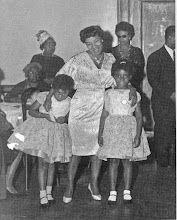
Barbara, MJ, Michele and Mom in the background in sunglasses at a fashion show in the early 60s