This blog is composed of images and writings related to the life and work of Faith Ringgold, her mother Mme. Willi Posey, and her daughters Michele and Barbara Wallace. There are pages with links to blogs composed of the materials arranged by decades. The blog, itself, will ultimately be composed of materials related to the life of the family in the 90s and the 21st century.

Showing posts with label Earl Wallace. Show all posts

Thursday

Photo-Essay: Change: Soul Pictures 1940s through 1950s


“Change: Faith Ringgold’s Over 100 Pounds Weight Loss Story Quilt” January 1, 1986. 
All rights reserved. Faith Ringgold Archive.


Faith’s older sister: this is Barbara’s official portrait as she was graduating from Morris High School in 1943 at the age of 16. She had begun kindergarten at three because on the first day of school (1930), the principal felt sorry for my grandmother (later Mme. Willi Posey) who seemed to have four small children (although one of them was her sister’s daughter). Faith was then a new born. Copyright Faith Ringgold Photo Archive. All rights reserved.


Faith and Earl as teenagers on Edgecombe Avenue.
It was 1946. Faith was 16 and Earl was 19. He was a musician and attended college at the New School and Julliard from time to time. They say he was very smart. Copyright Faith Ringgold Photo Archive. All rights reserved.


Faith and her friends in the 40s on the boardwalk in Atlantic City. Strolling in what was largely a segregated town then. Faith says they looked forward to staying all summer and enjoying the race movies at the local cinema. Faith Ringgold Photo Archive. All rights reserved.


Faith’s high school graduation photo. Faith graduated from Morris High School in 1948 and begun studies in Art Education at the City College of New York at a time when girls were still not admitted to the school of liberal arts, and when black students were practically non-existent. Faith Ringgold Photo Archive. All rights reserved.


Barbara remained ahead of her cohort educationally until she graduated she completed college at NYU in Home Economics. This is the day of her graduation with her mother. Photo taken by Cardoza Posey, her mother’s older brother who had helped with the expense. Copyright Faith Ringgold Archive.


Aunt Barbara's Wedding Series:
Photographs by H. DeLaigle Sr.


Arriving at Aunt Barbara’s wedding: Mme. Willi Posey, Mrs. Brown, Barbara, Faith and Grandpa Andrew. Posey and he are no longer married. Divorced since 1946 (also featured on the cover of Dark Designs and Visual Culture, Duke University Press 2004). Faith Ringgold Photo Archive. All rights reserved.


Aunt Barbara and Groom after the wedding. Faith Ringgold Photo Archive. All rights reserved


Aunt Barbara's ladies in waiting including her younger sister Faith on her right in the large flowers. Faith is 19. Faith Ringgold Photo Archive. All rights reserved.


Wedding Party including Earl (my father) and Faith (my mother) months before they were married and two years before I was born. 1950 at 363 Edgecombe Avenue in Harlem. Faith Ringgold Photo Archive. All rights reserved.


Uncle Andrew, Faith and Barbara's older brother, dressed for Aunt Barbara’s wedding. Faith Ringgold Archive. All rights reserved.


Mme. Posey (Faith’s mother) and her friends Lottie Belle and tba at 363 Edgecombe Avenue for Aunt Barbara’s wedding. Faith Ringgold Photo Arhive. All rights reserved.


Mme. Willi Posey business card. Faith Ringgold Photo Archive. All Rights Reserved.


Mme. Willi Posey fashion pose in dress of her own design. Photos by Thomas Morrison at 363 Edgecombe Avenue in 1950. Faith Ringgold Archive. All rights reserved.


Aunt Barbara modeling coat made by Mme. Willi Posey in apartment at 363 Edgecombe Avenue in Harlem. All rights reserved. Faith Ringgold Archive.

Sunday

Photo-Essay: Faith Jones and Earl Wallace Back in the Day


This is Faith and Earl when they were first going together. They are standing together on the park side of Edgecombe Avenue in 1946. She is 16 and he is 19, having already returned from his brief tour in the Navy.

Earl was never particularly happy at home. He was an only child and his mother had to work hard in the garment district in order to support the household. His father, who had come to the United States from Jamaica in the early 20s, while being an obviously brilliant and learned man, was not of a strong psychological disposition and had little tolerance for the racism that was endemic in American society. Grandpa Bob (as I knew him) had a reputation for being an iconoclast and a musician who only worked as much as he needed to keep body and soul together. Marrying my grandmother Teddy was no doubt a mistake on his part. Having a child with her (my father) was probably even more of an accident.

Momma T (my grandmother) had immediately sent her grandson home to Jamaica to be raised by her mother (or maybe it was grandpa Bob's mother-- never been entirely sure about this). In any case, Grandpa Bob was never able to support his son or his wife. Momma T soon found a replacement whom I called Chiefie. They were ultimately married but Earl did not get along well with him at all.

I am told at one point that Grandpa Bob's sister Sissie had tried to bring Earl to live with her family in Queens but for some reason he was not allowed to do this, probably because of the stubbornness of Momma T's sister, Doris Rhino who never had children of her own and never married. It was she who had the bright idea to bring Earl from Jamaica to live with his mother. She hoped that having him in the U.S. would help to reunite Momma T. and Grandpa Bob, which of course it did nothing of the kind.

In any case, in his misery Earl had enlisted in the navy at 16, lying about his age in order to get in. He had taken their aptitude tests and passed them all with flying colors. The tests said he should do something technically advanced but since he was black, and the military was still quite race crazy, it was not possible for him to actually have the job. It wasn't long before he was AWOL and dishonorably discharged and back on Edgecombe Avenue again. I am not exactly sure how or when he completed high school but he did spend some time attending both the New School and Juilliard so I imagine that a high school diploma wasn't much of a challenge. He probably got it at George Washington High School, which seems to be where all the kids from Edgecombe went then.


Saturday

Critical Essay: The Other Side of Harlem

This post originates at SOUL PICTURES:

http://mjsoulpictures.blogspot.com/2010/01/other-side-of-harlem.html

This blog has been devoted to interweaving the visual artifacts of my family, in particular the women, narratives and explanations of how they came about. In the process, one aspect of my family experience has been very consciously excluded: that of my father's family. It wasn't because I didn't or don't know my father's family or didn't know my father. It was rather because the rupture that took place between my father and mother's family when their marriage was annulled in 1956 was so profound and so unhealed even these sixty-five years later, that I conceived of the Soul Pictures project as solely a portrait of the transmission of culture via my maternal ancestry.

I thought to myself that I would leave my father's family to another time, a time when my focus on my father's family, their strengths and weaknesses, and the many photographs I have access to of them, would give less offense to the people who really raised me (in particular my stepfather Burdette) and took responsibility for me as a child.

But something very dramatic has happened since then related to this split between the maternal and the paternal sides of my legacy and ancestry. Also, some of the developments around the progression of the Soul Pictures project as a book about the women in my family has moved to the next stage, making it more conceivable to devote some space to my father's family in this blog afterall.

The dramatic thing that happened was the profile of Mom (Faith Ringgold) as part of a group of young people who began their careers as artists as children on Edgecombe Avenue, which recently appeared in the New York Times. Featured as a visual accompaniment to this article, is the multimedia presentation as part of the New York Time's new multimedia offerings at http://www.nytimes.com/interactive/2010/01/22/nyregion/sugarhill.html

My father Earl Wallace, who was a classical and jazz pianist, was one of the young people who grew up on Edgecomb Avenue, at 365 Edgecomb Avenue in fact, and Edgecomb Avenue is where Earl and Faith first met and played together. His parents were from Jamaica, West Indies as were the two other people featured in the article about Faith. Both Roy Eaton and Cecelia Hodges were of West Indian ancestry and, no doubt, knew my father Earl.

Granted Earl didn't survive or become distinguished, as was probably true of many of their generation of both Southern and West Indian ancestry, but the main point I want to make is this: there were two distinctly different black migrations to New York which contributed substantially to the concentration of talent in the Sugar Hill section of Harlem in the thirties, forties and fifties when my Mom was a young woman.

 There was a West Indian migration (from most of the islands of the Caribbean, of which my father's parents and extended family were part) and there was a Southern migration, which brought Faith's mother and father to Harlem. Both migrations were massive and both contributed substantially to the fame and cultural vibrancy of the area.  Although the relative dimensions would be hard to determine since we rarely acknowledge the fault line between the West Indians and the Southerners.

At least if my family stories are any indication, and my own experience of having served as the only bridge along with my sister between the two families since we were infants, there wasn't a lot of love between the West Indians and the Southerners. Although I need to acknowledge here as well the efforts of my maternal grandmother, Momma Jones, Mme. Willi Posey, and her determination to foster our connections with my father's family. As a result of her efforts, I saw a great deal more of my father and his family than I think my mother has ever been aware of.

It is hard to tell how my family experiences relate to the larger picture for the area in general though but I do know a great deal about the ancestry of my father's family and this area mapped out as Sugar Hill in Harlem is precisely where they were then. Thanks to a meticulous family history (not formally published) including many photographs written by a cousin named Robert Tomlinson (an artist now who lives in France) on my father's side of the family, I have extensive information about the members of this family lineage and where in Harlem they were concentrated.

Of course, I think the story gets a good deal more interesting and instructive to current audiences if it is allowed to go beyond the production of the reputations of the people who became world famous and gets more into the historical and cultural particulars--the nature of their practices.

The list of people pointed out as having emerged to flower, or having lived in Sugar Hill, I find particularly frustrating and am hoping that it will simply be a beginning to which flesh and blood can be added over time. Chronologies and Maps are wonderful audio visual tools when the layers are allowed to build. All in all, I am so happy this happened.

And now I will tell you about my father's family because my father, my Mom and my stepfather were all very good friends on Edgecomb Avenue and the second marriage issued almost seamlessly from the first marriage. Unfortunately, my father died in 1966 when I was 14 and he was an only child but as an adult I have come to know that he had an interesting and accomplished family of origin. He, himself, got swept away by the plague of heroin addiction that settled upon the jazz community in the 40s and 50s and then branched out into a full scale plague by the 60s and 70s.

Wednesday

Photo Essay: Momma T, MJ and Michele 1950s


Momma T, MJ and Michele, originally uploaded by olympia2x.
What are the chances of anybody having such gorgeous grandmothers in 1952. They are stunning, glamourous women like two great actresses who effortlessly outperform one another. The competition between them, the awkwardness of the fit between the two families--one Jamaican and one from Florida, both spearheaded by young women who fled their homelands for New York City while they were still in their teens. Both women pretend to be wryly thrilled about the arrival of their baby grandchild to persons who have no job or security.  My mother is 22, my father 25 but being a woman of this age myself and then some  (both were born in 1903 and were therefore 49 years of age pushing 50) , I can recognize the signs of their delight that their granddaughter is so fit but also that they are worried about what will become of my future. These are not women who stand back and let things go as they might.  Momma T has only one child, my father, although I guess you would have to say she had abandoned him for her second husband in a time of great need.  Momma T is on her way back to Guam with her second husband who is in the military. MJ is probably deeply wondering when or how her daughter and her grandchild will be removed from this apartment where things are not going well for her own daughter.  From what I understand, the uncertainty of their relationship was plain from the very beginning.

Friends of Soul Pictures

Michele Wallace

Post Archive

Michele Wallace: Talking in Pictures

Michele Wallace: Talking in Pictures
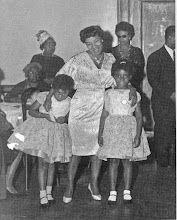
Barbara, MJ, Michele and Mom in the background in sunglasses at a fashion show in the early 60s