This was me in the school year I graduated (1968/69), the fall of 1968 I believe but now my hair is in an Afro.
It was Revolution time in New York, in Harlem, at New Lincoln and everywhere else yet I would go from studying dance at Arthur Mitchell's new school of ballet in Harlem to studying acting at the National Black Theatre on 125th Street. Martin Luther King must have already been killed by this time because as I understand it, Arthur Mitchell had been motivated by King's death to start his Dance Theatre of Harlem. It had always been his dream to start a black ballet company. King's death was the wake-up call he needed not to put it off any longer, I discovered somewhat later when I had a chance to interview him.
The classes were held in the former or still present Harlem School of the Arts in the buildings of the little church still standing on the corner of 141st Street and St. Nicholas Avenue. This institution was and is still called the Harlem School of Arts. At first, Mitchell used this space and he had two classes, one for all the children who were beginners and one for the more advanced group which either had previous training or talent and physical grace to burn. By obvious background in ballet, I was placed in the beginner class. The first day was one of the most pleasant days I had ever experienced in my aspirations to study dance.
The teacher whose name I can't recall (maybe it was Walter, very good looking) was a young black male who was either already an important dancer himself or on the verge of being one. He immediately separated me from the others and used me to demonstrate correct positioning of the body in the barre exercises, in particular simple exercises including tendu and demi and full plies in first, second and fifth position, releves, ronde de jambe tendu and developee. I had a great pointe at the time, and a good background in basic ballet, which I had worked on very diligently on my own. I even took ballet classes during our summers in Provincetown. Dancing ran in the family and nice feet with good arches were a family trait so my ability to point my toes and to perform the basic leg movements made me stand out as more competent than a rank amateur.
Also, I was 16 so that's pretty old to be a beginner in ballet. The rest of the beginner class was composed largely of children, under 13 I would guess. Not only was I 16, although I was only 5'2" at the time, I prided myself on appearing sophisticated and as adult as I could muster. I now know in retrospect that I probably could have succeeded in transforming myself into a passably competent ballet dancer because of my physical abilities. I was strong and graceful in the athletic sense although I was shy and withdrawn but the shyness would not have necessarily been a hindrance in the corp if I had been willing to do as I was told and follow the group. But there was at the time a tremendous glass ceiling facing the black female dancer in ballet and ballet was actually the only form in which I felt entirely comfortable.
You could say that I loved ballet and longed, in the deepest sense, to be a ballet dancer. New York had a lot of ballet dancers and it was $2 to sit in the cheap seats at the ballet. Dance classes were also very cheap, maybe two to four dollars as well. But I lacked both the discipline and the determination to really make good on Mitchell's opportunity. You might say we were on a collision course with me heading someplace else entirely. I was there more for the exercise, the physical training, the beauty of the music and the other dancers, and had accidentally stumbled into an express train when all I really wanted was to see the sights. The early days of Arthur Mitchell's school was a terribly exciting, inspiring and uplifting environment.
Through the years of my adolescence I had been taking advantage of the array of dance classes available in New York. These had included classes at the Joffrey School, with Valerie Bettis and with John Wideman in what would now be considered NoHo. Besides taking classes fairly frequently at the Harlem School of the Arts before Mitchell's arrival, I also took dance classes at Leroi Jones Black Arts School in the summer of 1965 along with my sister and my Mom who took printmaking with Ed Spriggs. It was at Jones' school that I first took African Dance I believe when I was 13, which was a real revelation. In those days all dance classes were taught with the most magnificent live music. With my love for music, the live music alone would have been enough to keep me coming for more.
I found young (adolescent) ballet dancers and their mothers the most fascinating creatures in all the world of Manhattan. I found the dramas unfolding in the classes, the dressing rooms, the hallways and performances absolutely riveting.
At the conclusion of that first day in the beginner class, Walter took me to the more advanced class, introduced me to the teacher Arthur Shook, Mitchell's wise ballet master. He told me that from now on I should attend the more advanced class, which was the end of my happiness. In the advanced class there were a full range of people, including people who were obviously already professional dancers, people who had come in from Europe just for this opportunity because a door that had been closed was getting ready to creak open (although it took at least another 30 years for the deed to be well and truly done, I think black ballet dancers have finally arrived and are here to stay).
Morever, Shook was not the type to give false praise, or any kind of praise at all. He spotted me for a slacker I think from when we first saw one another. As I know all too well these days that the desire to avoid hard work is the first thing a teacher is inclined to notice about a young person. Meanwhile, Shook was into slow arduous painstaking technique, lots of sweat and fore bearance. Work was his first, middle and last name.
I don't know whether I imagined them but it seems to me I recall, as well, a number of parenthetical lectures about the shortcomings of the training of American ballet dancers, the lack of discipline, the mindless and shapeless fluttering of the arms. Mitchell was a product of Balanchine's training which he brought from Russia and France and Shook, who I think may have been a European of some variety and was much older than Mitchell, obviously came from hell. Or at least I felt like he did often enough. If Shook's class was slow and painstaking then Mitchell's class was like being asked to fly without benefit of elevation. Mitchell raced through the barre and moved on quickly to lightening combinations, leaps and all sorts of crazy stuff that you had to pick up and do faster than you could think about it or be left in the back of the room staring. And it's not like he would just ignore the people who were lagging. He would taunts you and make funny cracks about you to his own considerable amusement. He had a wonderful bright charismatic personality. He was one of the most handsome men I had ever seen and he frequently performed in class for benefit. He held nothing back. What strikes me now is how available he was to us, how much time he took.
The schedule was two classes every afternoon and evening after school during the week and all day Saturday. It was an absolutely grueling routine. I was always hungry, as I recall, always sleepy. It was clear to me from almost the start that I wasn't going to last. The back of the room was not a viable place to remain in the forthcoming company class. It was no place to relax. And shyness was not anything Mitchell seemed to respect. In my case, I was taunted and chastised for every move I made or didn't make. I think I was vaguely aware that I was receiving all this attention because they were both interested in my possibilities, but in my heart of hearts I think I always knew that it could never work out.
I know at some point I decided to abandon the classes there, in the middle of Karl Shook's class one day. It may have been a pointe class, which I had looked forward to all my life but which I hated in actual fact, and he had just demanded that we do something I knew I could and would never do. So I just grabbed my stuff and walked out.
There are some other things related to this. First, I was attending a real and seriously challenging school, a school in which the aspiration to be a dancer was regarded with thinly veiled contempt. Also, my mind was very much on the revolution in the streets, the transformation and revelation of my black identity, and I was greatly disappointed by the generally low intellectual level of the conversation and aspirations of the other future dancers. The only people who really seemed to like me were the young men in the classes who were also the only ones who encouraged me and told me how beautiful I was because Mitchell and Shook were always complaining that I was too fat. The Anorexic thing was really in in the dance world at that time. It only made it worse that I had never heard the word anorexic or bulimic yet.
The other thing that must have happened somehow in coordination with my straying away from Mitchell's school was that at some point I decided to apply at Julliard as a dance major. Modern dance. I dared not speak the holy name of ballet. Encouraged by the dancer I had worked with at Music and Art High School during the summer, I had applied and was scheduled for the day of interviews and the audition. My plan was to use the routine that I had performed that summer at Music and Art at the final performance but once I left Mitchell, I didn't do much preparation or rehearsal I suspect. As I recall, the way they did the interview process was that you were called in for the day with a number of other girls, maybe three or four and the group of you toured the facilities, were acquainted with all the teachers and the way that Juilliard did everything. Everybody was encouraging and sweet. It was like being in heaven.
The final event of the day was the audition, which I was dreading because I knew I was not prepared for it. I don't know which order I performed in but I remember that there was a panel of reviewers which included Jerome Robbins and Agnes DeMille. The room was chockablock with famous dancers whom I had been reading about in Dance Magazine. Rarely can I recall ever having been so afraid in my life. I wanted to run away again but I was determined I was not going to run the way I had run from Shook's class. Being a coward did not feel right.
I don't know where my mother was but I don't recall anybody else's parents being there either. We were treated like adults, it seemed to me. So I performed my dance. It seemed to me that I had done so so poorly, that I was trembling and that I was a fake, somebody who had gotten into their midst on false pretenses. I was embarrassed, humiliated and ashamed, but then going to Julliard was really the only college I had ever dreamed of attending. This was enough to convince me that I never should or could be a dancer.
But I will always remember that Jerome Robbins encouraged me to try again, to continue training. At the time, I was so completely convinced that he didn't mean it, that he had said it out of pity and contempt. Of course being black in a room in which there were no other black people along with the implied assumption that serious modern or ballet was not our world didn't help the situation either. But I was only 16 and probably a good deal better and full of potential than I imagined. I didn't know then that there is almost nothing you can't do at 16 but it took moxie to go through with the audition given the odds of not being successful. The reviewers would have to be full out racists not to have admired me a little.
Not too many years after that, I saw a movie with my mother called FAME, which was about a performing arts high school. I watched the interviewing and auditioning process eagerly, gratified to see that not having a ghost of a chance or not having adequately prepared for an audition was not the most far out thing in an environment like that. One has to let these things go eventually. Also, I had the great pleasure of getting to visit my niece Faith during her time as a student at Bryn Mawr, a small private women's college where the Dance Department is extensive and well run. I attended a dance concert put on by their dance department. It was a Department in which I would imagine few of the students were expecting to have careers as dancer. But Bryn Mawr, like a lot of private colleges, had the view that instruction in dance could help to build character, taste, vision, good health, all the fine qualities that make you a wonderful human being.
Faith performed magnificently in an African dance troupe that was part of the classes offered at the college. We have the performance on dvd somewhere. Even more gratifying to me was to see the warmth and intimacy between Faith, the rest of the girls and the Dance Department at Bryn Mawr College. Once again I silently thanked the saints for leading Faith to Bryn Mawr and for making it possible for her to procure such a generous scholarship there.
More than 40 years ago. On a bench just outside of Central Park.
This was my yearbook picture, one grabbed on the fly by a patient student photographer.
Showing posts with label New Lincoln School. Show all posts
Showing posts with label New Lincoln School. Show all posts
Monday

Photo Essay: Michele in Anything Goes 1968
This is before I got an Afro, which means I was 16, maybe still dating Stanley Nelson, my boyfriend. I can hardly recall. I remember being that girl doing that routine but what else was going on in my life is fuzzy. Anything Goes was a New Lincoln musical production and great fun in the doing.
The summer before in 1967 Barbara and I had gone to Europe with MJ for two whole months while Mom Faith concentrated on producing her great murals DIE, THE FLAG IS BLEEDING and THE UNITED STATES POSTAGE STAMP TO COMMEMORATE BLACK POWER. During the day she painted at the Spectrum gallery on 57th Street with her friend Jeannine Petite, and in the evenings she avoided her own apartment where Dad was and went instead to MJ's smaller, less demanding apartment. Dad was effectively abandoned for the summer and eventually wondered away to establish his new apartment in 409. Faith tells me and tells everyone that this was the first time ever in her adult life that she had ever been entirely on her own, entirely alone and free to do whatever she wished without having to consider the wants and needs of her family. She was 37 years old and it had been a very long wait.

The summer before in 1967 Barbara and I had gone to Europe with MJ for two whole months while Mom Faith concentrated on producing her great murals DIE, THE FLAG IS BLEEDING and THE UNITED STATES POSTAGE STAMP TO COMMEMORATE BLACK POWER. During the day she painted at the Spectrum gallery on 57th Street with her friend Jeannine Petite, and in the evenings she avoided her own apartment where Dad was and went instead to MJ's smaller, less demanding apartment. Dad was effectively abandoned for the summer and eventually wondered away to establish his new apartment in 409. Faith tells me and tells everyone that this was the first time ever in her adult life that she had ever been entirely on her own, entirely alone and free to do whatever she wished without having to consider the wants and needs of her family. She was 37 years old and it had been a very long wait.
The sacrifice she made was that at the end of the summer, Dad and her were no longer living together. After the fall out from two month trip to Europe (to Paris, Rome, London, Florence and perhaps Nice) with MJ the summer of 1967, we were considered incapable of taking trips with adults. We had been rude with MJ, a problem we had never had before. I was consumed with guilt at the time because as I recall my one abiding thought in every beautiful European city we visited was how to get away from MJ so that I could have a cigarette. Barbara and I were both mildly addicted to cigarettes at this point.
Both of our parents smoked at home. Unfortunately, many of the kids at New Lincoln smoked. Cigarettes were easily procured from other students. We had a student lounge in which the major activity other than playing cards, was smoking and we had a little hangout down the street where the smoke was so thick you could cut it with a knife.
The kids at New Lincoln were very worldly and sophisticated, disrespectful and disdainful of both religion and authority, terrifyingly so in fact, and I am afraid it had a negative impact on my regard for MJ's more homespun style of childrearing and instruction. It was she who had given me my initial training in religion, deportment, manners, morality and ethics. I had always taken her very seriously, loved her food, her cooking, her clothes, everything about her. When we moved away from her house on Edgecombe Avenue to the Bronx, I had even tried to run away to go live with her, for which I got the only whipping that I can clearly remember.
We had only great times at MJ's house and even once we had gone to live in the Bronx or in 345, weekends, sick days and holidays were all spent with MJ. We were always welcome at her house. I often accompanied her wherever she needed or wanted to go. My relationship with her had always been easy, completely loving and warm. At MJ's house there was no housework and cooking, no holding back on the childcentered quality of the environment she provided. You were woken up early in the morning with a day of fun planned for you and then it was early to bed. Unlike my Mom, MJ could somehow easily manage this, all her housework, the cooking and her sewing too. Mixed in as well were delightful surprises of entertainments you had not imagined, foods you loved to eat but rarely saw in the Bronx and just the greatest fun you could possibly imagine.
Sometimes when it was warm, it was still light when we were put to bed. I know I would not have gone to bed so early for my Mom and Dad but for MJ, you did anything she wanted. So it was all the more surprising and unacceptible that we were starting to laugh behind MJ's back and keep secrets from her, sneaking away to grab cigarettes in the bathroom down the hall (in Europe we stayed all three of us in a single room in a pensione with a bathroom down the hall. Kids are not good at sneaking but we had to sneak to buy the cigarettes, sneak to smoke them, and sneak to keep them hidden from her finding them. It must have been truly terrible for her. All the time, i assumed she knew we were smoking although she never accused us of it. Years later my Mom told me that she never said we were smoking, only that we had misbehaved. I'll never know whether she knew or whether she didn't know that smoking was at the root of the problem.
So Barbara and I both spent the summer of 1968 in an arts program in Harlem at Music and Art, which was then located on the City College of New York campus. Given my superior training and maturity, I was soon drafted by the teacher as her demonstration assistant. Mom was chasing the Art World after the opening of her first one-woman show at the Spectrum Gallery in the fall of 1967, to which we invited all our friends from New Lincoln. We drank champagne and danced as the adults made a circle around us.
So Barbara and I both spent the summer of 1968 in an arts program in Harlem at Music and Art, which was then located on the City College of New York campus. Given my superior training and maturity, I was soon drafted by the teacher as her demonstration assistant. Mom was chasing the Art World after the opening of her first one-woman show at the Spectrum Gallery in the fall of 1967, to which we invited all our friends from New Lincoln. We drank champagne and danced as the adults made a circle around us.


Sunday
Photo Essay: Hide Little Children by Faith Ringgold
This painting was done by Faith in 1964, the year after we had begun school at New Lincoln in Harlem. It is called Hide Little Children for many reasons I am sure. Among them my mother's concern for our safety in the context of integration in the North. When this painting emerged and she explained that it was about us and our white friends, it gave me a good feeling because I read its message as highly protective. Our play and thus our relationships were hidden from view in an idyllic landscape, but as in William Blake's notion of childhood and innocence, it wasn't going to be possible to grow up, venture out and hold on to that innocence at the same time. That was just about right.

The American People Series #15: Hide Little Children 1964
(Oil on canvas) 36" x 32" Private Collection.
New Lincoln Reunion
These are two pictures of me in Starbucks with my feet up briefing my neice Faith (Ph.D. candidate in Microbiology at Tufts University) on the New Lincoln reunion at the old building on 110th Street. Barbara and I had just stopped there after the little after-party at David Formanek's mother's apartment.


For those of you who may not recall, David's father was once principal of New Lincoln, and he spoke about his father's time at New Lincoln during the ceremony at what is now a correctional facility.
These are a few of the pictures from that event taken by Barbara F. Wallace, my sister.

Beryl (former teacher), and Carla Goldberg (69)

Debby Offner and Rebecca Eddy, both class of 1969

David Formanek, Class of 1969, wife and two children

Henry Weisman, Michele Wallace, Class of 1969 and Barbara Wallace, Class of 1970

Rebecca Eddy, Class of 1969
Today Barbara and I participated in a reunion of the class of 1968 at New Lincoln, the private progressive school I attended from 1963 through 1969, from 7th through 12th grade. The building, located on 110th Street between 5th and Lenox Avenue at the gateway to Harlem is now a low-security prison superbly well run by what I assume are mostly African Americans, a small and dedicated staff of corrections officers and kitchen staff who made for us what looked to be a tasty meal (not so much as a spoonful ever cross my lips perhaps because of the excitement so I don't know) and gave us a courteous, even warm welcome.
Happily we have located a wonderful document, a B.A. thesis in the Department of Afro-American Studies at Harvard University written by Michaela O'Neill Daniel.


For those of you who may not recall, David's father was once principal of New Lincoln, and he spoke about his father's time at New Lincoln during the ceremony at what is now a correctional facility.
These are a few of the pictures from that event taken by Barbara F. Wallace, my sister.

Beryl (former teacher), and Carla Goldberg (69)

Debby Offner and Rebecca Eddy, both class of 1969

David Formanek, Class of 1969, wife and two children

Henry Weisman, Michele Wallace, Class of 1969 and Barbara Wallace, Class of 1970

Rebecca Eddy, Class of 1969
Today Barbara and I participated in a reunion of the class of 1968 at New Lincoln, the private progressive school I attended from 1963 through 1969, from 7th through 12th grade. The building, located on 110th Street between 5th and Lenox Avenue at the gateway to Harlem is now a low-security prison superbly well run by what I assume are mostly African Americans, a small and dedicated staff of corrections officers and kitchen staff who made for us what looked to be a tasty meal (not so much as a spoonful ever cross my lips perhaps because of the excitement so I don't know) and gave us a courteous, even warm welcome.
The emotional, psychological bridge was palpable in the course of the day's events between the present life of the building as a low security correctional facility for what is surely mostly brown and black male inmates of poor or impoverished background and our own relationship to the building some 40 years earlier when the school was a predominantly white, definitively bourgeois institution surrounded by a not yet gentrified black and Puerto Rican community.
During the speeches of today, I heard more than one former New Lincoln student speak of thier bruises as outsiders in Harlem with pride, and with a sense that New Lincoln white students had thus earned the right to think of themselves as pioneers of integration. I can agree with that and it certainly seemed as though those in attendance had made it a lifelong commitment on some level or other--lots of social workers and other kinds of mental health and therapeutic professionals it seemed at least to me. Cheerful, fiercely smart and well intentioned people.
Among the predominantly white crowd, or maybe even predominantly Jewish crowd there was a considerable sample of black students, a fairly strong representation of those who had attended the school at the time, or so it seemed to me: David Carter, Linda Ward, Steven Boyd and Roslyn Burks, all as charming as ever.
These festivities were but one event in an entire weekend planned for the class of 1968. The program at the prison was moderated by Marc Aronson (who picked me up at my house in Englewood still wiping the sleep from my eyes at 9 a.m.), and organized largely by the Solow twins, Jennie and Peggy. My sister Barbara handled the powerpoint, which was shown throughout the visit. There were videotapers and reporters and god knows what all. Verne Oliver, our sturdy leader, was there and every bit as much a force to be reckoned with as she was 40 years ago.
But I felt fortunate to be reunited with the small sample of my class who came to the prison (Steve Rustow, Henry Weisman, Debbie Offner, David Formanek), as well as those who turned up later at David's mother's house for our after-party including Carla Goldberg and Rebecca Eddy. A small group of the 1970 class, whom I know less well, including my sister Barbara joined us along with Jonathan Barnett (who was somebody who I hadn't remembered at all but who had fascinating things to say), Carla's younger brother, and I am not remembering that well who else besides David's wife, his daughter and his son. The food was good, the conversation even better and the cheese exquisite.
If I hadn't been so exhausted by the blistering sun, the heat and the whole early morning ordeal aspect of it, I don't know how I might have contained my pleasure about the whole thing. Especially since this is the summer I plan to spend really kicking into gear the project of Soul Pictures and its effort to organize the family archives of documents and photographs into something of general interest to the public and for posterity. I realized in the course of this thing that New Lincoln was in some ways a glaring hole mostly in my sense of my own formation. Although I have written on a number of occasions about the time spent at New Lincoln, it has been I think now always in an instrumental sense as a background for other issues-- my education, my adolescence, my racial identity.
I couldn't have known all those many years ago just how unique a New Lincoln education has turned out to be. I also don't know how the others who gathered have come to the same conclusion, or even if the large number who gathered were of the same mind about this or simply fulfilling a social obligation.
I hadn't yet really allowed myself to emotionally revisit the time I spent there. Having to go through the protocols of entering even a very low security detainment facility were helpful in making the mental pause needed to traverse the boundary between the remotest reaches of my consciously recollected past life and the present. Handing over my cell phone and my ipod to a zip lock bag labeled with my last name and then being essentially locked in until I was carefully and deliberately ushered out of the building again was something I found deeply moving for more reasons than I can count. I had forgotten how truly long ago it was that I had roamed those halls and thus begun, in a profoundly material sense, the journey by which I became the person I am today.
As I said to Debbie Offner, by the point at which I graduated in June of 1969 I was doing "angry," which prevented me from taking in vital information concerning my own personal development and growth at the time, much less that of any of my other mostly white classmates. There was I thought a Black Revolution either about to begin or having already begun, even though I have never seen myself as a major revolutionist. It was the collateral affects, the cultural and social aspects of it that were of most interest to me, which also made me completely uninterested for a time in where my classmates of 1969 might be headed.
I was so wrapped up in what I was doing and who I might be doing it with that I had not even yet made up my mind that I wanted to go to college. (I had convinced myself that it was some kind of sell out strategy). My decision making process during this year was deeply flawed. I guess I was having one of those walking nervous breakdowns. I mean I was 17, for god's sake and before that I was 16!
I don't remember participating in any aspect of the decision as to where I would go to college except that I said I wanted to go to Howard (because it was black and it had a student take-over in 1968 that was in the newspaper). I applied, or perhaps Verne applied for me and I was accepted. I went there in the fall although only after having spent half the summer in a commune in Mexico and the other half of the summer in the Sisters of the Good Sheppard Residence, a home for wayward girls, on 16th Street across from Beth Israel. I wrote about all of this in my first book Black Macho and the Myth of the Superwoman although all these years later, I can' remember very much about it at all. One day I hope to retrace my steps, which may help me to recollect more.
Actually I had kind of a marvelous and instructional time in both places is the part I do recall. In Mexico, I decided pretty quickly, under the influence of more marijuana than I had ever smoked before or since, that I wanted to spend the rest of my life there. It was both ridiculous and indefensible but as it happens I never had to think the whole thing through since I was 17 and had only been able to travel to Mexico in the first place because my Mom had given me special permission along with my passport. Once she rescinded the permission, I was ordered by the Embassy to return to the U.S. Which was just as well I guess. I mean there would be lots of American kids who would have a very difficult time getting home from Mexico. I don't know how I would have made out if I had been forced to join them, or maybe it was one of those situations where you know it isn't real because you aren't legally an adult yet. I know one thing. When I crossed the marker of my 18th birthday, my whole attitude about taking chances of this kind changed forever.
But I don't want to not do justice to the manner in which I was absolutely smitten by my impressions of Mexico. The air, the landscape, the culture, the language, the food, the people--all seemed utter perfection to my untutored eyes. I guess it was the sweet smell of absolute freedom I was sniffing too. This idea of spending some portion of my life in another country was nurtured early in me by my Mom who took my sister and I and my grandmother with her to Europe in 1961 and then proceeded to entertain the possibility of moving us all to France and sending Barbara and I to boarding schools in Schwitzerland or some such. In the end, we didn't do it of course but rather married my stepfather (whom we had known all our lives and who was a close personal friend of my birth father a classical and jazz pianist who died when I was 14) in 1962 and the very next year we left our previous school, Our Savior Lutheran School in the Bronx and came to New Lincoln School.
Which brings us full circle to many happy, fun filled, intriquing and educational days. At first I felt totally out of my depth, somehow much younger than the other students amidst the freedom and intellectual stimulation of New Lincoln's classrooms. The informality of the teacher/student relationship threatened and terrified me horribly, as if somebody had just thrown me into the deep end of the pool and I no longer had any idea how to swim. I could do what I wanted, come and go from the classroom whenever I wanted and yet there were sometimes endless discussions about what it all meant, if not with my teachers than certainly with my mother once she had been to the school and met with my teachers.
I grew to absolutely hate the evenings after those damn teacher/parent conferences in Middle School or High School. I just couldn't seem to manage to adjust my behavior or my academic performance in school to produce the report to my mother I wanted. I think that in some ways, as may be the case with kids who act very differently at school than at home, school was some kind of release for me from the very different pressures of our home.
In fact, I think I felt a great deal less pressure at home but at school I felt always on display, even on stage sometimes as a black female, sometimes no matter what. It may have had something to do with having eczema and being self-conscious about my skin and the fact that I was a late bloomer so far as secondary sexual characteristics.
I can remember whole periods in which the way I wore my hair was of vital concern, or the whole thing of when or if I would develop substantial breasts was just horrifying. By the time I was in ninth grade, I had become so shy that I could hardly open my mouth. My school work really suffered too. Some brand of gender conformity that I was still groping with was still uppermost in my mind. My best friend through the best of this was Debby Offner who shared my interest in dance and performance. Sometimes we went to dance classes together and often performed in New Lincoln shows together, which could sometimes generate endless rehearsals taking the whole question of a social life off of my hands for months at a time as I recall.
Two of my classmates who were not there today but who were, nevertheless, important to my development were Stanley Nelson, who was my boyfriend for awhile in 12th grade or maybe it was 11th grade, and Chris Rauchenberg, who was even then turning into the masterful photographer he would subsequently become. Today I love Chris's work and I look back on him as someone who knew even then what he would be, despite what must have been the pressures of having such a famous artist as a father, and a mother who was an artist as well.
To see Chris's wonderful work, which helps to confirm my increasingly expansive sense of what qualifies as important in photography, go to www.christopherrauchenberg.com.
Since I am mentioning Chris's work, I should mention Stanley's work in film (http://www.firelightmedia.org/flash/mainflash2.html), as well, all of which I adore, but most particularly his documentary on Sweet Honey and the Rock: Raise Your Voice and A Place Of Our Own, a personal film he did about the importance of his family's summers in a black community in Oaks Bluff on Martha's Vineyard.
Okay so I think this is now beginning to qualify as a major exhibition of self-absorption and I have only begun to scratch the surface. And it is getting late but I was just energized by the whole thing.
I know that the schools I've attended and how they intervened in my life has been critical to the person I've become. Also, what I learned today was that we were really really kids when we were 17 and 18 in 1968, 1969 and 1970. And as such, whatever we did, no matter how bad it may have seemed at the time, it just wasn't really that bad. There are kids in the place where we were today who never did anything worse than any of us, that aren't any worse than any of us, whose lives are already permanently crippled, caught up in a massive detour around the fruits of their own generation into an institutional framework which may deny them the vote, their freedom and gainful employment for much of the rest of their lives.
It is just crazy and it is all because we had parents who cared enough to dig deep into their pockets (especially those of us who were on half scholarship) to make sure that things went better than okay for us from the very start, despite whatever else our parents were trying to achieve and trying to deal with because they had lives too. And so it goes: kids with parents and kids without, or rather kids with parents who can't set much aside for their futures because they are too busy trying to ward off the hawk from the door right now.
See my blog on the Wire for more on this topic, especially pertaining to the fourth season dealing specifically with how the local junior high schools feed and support the drug market in the neighborhoods in urban Baltimore. Very compelling stuff. Important too.
Happily we have located a wonderful document, a B.A. thesis in the Department of Afro-American Studies at Harvard University written by Michaela O'Neill Daniel.
Entitled RACE AND PROGRESSIVISM AT THE NEW LINCOLN SCHOOL: TEACHING RACE RELATIONS THROUGH EXPERIENCE in 2003. The document includes the fascinating history of the birth and development of New Lincoln while located on 110th Street, from 1945 through 1974 as one of the few progressive schools in which questions of interracial integration in education were deliberately put to the test. I am sure we all suspected but how many of us actually knew.
The problem was that for much of the history, the goal of administrators and the board was the "color blind" approach, which is more likely to work for white students than black. Or rather let's say it just doesn't work at all, except to destroy people.
In any case, to read Michaela's clearly written history of the school, explaining both its birth and decline, is deeply moving after all these years. Apparently there was considerable documentation of New Lincoln's racial mission in the press and some photographs from such publications are included here.
In any case, to read Michaela's clearly written history of the school, explaining both its birth and decline, is deeply moving after all these years. Apparently there was considerable documentation of New Lincoln's racial mission in the press and some photographs from such publications are included here.
Just a priceless document, which can be found along with pictures and lots of other information at the New Lincoln Website at http://www.newlincoln.org.
Subscribe to:
Posts (Atom)
Subscribe


 Posts
All Comments
Posts
All Comments
Michele Wallace: Talking in Pictures
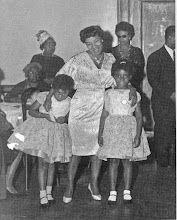
Barbara, MJ, Michele and Mom in the background in sunglasses at a fashion show in the early 60s