Showing posts with label the 80s. Show all posts
Showing posts with label the 80s. Show all posts
Sunday
Photo Collection: Barbara when she was sleek and fit
1981 in the little house I rented in New Haven. Barbara is 28 I think since it is Christmas apparently. Photo taken by I am not sure whom. Perhaps it was me with Barbara's camera. She lived with me in New Haven briefly.


Monday
Photo-Essay: Faith Wallace Gadsden as a Baby

Faith Wallace, originally uploaded by olympia2x. All rights reserved. Collection of Michele Wallace.
I loved her then and I attempt to love her still but love is a powerfully difficult thing between a woman of thirty (which she is now) and a woman of sixty (which I am now) when you are not at the very least mother and daughter. Sometimes they don't much love you back.
Nonetheless Soul Pictures is dedicated to her future, and to the future of the planet Earth.
Photo by Faith Ringgold.
Sunday
Photo-Essay: A Little Darling 1987 CHANGE

A Little Darling 1987, originally uploaded by olympia2x. All rights reserved. Copyright 1987 Clarissa Sligh. Collection of Faith Ringgold.
This post is just for you Dawn and your precious daughters and son.This picture is a photo taken of Baby Faith (Faith Wallace-Gadsden) by Clarissa Sligh in the process of documenting Faith Ringgold's CHANGE: PAINTED STORY QUILTS (1987). Faith is, of course, Faith Ringgold's oldest and first granddaughter.
In 1987, Faith had composed a quilt made up of a black and white collage of family archival photographs, which were then stencilled onto canvas and framed with quilting partly conceptualized by her lovely former assistant Lisa Yee. These photographs were made up of those that Momma Jones (Mme. Willi Posey, my grandmother, Faith's mother) kept and commissioned as part of her collection to document her work in fashion, and those photographs Faith had begun to keep and commission to document her work in visual art.
In addition, in 1986 Faith had begun a project to document a personal goal of losing 100 pounds, as her slow addition of body weight had become intolerable to her. In an attempt to politicize and universalize her own drama with food and excessive weight, she devised a script and a performance centered around the slow steady weight gain which often characterizes the lives of women as they have children and center their lives around their offspring and husband. She called it CHANGE and the message was that anyone could do anything he or she wanted, especially if it involved one's own body.
"January-October 1986The story of Tar Beach, that anyone could fly, came directly out of the resolve and the message of CHANGE. CHANGE also marks a transition in how Faith would approach her materials in the conception of her work. CHANGE was a story quilt composed of portions of her actual life in the form of her family photographs and the stories of her weight gain over the decades of her life due to the usual burdens of being a wife and mother.
The worst part of being fat was squeezing yourself sideways through the subway turnstile, hobbling down the stairs to the train in hopes that it would still be there when you finally arrive and that you would be lucky enough to find two seats. Together."
Text of Change: Painted Story Quilts. Copyright Faith Ringgold 1986. All rights reserved.
But by virtue of this composition, Faith invented an indelible marker delineating the first half of her career as an artist and the second half. She did in fact lose 100 pounds. And her life and her career, would in fact, be different from then on in so many ways. It wasn't that she would no longer struggle with her weight or leave all concerns about her appearance behind her. The interest in appearance, as well as fashion and imagery in general, is part of the legacy of our family, especially of the women, although the men were far from shabby either. I know the men less well because there have been very few men. Of the men who survived, few had any children. And if they had children, they were daughters and those daughters had no children or had children who didn't survive to have progeny of their own.
Someone just recently suggested to me that families tend to be either predominantly male or predominantly female and I have noticed that this tends to be the case. The ongoing war between the sexes probably helps to exacerbate this tendency. Some countries are using ultrasound in order to weed out female babies in order to produce a marked dominance of male children throughout their populations.
In any case, from 1987 onward, Faith's work would be marked by an optimism and a buoyancy not particularly evident in her work before this time. To some degree, she began to leave behind the preoccupation with the more earthy topics of her earlier works, paintings and sculpture, such as the Slave Rape Series, the Weeping Women Masks, Windows of the Wedding, Emanon, Dah and Baby Faith and Willi Series of paintings, the America Black and American People Series, The Wake and Resurrection of the Bicentennial Negro and the Atlanta Children Sculpture.
The particular works of that immediate period--The Street Story Quilt, The Bitter Nest and the Flag Story Quilt would help to provide the transition to a more utopian as well as child centered vision. The work that fully signaled this development was the hugely successful Tar Beach Story Quilt, which is today part of the collection of the Guggenheim Museum and the basis for an award winning children's book also called Tar Beach.
In the 60s, 70s and the 80s work before CHANGE, the difficulties of being born the descendant of slaves and of being the survivor in the midst of a family in which alcoholism and drug addiction had taken its toll were obviously overwhelming in the issues addressed by her work (from The Flag is Bleeding (1968) to Die Nigger Flag for the Moon (1969), Political Landscapes (1972), Slave Rape Series (1973), The Wake and Resurrection of the Bicentennial Negro (1976), Who's Afraid of Aunt Jemima (1983) for example).
In the 1980s, after her mother died and her sister died, Faith would do the Emanon Series, Baby Faith and Willi Series, the Dah Series and the California Dah Series, all abstractions in which she would express her grief over the death of all her immediate family as well as her joy over the birth of her first granddaughter Faith.
Photo Collection: Grandma, Teddy and Faith 1980s

Grandma, Teddy and Faith , originally uploaded by olympia2x. All rights reserved. Faith RInggold Collection. Photo by C. Love.
Saturday
Photo Collection: Faith Ringgold's Change 1980s VII

Faith in La Jolla, California. 1987. Photo by C. Love

More of the performance of Change by Faith Ringgold. In the foreground, plastic bags filled with water equivalent to 100 pounds of weight. Celebratory dance at the end with Barbara and her two children, Faith in the dress and Teddy in her arms. 1987.

Faith reading from her text in the Change Performance (1987). Seated in the audience is Lisa Yi, her artist assistant and collaborator then. Photograph by Clarissa Sligh. All rights reserved.

Faith in La Jolla, California at an earlier stage in her weight loss program. Perhaps 1986. Photo by Lind Shlecht. All rights reserved.
Thursday
Photo Collection: MJ and Me on The Beach at Setauket 1980s

These were good times, the summer of 1980 or so with Momma Jones (MJ) and Pop-Pop on the Beach at Setauket. MJ married Pop-Pop, her teenage sweetheart, in the late 70s perhaps because her cataracts made her feel as though she needed a shoulder to lean on. I am 28 and the author of Black Macho and the Myth of the Superwoman. My sister Barbara, I suspect, is the photographer in this case. By this time, MJ had begun to wear a blonde wig, much to the consternation of her daughter Faith.
Subscribe to:
Posts (Atom)
Subscribe


 Posts
All Comments
Posts
All Comments
Michele Wallace: Talking in Pictures
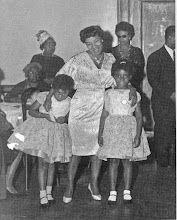
Barbara, MJ, Michele and Mom in the background in sunglasses at a fashion show in the early 60s