This blog is composed of images and writings related to the life and work of Faith Ringgold, her mother Mme. Willi Posey, and her daughters Michele and Barbara Wallace. There are pages with links to blogs composed of the materials arranged by decades. The blog, itself, will ultimately be composed of materials related to the life of the family in the 90s and the 21st century.

Showing posts with label Critical Essay. Show all posts

Tuesday

Critical Essay: American People: Die (1967) by Faith Ringgold


American People #20: Die by Faith Ringgold copyright Faith Ringgold.


 This was a discussion of Die I posted on my blog Soul Pictures: Black Feminist Generations
http://www.mjsoulpictures.blogspot.com in 2009 when Die was exhibited at the Art Galleries of Ontario.  There was talk then of them buying the painting, which makes it all the more wonderful that The Museum of Modern Art finally has, and is already showing it prominently as part of their collection from the 1960s.

Two really wonderful articles help to provide background for this extraordinary accomplishment, the first of these is in Art News today:

http://www.artnews.com/2016/07/18/moma-acquires-and-hangs-a-major-early-faith-ringgold/

The second of these is by Anne Monahan and appears in NKA and is called "Faith RInggold's Die: The Riot and Its Reception. (See subsequent post).

My words concerning the Ontario exhibition and other master works of the American People Series are as follows. Including references to American People #18 and #19--The Flag is Bleeding and U.S. Postage Stamp Commemorating the Advent of Black Power, also dating from 1967.


Faith's mural Die is featured in an exhibition at the Art Galleries of Ontario, which has a post on the web at http://www.ago.net/contemporary-collection-1960s-freedom-and-conflict.
I remember very clearly and very distinctly when Faith painted this diptych oil on canvas somewhat imaginative depiction of the "race riots" that had begun to plague the United States landscape every summer like clockwork.  I was fifteen and had just returned from a summer in Europe with my grandmother (MJ) and my sister Barbara.  I came home to find mother hard at work still on two of her three murals for her first one man show at the Spectrum Gallery scheduled for the fall.  

These riots were almost always in what we then called "black ghettos," and most participants were either black people who lived in the community, or white officers policing the black community, or white press attempting (usually unsuccessfully) to report on the action.  Faith's Die (1967) has grown even more fascinating to me over the years because I am more struck by the tension between her depiction, which portrays both whites and blacks bleeding and fleeing, males and females engaged in a free-for-all reminiscent of Picasso's Gernica (which we had been to visit so many times at the Museum of Modern Art when I was a child) whereas the actual riots were largely black men breaking into stores, battling the police who had guns with rocks or other objects, chaotic affairs.   

So the battle Faith's mural portrays is a conceptual one, revealing the undercurrents of what was really at stake in the riots of the 60s, which was black against white conflict mostly in urban cities.  Blacks (mostly males I believe) were registering their dissatisfaction with the restrictions of ghetto life, the lack of genuine opportunities for advancement and prosperity, and their realization that despite the absense of the obvious signs of Jim Crow segregation and restriction in the cities, the white power structure was still pulling the strings and keeping them in check. 

From this point on (in the late 60s), by the way, the numbers of black males incarcerated begun to increase exponentially even as other kinds of opportunities began to open up for black men who were educated and had bourgeois aspirations.  Up until today where we find ourselves with a black president, a black secretary of state, a black governor of New York, and it was a white Governor Rockefeller who caused the massacre at Attica and engineered the discriminatory incarceration practices (see my first book Black Macho [1979], which was all about Black Power, as well as subsequent editions and publications).

Aside from Die, there was also The Flag is Bleeding, which was entirely finished I believe, and U.S. Postage Stamp Commemorating the Advent of Black Power, which immediately became my favorite painting in the world. I was only fifteen so my thinking about it wasn't particularly deep. It was for the simple reason that it included 100 faces in a grid of ten faces by ten faces, with ten black faces in diagonal order representing their status as 10% of the population of the United States and all the rest of the faces were white.

What really held my attention as she painted this painting was the idea, which she shared with me, that the trick of it would be to make each of the faces somewhat distinct from every other and yet obviously more alike than different apart from the difference of skin color. This notion of difference was enthralling to me. Even more enthralling was that every day when I got up and looked at the painting, I would notice that one or more of the faces would have changed owing to the manner in which Faith was building up layer upon layer of paint in construction of these images. Each and every face was entirely different from every other ever so slightly but how? I would scan the surface looking for the slight differences of appearance, and how it was that I knew one face from the other.  I never grew tired of this exercise.

These many years later, I have learned of the fascinating work psychologists have done on the human memory for faces as well as the scientific verification we now have that each and every face, with its complex structure of muscles and tendons and emotions, is completely unique and goes much deeper than differences of skin tone or hair texture or gender. It is possible to have a stroke and have one's memory for faces knocked out, leaving other kinds of memory intact. Apparently the loss of the ability to distinguish one face from another and to recognize familiar faces is devastating.

The 60s were a complicated period about which there is a great deal more to say.  It is great to see that museums in Canada are taking on the political art of the 60s since our own museums in the United States have been largely unwilling to come to terms with the masterpieces of American political art of the 60s.  Of course, a lot of that art would be African American.  Could that have something to do with their reluctance?  I hope not.

Monday

Critical Essay: Declaration of Freedom and Independence: The Invisible Story


This essay was written by me in conjunction with the 50 Year Retrospective exhibition of Faith's work at Rutger's University, and published in the catalogue.


Your country? How came it yours? Before the Pilgrims landed we were here. Here we have brought our three gifts and mingled them with yours: a gift of story and song—soft, stirring melody in an ill-harmonized and unmelodious land; the gift of sweat and brawn to beat back the wilderness, conquer the soil and lay the foundations of this vast economic empire two hundred years earlier than your weak hands could have done it; the third, a gift of the Spirit.


W.E.B. Dubois, The Souls of Black Folk (1903)


Primitive is a word I use in a positive way to explain the completeness of a concept in art. I like to layer and pattern and embellish my art in the manner of tribal art, and then, like a blues singer, I like to repeat and repeat it again. Fragmented, understated, or minimalist art forms frustrate me. I want to finish them. In the 1960s there was a minimalist aesthetic advocating “less is more.” To me, less is even less and more is still not quite enough. I was now using feathers and beads as never before.


I had been to the African source of my own “classical” art forms and now I was set free.

Faith Ringgold, We Flew Over The Bridge (1995)


In W.E.B. Dubois’ beautiful words on the cultural legacy of African Americans, which were written relatively early in a lifetime of struggle to uplift the race, one hears succinctly put the counter-claims of the African American experience in active contradiction with the utopian rhetoric of Thomas Jefferson’s Declaration of Independence. No, Dubois, seems to say, none of you who would call it your country have a claim that proceeds or outweighs the claim of the descendants of the slaves. It was the slaves, the kidnapped Africans who were here from the time of Jamestown in 1619 tilling the soil, contributing their flesh and sinew and ingenuity to build up this beautiful country, those 13 colonies, that the Founding Fathers would declare independent of the British crown.

It was the former slaves who would supplement the military forces of the colonies in the hopes of earning their freedom in a new nation. And for some time immediately after the Revolution, it seemed in some quarters as though slavery’s day was done. It was in this context that the Northern and Southern colonies struck the pact that would give slaveholders three-fifths of a vote for each of their slaves in the subsequent writing of the Constitution, helping to make their weight in national legislative bodies roughly equivalent to the non-slaveholders until the balance of power could not be maintained one minute more and the country itself faced a great Civil War.

Ironically, neither Dubois nor anyone else gave much thought to the potential for visual productivity among the slaves or even for the role of visual art in the lives of African Americans generally. When Dubois lists the African American contributions to the building of the land, the houses, the fences, the gardens and estates that the slaves made possible are considered unworthy of a mention. It follows then that it should be no surprise but when we turn to look for illustrations of the issues of race and gender in connection with the Declaration of Independence, we find precious little worthy of our respect and consideration. We find very little that can help enlighten us on the relationship of the Founders to their many slaves, and the future of those slaves. The women of any color were not even a thought.


Therefore when Faith turned last summer to the project of illustrating the Declaration of Independence, I took upon myself the task of finding what did exist among the images Americans invoke in celebration of the birth of the United States of America. I could find no visual images created specifically by African Americans in the 18th century at all bearing upon the rhetoric of the Declaration. Of the objects or images produced at the time of the American Revolution, I found some black artists: Joshua Johnston, the portrait painter who painted both blacks and whites, the slave potter from North Carolina known as Dave, the etchings by Scipio Moorhead (1773), among them one of the slave poet Phyllis Wheatley, the silhouettes of Moses Williams, who was a slave of Samuel Copley, the artist, including a silhouette of himself (in Portraits of a People: Picturing African Americans in the Nineteenth Century by Gwendolyn DuBois Shaw, Addison Gallery of American Art 2006).


With little in the way of precedents, Faith nonetheless devised six original images, each one double-sided with an image taken from the struggle of the American Revolution paired with an image relevant to the African American struggle for freedom and justice which continued for another two hundred and fifty years after the Revolution. First she made paintings of them as the basis for a series of lithographs with the help of her favorite Master Printer Curlee Holton, with whom she had collaborated on the prints included in The Jones Road Series and in the limited edition of Martin Luther King, Jr.’s, Letters from a Birmingham Jail (2007).

From the outset Faith knew she wanted to emphasize African slavery since we know that slavery was a vital aspect of the colonies and would remain crucial to the productivity of the new nation. But her biggest challenge turned out to be not representing the plight of African Americans in relation to the Declaration, but rather the plight of women.


It is no secret to anybody who knows me that I love to watch films and I love to read books. There are a lot of great books about slavery, and the books that consider the issues of the 18th century and the Enlightenment in relation to slavery form a distinct category in the field of American History. In the past two decades since the unearthing of the colonial slave burial grounds in lower Manhattan, our picture of the lives of slaves and the role slavery played in the colonies, particularly in the North, has been irrevocably altered and enhanced. (This material resulted in among other works the epic New York Historical Society’s Slavery in New York edited by Ira Berlin and Leslie M. Harris, The New Press 2005).


Whereas when I was a graduate student in American Studies at Yale University briefly in the early 80s and studied the history of slavery and abolitionism there, the colonial period was interesting yet still sketchy in terms of readily available secondary sources, now the secondary sources are both provocative and fascinating with work on the slave trade, itself, on the piracy on the high seas that resulted from it, on the development of abolitionism and African Diasporic contributions to the movement to end slavery, as well as such special works as Annette Gordon Reed’s Thomas Jefferson and Sally Hemings: An American Controversy, University of Virginia 1997, in which we learn about the fascinating connection between a family of slaves and the family of the most prominent of Founding Fathers.


I drew upon my background readings in the field to advise my Mom, such as most significantly the incomparable Inhuman Bondage: The Rise and Fall of Slavery in the New World (Oxford UP 2006) by my former teacher at Yale, arguably the most distinguished historian of abolitionism in the world today—Professor David Brion Davis. But Faith would insist upon visual sources, regardless the arguments I might make for the supremacy of concepts and ideas, and for the visual we turned together to the recent documentary work in the field. The best of these were the following:


Slavery and the Making of America Series produced by Thirteen/WNET New York 2004, Africans in America: America’s Journey Through Slavery Series produced by WGBH Boston 2006 and The Middle Passage produced by HBO 2003. But with precious few antecedent illustrations, paintings and sculpture to draw upon, no photographs and little in the way of a visual imagination, the palette of these documents remained largely monochromatic. Their artistic strengths lay largely in their use of music, in particular Slavery and The Making of America for which the celebrated African American musician Bernice Johnson Reagon wrote the score and performed much of the music, some of it with the help of her multi-talented daughter Toshi Reagon. I acquired as well the extended cds Reagon wrote and produced to accompany the production. Since the world of the slaves she is creating is as much a mystery in its musical composition as it is in its visual composition, Reagon uses her considerable knowledge of the history of African American music in the 19th and 20th century to reconstruct the music the slaves of the 18th century might have made, or might have understood if they had heard it. In the process, Reagon produces one of the most beautiful compilations of music I have ever heard, which served as an inspiration, albeit in the abstract, to Faith’s wonderful work.


Faith was particularly struck by Reagon’s rendering into song, WEB Du Bois famous words on the founding of the American nation, “Your country? How came it yours? Before the Pilgrims landed we were here,” which he addressed to his white readers in The Souls of Black Folk (1903).

But perhaps my fondest memory of our whole interaction during her completion of the project was viewing together the docu-drama of the life of John Adams produced by HBO that spring. From this riveting experience came Faith’s interest in the letters Abigail Adams wrote to her husband John Adams who was one of the signers of the Declaration. Sadly, this was as close as any woman in the 18th century got to having a verifiable impact on the contents of the Declaration.

In the second of her illustrations of the Declaration, Faith used a painted portrait image of Abigail Adams as her model, rendering it in black and white and juxtaposed it with a carte de visite photographic portrait of the 19th century black feminist orator Sojourner Truth. On these images Faith superimposed in turn the handwritten words by Abigail Adams in the 18th century concerning the rights of women and the words Truth spoke in her defense of the vote for women (which were not successful) at the conclusion of the Civil War.

Faith’s first image juxtaposes King George III against a background of the British Flag. He is walking on the heads of the American Colonists. King George III was the person to whom the Declaration of Independence was addressed. His response was extremely dismissive, which set off the American Revolution. Next to King George, Faith has set an image of a slave ship in which there is superimposed a diagrammatic portrayal of how the slaves were packed in the holds.

In the water are slaves either being dumped or jumping to their deaths, recalling most famously JW Turner's 19th century masterpiece “Slaveship.”

The third illustration "Absolute Tyranny" juxtaposes the portrayal of the Boston Massacre in which Crispus Attucks, an African American was the first to fall (a version of the images printed and circulated by Paul Revere) with a lynching scene in the American South.


The fourth illustration juxtaposes a rendition of The Boston Tea Party with an image taken from the famous photograph of the Civil Rights Confrontation on the Edmund Pettus Bridge some two hundred years later.


Illustration 5 juxtaposes an image of Benjamin Franklin pleading the case of the new nation before the British Crown after the American Revolution in 1776 with an image of Frederick Douglass addressing a hypothetical abolitionist meeting under the trees in the period after his escape from slavery in the 1830s.


Wherever the slave ships traveled on the high seas, there was an ongoing blood bath of contending forces. There was no justice. There was no peace.


Faith’s final image juxtaposes Thomas Jefferson writing the Declaration of Independence at his entirely slave-built estate in Montecello, Virginia with Martin Luther King writing Letter from a Birmingham Jail in his cell in 1963.

The Enlightenment was full of contradictions, including the Declaration of Independence which was arguably the first world historical document to result from Enlightenment ideas: equality yes but for rational, civilized human being, which as everyone knew included only white adult land-owning males. This was such an implicit assumption at the time of the writing of the Declaration, that these terms need not even be explicitly stated, leaving perhaps the loophole of the next two centuries which find us now with a President who descends from Africa and from America combined.

Of course, Thomas Jefferson, the most revered of our founding fathers and the author of the Declaration of Independence, thought that Africans were culturally inferior based upon some rather fanciful observations culled from existing readings of African cultures and his close observation of the African slaves he owned and carefully managed. His Montecello estate, where Faith pictures him quietly writing the Declaration, still stands today as a celebration of the beauty and careful design that he and his well trained and skillfully trained artisan slaves constructed. He kept his slaves and their families with him for life, if his finances didn’t interfere, and he also chose to have each of his slaves educated in a useful trade or craft contributing to the self-sufficiency of the beautiful Monticello. But they were still slaves, and even Sally Hemmings, whom it is widely thought bore him children, was sold to cover his debts when he died.

Thomas Jefferson was one of the masters of enlightenment thought, which has been remembered for its rationalism based upon observation, its banishment of confusing and useless emotionalism as well as religious intolerance. Yet Jefferson’s pristine intellect remained tainted by his own complicity in the horrifying ordeal of European and American cooperation in the slave trade in Africa. As such, his dream nation remains haunted by the psychological and historical traumatization of slavery's middle passage.

ENDIT

Thursday

Critical Essay: Soul Pictures: Mid 1940s Through Early 1950s

Soul Pictures: Black Feminist Generations--
Mid 1940s to Early 1950s
by
Michele Wallace

By 1986, Faith Ringgold was even somewhat ahead of her plans for artistic success. She had been unrelenting in her choice as a black woman artist to do that which no one had ever seen anyone do, which was to render herself a world class visual artist, somebody her peers regardless of race, gender and ethnicity would know, respect and recognize. Failing that—because it didn’t look much like anything anybody else of her race and gender could do in 1959 when she started out after grad school—well at least she would have pursued every possibility, produced as much first rate work in as many ways as she could imagine.

In 1986 she had achieved her 50-year landmark and then some, despite the burden of two daughters who didn’t always appreciate the importance of her goals and two husbands. Her second husband (Burdette Ringgold) had been extremely helpful in terms of providing security both for her and the girls.

Faith had thus become a relatively well known artist in cultural circles all over the United States and abroad via her travelling exhibitions of tankas (sewn clothe frames around acrylic paintings, which included her Slave Rape Series, her Political Landscape Series, and her Feminist Series), her soft sculpture (including sewn and beaded dolls, sculptures and masks) and her performance pieces in which she read to college audiences from the text of her autobiography in-progress wearing a variety of costumes and masks she had made with the help of friends and various artist assistants. [1]

By this time she had major league representation in a gallery in SoHo and she had received an appointment as a full Professor at the University of California in San Diego where the position granted her a large studio to work in, spending six of the coldest months of the year in California. Now she retained artist assistants in both New York (Lisa Yee) and California (Gail Leibig) to handle the increasing commissions, to do the intricate needlework her projects required, and to leave her time to continue to pursue her further developments in her own art even as she still engaged in college tours and college teaching. She had always had a lot of energy and an indomitable spirit. Such qualities were to rise particularly to the surface in the 80s. Her New York address remained in Harlem in the apartment where our family had come to live in the early 1960s.

But the single aspect of her work that would account for bringing her the most attention in the 80s was the development of the story quilt. Quilting she had learned from her mother (Mme. Willi Posey), who had learned it from her mother (Ida Matilda Posey) and her grandmother (Betsy Bingham) in Palatka and Jacksonville, Florida, who had learned it from their female forebears who had been weavers, quilters and seamstresses for their families and their communities.
When Faith’s mother Willi Posey died in 1982, it was a setback for the entire family but especially Faith because she was still in the early stages of pursuing the quilting collaboration with her mother prompted by an invitation to participate in an artists/quilters collaborative show which begun at the University of Texas in San Antonio.[2] Out of that collaboration had come “Echoes of Harlem (1980),“ and then “Mother’s Quilt (1983),” which was made by Faith from pieces cut by Posey shortly before her death.
In 1983, when Faith was producing her first story quilt “Who’s Afraid of Aunt Jemima?” she was doubtful of its artistic value or legitimacy in the beginning, not sure of what it was she had.


Image One--Who's Afraid of Aunt Jemima? By Faith Ringgold (1983). Private Collection. All rights reserved. Story Quilt Acrylic Painting framed in tie-died quilted fabric. Tie-Die by Marquetta Jones.


Image Two--Detail of Who's Afraid of Aunt Jemima? Handed beaded and painted images of Aunt Jemima as a modern middle aged woman with dignity and ambition. Faith's first story quilt.

Faith hid this quilt under an extra bed because she wasn't sure she had done anything worth being seen. Moira Roth came to stay with us at 345 West 145th Street. I was then living with my parents. Moira who would offer the job of the professorship at UCSD wanted to see her work in preparation for writing about her for a catalogue for her 20 Year Retrospective at the Studio Museum in Harlem when mother confessed that her newest work she had hidden under her bed. Of course Moira asked to see it, loved it. She and Mary Schmidt Campbell (who was then Director of the Studio Museum) insisted that it be featured on the cover of the catalogue (which I edited) and on a poster advertising the show. Both the catalogue and the poster can still be found on sale at the Studio Museum.


Made up of heavily embroidered squares of all the characters in the story, in particular several versions of Aunt Jemima, Faith centered the art work around a fictional narrative in dialect describing the rise to economic glory of Aunt Jemima and her happy marriage followed by her death and the African funeral her children then gave her.[3]


Image Three--“Change: Faith Ringgold’s Over 100 Pounds Weight Loss Story Quilt” January 1, 1986. All rights reserved. Faith Ringgold Archive.


At that point, Faith’s major writing experience had been in the context of her autobiography in-progress, which had not yet found a publisher. Indeed, she read from the autobiography and began to write on her quilts as a way of publishing despite the rejection of publishers.
Of course, in 1988 Faith would do what is still her most famous story quilt, «Tar Beach», which is currently in the Collection of the Guggenheim Museum, as part of her Women on a Bridge Series of story quilts featuring as well «Sonny's Quilt.» which featured her childhood friend Sonny Rollins practicing his saxophone on a bridge. It was someone who admired Tar Beach who first came to her with the idea of making a children’s book out of it. That book had such success among children and adults that it won the coveted Caldecott Prize.


Nonetheless in 1985, Faith was still lugging one very concrete vestige of the grief that had descended onto her shoulders after the unexpected death of her mother in 1981 (Posey was 78) and the equally unexpected death of her sister, and her only remaining sibling, Barbara (she was 58) in the following year. It had been a sad business indeed but it was now time to shed that burden, which had taken the all too tangible form of a precipitous weight gain. In the course of this struggle, Faith produced a work of art unlike any she had done before or has done since. It was a joyful and mostly light spirited work of art (probably the lightest she had done yet) that would draw heavily upon the story of her family as represented by the huge photographic archive my grandmother and her mother Mme. Willi Posey had painstakingly composed in the course of her lifetime. This new work in story quilt form would summarize and comment upon her travails as a black woman up to and including the present (Faith was 58 at the time, the same age I am now). The purpose of the work, which was clearly stated in the work, itself, was to support her in her effort to lose the weight she had gained over the decades.[4]

Change: 100 Pound Weight Loss Story Quilt was anchored around yet another version of a story quilt, this time based on Faith’s life and her relationship to food in 7 rectangular sections composed each of a photo/collage of pictures of herself and family transferred to a white muslin surface in a then experimental printing technique with matching text panels hand printed by Faith telling stories about the role food had played in her life in that particular decade. The panels were then sewn together and quilted.

Since this story quilt seems to me to provide such a pivotal turning point in the development of our life as a family and in the development of Faith’s work as an artist, I have decided to use its gathering of pictures and family memories to organize the story of the women in our family.

Their black feminist legacy was curiously shaped out of many things not ordinarily thought of as feminist, such as fashion shows, weddings, cocktail parties, club dances, and trips to Africa and Europe, although these activities are often thought of as markers of striving for upward class mobility, particularly among the black bourgeoisie. What I would like to suggest in this case is that it is visually impossible to distinguish the aspirations of women for improvement in their status as nonbeings in a world dominated by men from the more problematic characteristics of striving for what Thorsten Veblen called invidious class distinction.

From the mid 1940s, when her daughters finished high school and 1960, Posey was heavily engaged in the life of a fashion designer (self-employed Harlem seamstress) and active in a variety of national women’s clubs and local organizations, many of them formed by her and her close friends. These were also the years in which Posey divorced her husband (Andrew Jones) who had financed Faith’s childhood, took back her maiden name (Posey) and moved from 222 West 146th Street to an apartment on the 4th floor of 363 Edgecombe Avenue on Sugar Hill.


Change Text: Part II by Faith Ringgold (copyright 1986)

“1940-1949 (Transcription)
By the 1940s we all had to clean up our plates for the starving children. That of course was right up your alley since you never left anything anyway. It was in those years that you discovered chocolate candy bars. They were a nickel then and as big as the ones that cost 50 cents today. All you really thought about in those years were chocolate candy bars, boys, make-up and clothes. Actually you never really pursued your chocolate addiction past your teens, except for the time you thought of making chocolate candy as a business. You found it’s quite easy to make chocolate candy and even easier to eat it all.
It’s lucky for you that you never learned to make pastry. The few times you tried it, the results were more useful as bricks you could throw in a real pastry shop window. Some people would call that a sacrilege, and give you two to four years time. But you wouldn’t have minded if you could do it in a bakery. Some ideas are so bad you wonder how you entertained them even for a minute—like the one you had about making all your pastries so that you would at least have good nutrition. You made a pound cake that weighed more than you did. Industrial strength pound cake. You needed a saw to cut it. And you ate it. You had to steam it first, but you ate it.”

Change Part II: 1950-1959 Text by Faith Ringgold (transcription) “Women in the 1950s had to get married to leave home. Barbara was married first. Her wedding was beautiful; however, both of you marriages were terrible mistakes. You were still in college when you and your two daughters moved in with your mother after your divorce. All through the 1950s you were scantily clothed in tight, revealing dresses with matching three-inch heels, a size too small; and often amazed onlookers by falling down whole fights of stairs without injury.

You also modeled for your mother in her many fashion shows, and was her master of ceremonies, which was more appealing to you. Being a model seemed an unnatural thing to do. You were a connoisseur of pork chop sandwiches—that was natural to you. Birdie, (your soon to be second husband) often brought you a pork chop sandwich and some tutti frutti ice cream made from whole milk and cream when he came to call. That was love.

Pork chop sandwiches cost 75 cents. They were greasy and fried—better than steak. A date was to go to the movies or a concert for a dance and then dinner at Sherman’s Barbeque or the Red Rooster on 7th Avenue for fried chicken and a drink. The next day after a date you were always sick with asthma. As a matter of fact, many times you got asthma before the date and had to go to the hospital instead; or you went out and got asthma on the way home and had to be carried upstairs. That was romance in the 50s.”

[1]For information concerning Ringgold’s work during the 70s and the 80s, refer to Dancing at the Louvre: Faith Ringgold’s French Collection and Other Story Quilts edited by Dan Cameron et al. University of California Press 1998 and We Flew Over the Bridge: The Memoirs of Faith Ringgold, Duke University Press (originally published by Little Brown 1993) 2005. For more information concerning Faith’s earliest mature works, mostly oil paintings on stretched canvases, see Lisa Farrington’s Art on Fire: The Politics of Race and Sex in the Paintings of Faith Ringgold, Millenium 1999 and her more recent monograph on the work of Faith Ringgold published as part of the Pomegranate Series edited by David Driscoll.

[2] See Declaration of Independence: Fifty Years of Art by Faith Ringgold, May 17-June 26, 2009 curated by Judith K. Brodsky and Ferris Olin, Essays by Tanya Sheehan and Michele Wallace, Mason Gross School of the Arts Galleries, Rutgers University, Institute for Women and Art, New Brunswick, NJ.
[3] "Whose Afraid of Aunt Jemima?" was featured on the cover of Faith Ringgold: Twenty Years of Painting, Sculpture and Performance edited by Michele Wallace, The Studio Museum in Harlem, 1984. One of Faith's favorite stories is about how she asked me to write the text of Whose Afraid of Aunt Jemima and that I declined, saying that Aunt Jemima wasn't my story, that I ran several miles a day in order to avoid that story. So Faith took up the pen and wrote her own story and put it on her quilt for the first time. In the following year, Faith composed a story quilt series called The Bitter Nest, which has said in both her autobiography and elsewhere was in response to the difficulties of her relationship with me at that time.
[4] Faith Ringgold Change: Painted Story Quilts, January 13 through February 7, 1987, Bernice Steinbaum Gallery. All rights reserved. Essays by Moira Roth,Thalia Gouma-Peterson.

Saturday

Critical Essay: The Other Side of Harlem

This post originates at SOUL PICTURES:

http://mjsoulpictures.blogspot.com/2010/01/other-side-of-harlem.html

This blog has been devoted to interweaving the visual artifacts of my family, in particular the women, narratives and explanations of how they came about. In the process, one aspect of my family experience has been very consciously excluded: that of my father's family. It wasn't because I didn't or don't know my father's family or didn't know my father. It was rather because the rupture that took place between my father and mother's family when their marriage was annulled in 1956 was so profound and so unhealed even these sixty-five years later, that I conceived of the Soul Pictures project as solely a portrait of the transmission of culture via my maternal ancestry.

I thought to myself that I would leave my father's family to another time, a time when my focus on my father's family, their strengths and weaknesses, and the many photographs I have access to of them, would give less offense to the people who really raised me (in particular my stepfather Burdette) and took responsibility for me as a child.

But something very dramatic has happened since then related to this split between the maternal and the paternal sides of my legacy and ancestry. Also, some of the developments around the progression of the Soul Pictures project as a book about the women in my family has moved to the next stage, making it more conceivable to devote some space to my father's family in this blog afterall.

The dramatic thing that happened was the profile of Mom (Faith Ringgold) as part of a group of young people who began their careers as artists as children on Edgecombe Avenue, which recently appeared in the New York Times. Featured as a visual accompaniment to this article, is the multimedia presentation as part of the New York Time's new multimedia offerings at http://www.nytimes.com/interactive/2010/01/22/nyregion/sugarhill.html

My father Earl Wallace, who was a classical and jazz pianist, was one of the young people who grew up on Edgecomb Avenue, at 365 Edgecomb Avenue in fact, and Edgecomb Avenue is where Earl and Faith first met and played together. His parents were from Jamaica, West Indies as were the two other people featured in the article about Faith. Both Roy Eaton and Cecelia Hodges were of West Indian ancestry and, no doubt, knew my father Earl.

Granted Earl didn't survive or become distinguished, as was probably true of many of their generation of both Southern and West Indian ancestry, but the main point I want to make is this: there were two distinctly different black migrations to New York which contributed substantially to the concentration of talent in the Sugar Hill section of Harlem in the thirties, forties and fifties when my Mom was a young woman.

 There was a West Indian migration (from most of the islands of the Caribbean, of which my father's parents and extended family were part) and there was a Southern migration, which brought Faith's mother and father to Harlem. Both migrations were massive and both contributed substantially to the fame and cultural vibrancy of the area.  Although the relative dimensions would be hard to determine since we rarely acknowledge the fault line between the West Indians and the Southerners.

At least if my family stories are any indication, and my own experience of having served as the only bridge along with my sister between the two families since we were infants, there wasn't a lot of love between the West Indians and the Southerners. Although I need to acknowledge here as well the efforts of my maternal grandmother, Momma Jones, Mme. Willi Posey, and her determination to foster our connections with my father's family. As a result of her efforts, I saw a great deal more of my father and his family than I think my mother has ever been aware of.

It is hard to tell how my family experiences relate to the larger picture for the area in general though but I do know a great deal about the ancestry of my father's family and this area mapped out as Sugar Hill in Harlem is precisely where they were then. Thanks to a meticulous family history (not formally published) including many photographs written by a cousin named Robert Tomlinson (an artist now who lives in France) on my father's side of the family, I have extensive information about the members of this family lineage and where in Harlem they were concentrated.

Of course, I think the story gets a good deal more interesting and instructive to current audiences if it is allowed to go beyond the production of the reputations of the people who became world famous and gets more into the historical and cultural particulars--the nature of their practices.

The list of people pointed out as having emerged to flower, or having lived in Sugar Hill, I find particularly frustrating and am hoping that it will simply be a beginning to which flesh and blood can be added over time. Chronologies and Maps are wonderful audio visual tools when the layers are allowed to build. All in all, I am so happy this happened.

And now I will tell you about my father's family because my father, my Mom and my stepfather were all very good friends on Edgecomb Avenue and the second marriage issued almost seamlessly from the first marriage. Unfortunately, my father died in 1966 when I was 14 and he was an only child but as an adult I have come to know that he had an interesting and accomplished family of origin. He, himself, got swept away by the plague of heroin addiction that settled upon the jazz community in the 40s and 50s and then branched out into a full scale plague by the 60s and 70s.

Sunday

Critical Essay: This Whole Blogging Thing is Crazy

You never know whether anybody is reading this stuff or not, or whether you are just playing with yourself in public. In any case, last weekend I was honored to participate in the Porter Colloquium at Howard University. Everything about it was just a blast from the past. I saw and heard artists William T. Williams, Frank Bowling and Mel Edwards talking about and showing their own work on an artist panel. Also in attendance was Deborah Willis moderating a Collecting Panel.

I managed to completely exhaust myself by insisting upon walking from the hotel to Howard University's campus but it gave me a wonderful opportunity to reacquaint myself with a little bit of Washington, D.C., particularly that part immediately around the campus. My own presentation was called The Soul Century and was focused on pictures and stories relating to the development of the women in my family since my grandmother's birth in 1903 through the final years of the 20th century.

I tried to use my pictures on Flickr with an internet connection, hoping I would be able to set it on automatic slideshow but that was a disaster, probably because of fluctuations in the internet connection. Subsequently I was forced to narrate my images rather than reading from the text of the two chapters I have prepared on Soul Pictures. One of the texts will appear in an anthology on The Black Bougeoisie, which should be out in about a year.

This is why you have to use powerpoint when you do public lectures. Powerpoint is boring and inhibiting but it is ideally constructed for the rigors of a public lecture. So I've started rounding up my powerpoints and will begin to work on them again. Unfortunately, they take up so much space on a hard drive and I've got a lot of material. I have to get a new computer just to be able to handle it all.

I should think each chapter of Soul Century will have its own powerpoint presentation for public lectures. And that the chapters that will make up the book will be entirely different from the lectures because you can show a great many more pictures in a public lecture than you would ever want to put in a book, or that I would want to put in a book. You could have postage stamp pictures but I don't like those in books.

The reception for my work at Howard, despite my technical difficulties, seemed warm and enthusiastic and I was much heartened by the questions that were asked. They were as follows:


Does your family have re-unions. If not, you should because this is a great way to access further material. The answer to that is that we don't have family reunions because we have so little surviving family. Almost everyone is dead. It was not a prolific family so far as offspring to begin with and the death rate among the young men was high--my biological father, my Mom's oldest brother and my Mom's cousin Jimmy. Of MJ's two brothers, neither of them had children. MJ had the most children but they are all dead except Mom who has two children, my sister and I. I have no children. My sister has three children, all girls none of whom is married or who has any children.

Another question. Had I ever heard of any Posey's in Oklahoma City? No I haven't but Prof. B.B. Posey had 22 siblings and it seems as though they may have wandered far and wide so Oklahoma City would not be a surprising place for some of them to end up. It was one of the places blacks went at the turn-of-the-century in hopes of reversing their fortunes.

Another question. Am I interested in genealogies? Not so much as i am interested in learning about the pulse of our cultures and societies during the early through the middle twentieth century. The mixtures of the varieties of human personalities and how the children who are nurtured in them turn out is fascinating to me. Since I am less wedded to the precise genealogy of my family of origin, this frees me to include Burdette's (Dad) kinships and whatever else about their contemporaries that is interested in my picture of the century.

What has been happening is that I've started to get interested in Darwin's theory of evolution and the elaborate observations of plants and animals that led to them. I am interested in the human genome as well, and how surprisingly genetic variables can turn out in combination.

What happened to Earl? What happened to Andrew? They both died prematurely of drug overdoses, in 1966 and 1961 respectively.

The other thing that really struck me was how much work it would be to completely archive and digitize Faith's entire collection of family records. I am thinking perhaps it is too ambitious for me, not to mention my wallet, so I am going to stick to something I can handle--the book on the Soul Generation.

Thursday

Critical Essay: Concerning Work on The Ancestors


Michele Wallace and Mme. Willi Posey (Momma Jones) after the college graduation of the former standing outside of Madison Square Garden, New York June 1974.  It was a windy day and Mom (Faith Ringgold) was took the picture.

Yesterday I attended a powerpoint Faith did at the National Arts Club as she was receiving a Lifetime Achievement Award for the City College of New York Art Alumni.

She presented recent soft sculpture of her ancestors--her grandmothers and grandfathers, and her great-grands and great-great grands with the years of the life span following the place of birth.  Almost all died some place else other than where they were born owing to the Great Migration of African Americans from the South to the North during the early decades of the 20th Century.

In particular I was struck by this in the case of Ida Matilda Posey, Mom's grandmother, who was born in Jacksonville, Florida in 1869 but then died in New York City in 1927. It creates an entirely different picture if you think she lived her whole life in Florida, which she did not. Mom's grandfather was born in Rocky Grove, Aiken County, South Carolina--so far as I can tell--but he died in Palatka, Florida in 1912 suddenly of appendicitis. 

Although it is often remarked how young he was when he died, he was born in 1860 and he was 52. The same story was told of Ida that she died in her youth, yet she was actually 58. Not that 52 and 58 are that old but it isn't the first blush of youth either. Ida died of Bright's Disease. Obviously they both died of the tenuous health care of the early 20th century, with an added component perhaps of Jim Crow health care although how this worked for Ida Posey in the New York hospitals is a subject to be explored.  I am assuming that blacks received sub-standard health care in the hospitals of New York in the 20s since they still do especially in the public hospital of New York in 2009.

But it may be that people didn't often live of a burst appendix in 1912 or of Bright's disease in 1927 period.

I do know that great care was frequently taken to conceal the true age, to the point of lying to the census takers, for which they no doubt had their very good reasons. I suspect in cases where education was highly valued (such as happened with Zora Neale Hurston), the age was put back in order to take advantage of some public program restricted to the young. From the time of the Emancipation Proclamation until now blacks were always playing catch up.

But the location and date of B.B.'s death in Palatka in 1912 is very important because Palatka is also where his youngest children Edith, Willi (Mom's mother) and Hilliard were born. It was when BB died suddenly of appendicitis that the family was gradually split up and scattered. It is also important because in the interviews I did with her in 1978 and 1980, MJ obviously considered Palatka her true place of origin. Apparently MJ ended up staying in Palatka to finish her primary schooling perhaps at that very same primary school for colored listed in the directory, living with a family named the Massingales, who had never had children themselves, whereas Ida sold the house in Palatka and took the other children with her to live with her mother, Betsy Bingham in Jacksonville, Florida. 

Palatka and Jacksonville are only about 30 miles away from one another and connected by a very convenient railroad line then.  There was also a ferry although MJ doesn't mention it.  No doubt it practiced Jim Crow and it may be that blacks carefully avoided Jim Crow accommodations and shielded their children from them whenever they could.  MJ remarks upon how her mother would bring Edith and Hilliard with her to visit MJ in Palatka on Christmas and other holidays.  Could it be that the commuter rail was small enough that the seating wasn't racially segregated or perhaps it was underutilized?

The education of the eldest children Cardoza, Bessie and Inez at the Florida Baptist Academy was terminated because of lack of funds. Cardoza who had been born in 1892 was 20 years old and would by 1917 move North to New Jersey, establishing the first outpost of the immediate family in the North. Bessie who was 16 in 1912 and would live with her mother in Jacksonville until she married Henry Austin and then moved to Harlem with her husband who had a job as a cook on a boat docking in New York. This change of venue is important to our wing of the family because MJ would travel to Harlem to live with her and to attend Wadleigh high school in New York, and so therefore MJ went from really small rural town, which was hardly racially segregated to Harlem which was the capital of the black world.  Although she was born in the South, she had never really experienced the pain of segregation and Jim Crow first hand.

Which may account for much of her sunny disposition toward life, I wonder?  She was no doubt of an optimistic bent but whether this was her innate disposition backed up by life circumstances or whether life circumstances generated her optimism is not a question I can answer any better than most psychologists.

For me the fact that Mom is doing this work is fascinating, particularly since she has done so much other work using the figure of MJ and her immediate family. If it happens over and over again in an artist's work, one must ask how has that meaning grown? What does it mean this time, as she grows older. It's like artist self-portraits as the artist changes. 

One can see the development in self-perception and world perspective. In any case, this project was initiated with friends Linda Freeman and Grace Matthews.

Saturday

The Place of the Photograph in a Digital Universe


The French Collection Number 4: Sunflower Quilting Bee at Arles, 
acrylic on canvas, tie-dyed pieced fabric border
73.5 x 80 inches 1991
Collection of Oprah Winfrey
Copyright Faith Ringgold 1991

This blog is devoted to exploring the photographs and art works of Faith Ringgold, with a particular focus on the photographs, documents and art related to the lives of Ringgold, her mother Willi Posey and her two daughters, Michele Wallace and Barbara Wallace.

We have always lived in the immediate context of a world mediated by visual art and photography.  Both Barbara and Faith, Sr. are wonderful photographers in their own right. Barbara's oldest daughter Faith, whose major occupation is as a micro-biologist, is also a wonderful photographer, as well as the prime initiator of these blogs and my new website, www.michelefwallace.com.  Barbara has also been tremendously helpful in getting the blogs started and I am looking forward to loading onto this site the many wonderful pictures she took of me during the heyday of my first book Black Macho and The Myth of The Superwoman in the late 70s.  There are also the photographs she took of us around the time that Faith Jr. was born. I find that I am scarcely able to remember those chapters in my life which aren't bookmarked with photographs taken at the time.  

I find that often when I look at a picture of myself, whether it is photographic or an original work of art, I can remember exactly what I was thinking at the time, and even though a moment before I had no recollection of the events, I can now remember the context, the people that were there and things that happened that I had completely forgotten.  This is also true, sometimes, of photographs and images of others, photographs and/or images of news events or photographs which recall for me a landscape or a location or even a piece of furniture that was once in my life.  It seems that these images occupy the key to the cryptic manner in which my memories are arranged, with the most important memories right beneath the surface of the gaze when my eye comes in contact with something visual that seems familiar.  The next moment I am remembering something that I had completely forgotten, in oddly shaped fragments.  Each time, for particularly powerful images, I will remember something altogether different.  

I don't believe it has much to do with the intrinsic qualities or value of the image-- how well it is done according to some impartial standard of photography or art making-- although it may be that the images to which we attach the most meaning, significance and financial value are those that touch the widest array of people, or maybe they touch the richest people, or the whitest people, or the people who think of themselves as white.  I don't know and I don't have much interest really in figuring this part out.  All I know is that the images you care about (or that I care about) have to be safeguarded because there are a lot of people out there who wish to tell you that your visuals are without value or importance and that you should stop looking at them and get rid of them.  This seems perhaps the unintended consequence of the digital revolution and everybody snapping cell phone images twenty-four-seven.  

In short order, if it hasn't already happened, this endless proliferation of digital images which are crowding everybody's hard drive and so forth will drown out all sense of the place photography once occupied in our lives before computers and digital files and digital cameras.  Not that digital cameras don't produce beautiful pictures.  They can and they do.  And it seems the difference between the real photographers and the fakes is as much in place as ever.  

BUT it is going to get harder and harder for ordinary people (who have no time to study the situation) to tell the difference and to attach value and/or meaning to visual images in general, photographs perhaps in particular. 

Wednesday

Critical Essay: 1960s--Barbara Ann Teer & NBFO

http://xenba.blogspot.com/2008/08/beloved-dr-barbara-ann-teer-1937-2008.html is the address for the Barbara Ann Teer Funeral Procession as photographed by Xenobia Bailey, whose blog is a great source of information on Harlem in general.  

Here are my notes upon first learning of Teer's death:
I find it more and more difficult to take in the deaths of so many people who have been so important in my life.  When MJ, my grandmother, died in 1981 I began to wonder and continue to wonder what does life mean once you've lost your major signposts?  In any case, the longer I live, the more it seems as though everybody who really matters is gone but I remember laughing at the elders who I heard say such things when I was in my twenties.  

I use to love to hear them say it, and the attempt to imagine where it was they had gone in their thoughts when they said such things.  I pondered the names they would call as the ones who were gone and who would never return in any form.  And now here I am myself at 56 mumbling names and hoping that the young ones will have some idea of the spirits that existed behind the names because it is becoming clearer to me that some of them are not coming back in any form, at least not in the orbit I am in.  Maybe in India or in Saigon or in Moscow somewhere where they desperately need such spirits, by the way.  

So today getting this news that Dr. Barbara Anne Teer had transitioned out of my orbit brought me suddenly back to 1968 when I was 16 and the tumultuous and turbulent times in Harlem in which I first met her, studied under her and simply adored her.  After I passed on to other things, she continued to be there, to fight the very best kind of fight for the soul, spirit and culture of Harlem.  And it is the Harlem she imagined that is rising like a phoenix as I write this.  

How ever some of us may subsequently regret the excesses of black cultural nationalism in the Harlem of the 60s and 70s, I don't think we can ever afford to forget how much fun we had, how much we all learned about one another and ourselves in the course of that intoxicating moment of full body immersion into the folkways of the African Diaspora.  

I've since begun to gather that some of the larger distinctions between how others of my generation may remember it have to do with the fact that I was particularly lucky in that my home was in Harlem in the household of one of the emerging leaders of that generation (my Mom Faith Ringgold).  As a result, our brand of black cultural nationalism was stylish, sophisticated, anti-racist and cosmopolitan.   Political people sometimes make the mistake of thinking that style isn't political but when other forms of power are questionable, style can be the ultimate public protest.

And in Harlem we were stylish indeed, with both Mom and Dr. Barbara Anne Teer serving as role models along with Sonia Sanchez, June Jordan, Nikki Giovanni, Michele Murray and the stunningly beautiful Amina Baraka for all of us who happened to be born female. 

I don't think I need to mention the gorgeous men  who are better known to the general public and who were everywhere--such as Don L. Lee, Clayton Riley,  Archie Shepp, Charles Lloyd, Amiri Baraka, Rap Brown,  Stokely Carmichael, and the various Last Poets (Kane was my particular favorite) who shared a space on 125th Street with the NBT (National Black Theatre) and who were often in and out during my classes there. 

 I won't get into the hairstyles and the clothing and the accessories and jewelry because without lots of photographic illustrations it would be pointless.  Suffice it to say, that I can't hardly look at a music video or a film or a television show from any country on the planet in which that style doesn't resonate.  

As for music, which was always at the core of everything we did, our everyday choices for live entertainment might range from Aretha Franklin at the Metropolitan Opera House to Nina Simone at the Filmore East to Marvin Gaye at the Apollo to whoever was gigging at the local club just around the corner.  To this day, I still feel as though recorded sound is an insufficient second best to the vibrations of live acoustic music. 

When Fidel Castro visited the city, he stayed at Harlem's Theresa Hotel resulting in traffic jams on 125th Street in every direction.  But it was also absolutely normal because it was Harlem. There is so much more that could be said and not enough time.

These following words come from a press release I just got on her transition:

Dr. Barbara Ann Teer, Founder and visionary of the National Black Theatre Inc, made her transition peacefully at home Monday, July 21, 2008.  Dr. Teer was an icon in the healing art of Black Theatre.  Leaving behind a lucrative show business career in 1967, she came to Harlem in 1968 and founded the National Black Theatre (NBT). This began a 40-year passion that changed the cultural landscape of the theatrical world. She created a new cultural art form by blending cultural appreciation, performing arts and community advocacy. In 1983, she expanded that vision with the purchase of a 64,000 sq ft building located at 125 Street & Fifth Avenue. There she created a thriving cultural and business complex housing the largest New Sacred Yoruba Art collection in the western hemisphere.  Through a commitment to her vision and purpose, the National Black Theatre is a world-class institution that inspires cultural transformation, social change, human re-development, historic relevance, and futuristic innovation.

Throughout her life, she was always on the cutting edge as the world paced one step behind her trail blazing vision and provocative stage productions. As a former dancer, actress, producer, director, writer, cultural entrepreneur, and more recently officially an African Chieftain, she has won countless awards and received numerous Honorary Doctorate Degrees. However, what mattered most to her was spiritual, self-empowerment.  She was known for providing a cultural incubator and training forum for artists in all walks of life. Her commitment through the National Black Theater was to offer an alternative learning environment where she attracted people from around the world whose work she impacted and showcased.

Dr. Barbara Ann Teer loved Harlem and took a stand for it against the odds.  As much as she loved Harlem, she loved her birth home, East St. Louis, Illinois .  Dr. Teer leaves in spirit and love two children: Sade and Michael Lythcott and a host of long-term staff, friends and family. Owens Funeral Home will host her transition in New York. She will be released in perpetuity when returned to her home town for her interment with her family who preceded her. 

In her own words: "The only thing you can take to the bank is love."  Love is the currency, the vibratory frequency that Dr. Teer's spirit leaves for us to continue.  She's given the world her legacy as a treasure chest of authentic, unprecedented achievements that will stand forever as a tribute to her vision and tireless work.  Now and forever more, her legacy and love will live on to impact generations to come.

Contact: Pat Faison, National Black Theatre

For More information: www.nationalblacktheatre.org

Thursday

Critical Essay: Palatka, Florida

Willi Posey was born in Palatka, Florida in 1903.  She describes it as a very small town in which there was little formal segregation, or so it seemed to her from the perspective of her early childhood through adolescence when she moved to New York to join her sister Bessie and her husband Henry in Harlem.

In the series of autobiographical texts I have from my grandmother (two interviews in 1978 and 1980 respectively, and an autobiographical essay 19 pages in length), some of her most fascinating observations and remarks are made concerning this place of her birth and early upbringing.  She describes in detail her memories of the day in 1912 when her father, B.B. Posey, died of appendicitis.  She was fascinated by her most visual memory in which the doctor arriving at her house in a horse-drawn carriage with the dirt in the road flying up in the air around the hoofs of the galloping horse.  Her sister Inez (who would have been about 16) was taking her for a walk, she tells me.  Her memories of this day, as well as the events that preceded and followed it, are highly elliptical and fragmentary.  That she couldn't tell me when he died or how old she was (her guess that she was about 6) made it difficult at the time to imagine what it was like for her.  But now that I know she was nine, it is perhaps a coincidence that I, too, had a harrowing experience with death at the same age when I was travelling in Italy with my grandmother, Mom and my sister, and we received the news that Uncle Andrew was dead. 

So I can compare MJ's memories to my own in terms of fullness and/or precision.  I can remember a lot of things about being nine, and before I was nine, very clearly.  For instance, I can remember the day we received the call at the hotel in Rome.  But at the same time, there are other things which are totally blank, such as the content of conversations that my mother and my grandmother had.  I don't think I can remember anything MJ ever said to me during that trip although I shared a room with her, and my sister shared a room with Mom. 

MJ can remember little of a personal and intimate nature about her father.  She was nine when he died although I wouldn't have known that when I was interviewing her in the late 70s and the early 80s because she was most insistent that I not mention her age in anything I might write about the family.  

But she needn't have worried about that then since I was so completely disoriented by her description of her life in Florida.  In particular, her total lack of a sense of hardship, either racial or economic, came as a complete surprise to me, given the literature that then provided my understanding of her historical period.  When I interviewed her, I had no knowledge whatsoever of this period of history, the turn-of-the-century, which has become my favorite. For black people in particular these were difficult times, especially in the South where the largest number of blacks were congregated.  My sense of this difficulty was only in the vaguest terms and based upon the generalizations that most people my age took for granted, which was the Civil Rights Movement was the most important thing to happen for black people in the South since the Civil War.  

I knew there was  a Reconstruction period but I had not yet become a student of DuBois's Souls of Black Folk (1903) and his cogent historical account of how black people had fared since the Emancipation Proclamation.  DuBois work had endured a kind of blacklisting and neither he nor his writings were back in fashion yet.  When I did finally begin to read Souls a few years later while I was teaching at the University of Oklahoma, I found the language and the assumptions nearly inpenetrable, mostly again, I think because I had had so little previous exposure of how black folks got from 1865 to 1965.

So the period my grandmother was born in was closed to me, especially the part having to do with the South.  The furthest South I had ever been at that point was Washington D.C. when I attended Howard University or one semester in 1969.  Then I had taken a short trip to Tupelo Mississippi to do a story for Rolling Stone about a supposed resurgence of the Civil Rights Movement in 1980.  They cancelled the assignment before I could begin to write it.


Monday

Critical Essay: Invisibility Blues, New Edition


   Invisibility Blues is being reissued by Verso Press in July of 2008 with a new cover shown here.

   For The Women's House is a a mural painted by Faith Ringgold in 1971 in response to the riot at Attica Correctional Facility in Attica, New York in 1971. which resulted tragically in the deaths of both prisoners and guards. Ringgold's project was funded by CAPS, which no longer exists. The mural was installed in 1972.

But years later, one of the guards at the prison came to tell Ringgold that her painting had been moved from a corridor to the cafeteria in what had subsequently become a male facility and then painted over, and put in a basement. Ringgold then contacted the authorities in the prison system only to discover that there was a new program in charge of refurbishing and maintaining the prison system's vast art collection. This program refurbished her mural and re-installed it in the present women's facility on Riker's Island, the Rose M. Singer Center in a safe place where it is visible to everybody who wants to see it.

I always really liked this mural, and the ordeal that went into its composition-- the decision to portray only women and to show them in what were then unusual roles in society. The bite of the painting has not dulled with age over the past 28 years, yet its intrinisic sweetness continues to lingers. As Ringgold's other works become more famous and well known, I am proud to reclaim this particular work which so many fewer people have ever had a chance to see.

Friends of Soul Pictures

Michele Wallace

Post Archive

Michele Wallace: Talking in Pictures

Michele Wallace: Talking in Pictures
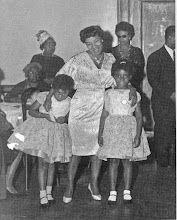
Barbara, MJ, Michele and Mom in the background in sunglasses at a fashion show in the early 60s