Showing posts with label Burdette Ringgold. Show all posts
Showing posts with label Burdette Ringgold. Show all posts
Thursday
Change Video 1


Saturday
Critical Essay: The Other Side of Harlem
This post originates at SOUL PICTURES:
http://mjsoulpictures.blogspot.com/2010/01/other-side-of-harlem.html
This blog has been devoted to interweaving the visual artifacts of my family, in particular the women, narratives and explanations of how they came about. In the process, one aspect of my family experience has been very consciously excluded: that of my father's family. It wasn't because I didn't or don't know my father's family or didn't know my father. It was rather because the rupture that took place between my father and mother's family when their marriage was annulled in 1956 was so profound and so unhealed even these sixty-five years later, that I conceived of the Soul Pictures project as solely a portrait of the transmission of culture via my maternal ancestry.
I thought to myself that I would leave my father's family to another time, a time when my focus on my father's family, their strengths and weaknesses, and the many photographs I have access to of them, would give less offense to the people who really raised me (in particular my stepfather Burdette) and took responsibility for me as a child.
But something very dramatic has happened since then related to this split between the maternal and the paternal sides of my legacy and ancestry. Also, some of the developments around the progression of the Soul Pictures project as a book about the women in my family has moved to the next stage, making it more conceivable to devote some space to my father's family in this blog afterall.
The dramatic thing that happened was the profile of Mom (Faith Ringgold) as part of a group of young people who began their careers as artists as children on Edgecombe Avenue, which recently appeared in the New York Times. Featured as a visual accompaniment to this article, is the multimedia presentation as part of the New York Time's new multimedia offerings at http://www.nytimes.com/interactive/2010/01/22/nyregion/sugarhill.html
My father Earl Wallace, who was a classical and jazz pianist, was one of the young people who grew up on Edgecomb Avenue, at 365 Edgecomb Avenue in fact, and Edgecomb Avenue is where Earl and Faith first met and played together. His parents were from Jamaica, West Indies as were the two other people featured in the article about Faith. Both Roy Eaton and Cecelia Hodges were of West Indian ancestry and, no doubt, knew my father Earl.
Granted Earl didn't survive or become distinguished, as was probably true of many of their generation of both Southern and West Indian ancestry, but the main point I want to make is this: there were two distinctly different black migrations to New York which contributed substantially to the concentration of talent in the Sugar Hill section of Harlem in the thirties, forties and fifties when my Mom was a young woman.
There was a West Indian migration (from most of the islands of the Caribbean, of which my father's parents and extended family were part) and there was a Southern migration, which brought Faith's mother and father to Harlem. Both migrations were massive and both contributed substantially to the fame and cultural vibrancy of the area. Although the relative dimensions would be hard to determine since we rarely acknowledge the fault line between the West Indians and the Southerners.
At least if my family stories are any indication, and my own experience of having served as the only bridge along with my sister between the two families since we were infants, there wasn't a lot of love between the West Indians and the Southerners. Although I need to acknowledge here as well the efforts of my maternal grandmother, Momma Jones, Mme. Willi Posey, and her determination to foster our connections with my father's family. As a result of her efforts, I saw a great deal more of my father and his family than I think my mother has ever been aware of.
It is hard to tell how my family experiences relate to the larger picture for the area in general though but I do know a great deal about the ancestry of my father's family and this area mapped out as Sugar Hill in Harlem is precisely where they were then. Thanks to a meticulous family history (not formally published) including many photographs written by a cousin named Robert Tomlinson (an artist now who lives in France) on my father's side of the family, I have extensive information about the members of this family lineage and where in Harlem they were concentrated.
Of course, I think the story gets a good deal more interesting and instructive to current audiences if it is allowed to go beyond the production of the reputations of the people who became world famous and gets more into the historical and cultural particulars--the nature of their practices.
The list of people pointed out as having emerged to flower, or having lived in Sugar Hill, I find particularly frustrating and am hoping that it will simply be a beginning to which flesh and blood can be added over time. Chronologies and Maps are wonderful audio visual tools when the layers are allowed to build. All in all, I am so happy this happened.
And now I will tell you about my father's family because my father, my Mom and my stepfather were all very good friends on Edgecomb Avenue and the second marriage issued almost seamlessly from the first marriage. Unfortunately, my father died in 1966 when I was 14 and he was an only child but as an adult I have come to know that he had an interesting and accomplished family of origin. He, himself, got swept away by the plague of heroin addiction that settled upon the jazz community in the 40s and 50s and then branched out into a full scale plague by the 60s and 70s.
http://mjsoulpictures.blogspot.com/2010/01/other-side-of-harlem.html
This blog has been devoted to interweaving the visual artifacts of my family, in particular the women, narratives and explanations of how they came about. In the process, one aspect of my family experience has been very consciously excluded: that of my father's family. It wasn't because I didn't or don't know my father's family or didn't know my father. It was rather because the rupture that took place between my father and mother's family when their marriage was annulled in 1956 was so profound and so unhealed even these sixty-five years later, that I conceived of the Soul Pictures project as solely a portrait of the transmission of culture via my maternal ancestry.
I thought to myself that I would leave my father's family to another time, a time when my focus on my father's family, their strengths and weaknesses, and the many photographs I have access to of them, would give less offense to the people who really raised me (in particular my stepfather Burdette) and took responsibility for me as a child.
But something very dramatic has happened since then related to this split between the maternal and the paternal sides of my legacy and ancestry. Also, some of the developments around the progression of the Soul Pictures project as a book about the women in my family has moved to the next stage, making it more conceivable to devote some space to my father's family in this blog afterall.
The dramatic thing that happened was the profile of Mom (Faith Ringgold) as part of a group of young people who began their careers as artists as children on Edgecombe Avenue, which recently appeared in the New York Times. Featured as a visual accompaniment to this article, is the multimedia presentation as part of the New York Time's new multimedia offerings at http://www.nytimes.com/interactive/2010/01/22/nyregion/sugarhill.html
My father Earl Wallace, who was a classical and jazz pianist, was one of the young people who grew up on Edgecomb Avenue, at 365 Edgecomb Avenue in fact, and Edgecomb Avenue is where Earl and Faith first met and played together. His parents were from Jamaica, West Indies as were the two other people featured in the article about Faith. Both Roy Eaton and Cecelia Hodges were of West Indian ancestry and, no doubt, knew my father Earl.
Granted Earl didn't survive or become distinguished, as was probably true of many of their generation of both Southern and West Indian ancestry, but the main point I want to make is this: there were two distinctly different black migrations to New York which contributed substantially to the concentration of talent in the Sugar Hill section of Harlem in the thirties, forties and fifties when my Mom was a young woman.
There was a West Indian migration (from most of the islands of the Caribbean, of which my father's parents and extended family were part) and there was a Southern migration, which brought Faith's mother and father to Harlem. Both migrations were massive and both contributed substantially to the fame and cultural vibrancy of the area. Although the relative dimensions would be hard to determine since we rarely acknowledge the fault line between the West Indians and the Southerners.
At least if my family stories are any indication, and my own experience of having served as the only bridge along with my sister between the two families since we were infants, there wasn't a lot of love between the West Indians and the Southerners. Although I need to acknowledge here as well the efforts of my maternal grandmother, Momma Jones, Mme. Willi Posey, and her determination to foster our connections with my father's family. As a result of her efforts, I saw a great deal more of my father and his family than I think my mother has ever been aware of.
It is hard to tell how my family experiences relate to the larger picture for the area in general though but I do know a great deal about the ancestry of my father's family and this area mapped out as Sugar Hill in Harlem is precisely where they were then. Thanks to a meticulous family history (not formally published) including many photographs written by a cousin named Robert Tomlinson (an artist now who lives in France) on my father's side of the family, I have extensive information about the members of this family lineage and where in Harlem they were concentrated.
Of course, I think the story gets a good deal more interesting and instructive to current audiences if it is allowed to go beyond the production of the reputations of the people who became world famous and gets more into the historical and cultural particulars--the nature of their practices.
The list of people pointed out as having emerged to flower, or having lived in Sugar Hill, I find particularly frustrating and am hoping that it will simply be a beginning to which flesh and blood can be added over time. Chronologies and Maps are wonderful audio visual tools when the layers are allowed to build. All in all, I am so happy this happened.
And now I will tell you about my father's family because my father, my Mom and my stepfather were all very good friends on Edgecomb Avenue and the second marriage issued almost seamlessly from the first marriage. Unfortunately, my father died in 1966 when I was 14 and he was an only child but as an adult I have come to know that he had an interesting and accomplished family of origin. He, himself, got swept away by the plague of heroin addiction that settled upon the jazz community in the 40s and 50s and then branched out into a full scale plague by the 60s and 70s.
Sunday
Photo Essay: Halloween at 409 Edgecombe Avenue 1980s

"Time Out" by Faith Ringgold. All rights reserved. Copyright Faith Ringgold. Collection of Michele Wallace
How old is Teddy in this picture? Perhaps three. Dad, who was then about 59, took his second granddaughter Teddy to a Halloween party in the lobby of 409 Edgecombe where he had grown up and his Mom was still living. So my guess is this is either 1988 or 1989. It has always been one of my favorite pictures of the two of them. Mother Faith accompanied them and took this picture.
In fact, I wanted to use this picture on the cover of my most recent book Dark Designs but it was ruled out immediately for reasons that completely escaped me since nothing was ever articulated but over the years I have formed an opinion of what was being seen here that others found objectionable and inappropriate, but that I found highly seductive and irresistible. Of course, it has everything to do with race, and the perception of what is expected of a person in terms of conforming to expectations of race, especially in terms of skin color.
Not the least of which has me thinking about these matters lately has been the controversy over Michael Jackson's recent death and the difficulty people seemed to have with accepting him as he was or as he had become. Also, the ongoing discussion of who and what our President is, mostly generated by the fact that he is of biracial birth and that his father was African and Muslim. Clearly it makes people crazy. It's his blessing but it is unsettling for some. Not me but for some. Is he or was he or will he ever be a real black man? If not, what is he? Answer: he is the President of the United States but that doesn't satisfy some.
I cannot remember a time when I didn't know Burdette Ringgold. We called him Daddy long before mother and he were married. Not sure why but he was a close friend of my real father to begin with. He was also good friends with my grandmother Momma Jones. He knew Earl's mother as well, Momma T. They were all Edgecombe people, as was my mother. Almost a tribe they were. He use to take us out a lot to the zoo, Coney Island, the circus (which he adored), walk us to death, babysit with us, help my Mom out, etcetera, which was part of the thing that made us all feel that he would make a good permanent addition to the family.
But at a certain point, not sure what our age was, Barbara and I began not only to notice that he could be mistaken for white, we also began to ask him point blank in the manner that children will, "Are you white?" I would imagine that this would have been soon after we had begun to notice that there were different races, which I can recall was not obvious to me from the very beginning. But I can remember us asking him again and again, determined to get an answer, and he never answered.
We could see that he was flustered and disturbed by the question but he brushed it off pleasantly and tried to distract us. We discussed it among ourselves, what to make of it and could come to no satisfactory conclusion except to ask him again. But he mentioned it to Mom and I don't recall how she got us to stop but I know she told us he was black, or rather Negro or colored as we use to say in those days (this is in the late 50s) and we finally lost interest in the question.
Before we get too deep into this, you need to know that both of his parents were racially black. Obviously of racially mixed descent but all sorts of racial mixtures are by no means unusual in the Afro-American community mainly because we are descendants of slaves and the slavemasters had their choice of the women in the quarters, just generally. The outcome was slaves who were biracial. Sometimes the master freed such slaves or adopted them. But obviously this was unusual as we can see from the variety of shades among Afro-Americans who were around when slavery finally ended in the first half of the 1860s.
So the thing is this. While this picture encapsulates my fondest memories of my family, to others the picture is both inconceivable and unacceptable. It matters if you are black or white and looking white or not looking black enough if you are actually black is not one of the options. So I am writing this as a present to Teddy who is the little girl in this picture. This is your birthday present Teddy, something educational, constructive, character building, not pleasure seeking in the childlike sense because you are 24 years old now and I would like it very much if you were to point your nose in the direction of growing up. If you were to really work at it. Part of it is to understand your unusual legacy, having a grandmother who could take such a picture and a grandfather whose greatest joy was to take you to such a party. In this picture you are having a time out because you had been having a little too much fun with those balloons. I guess we should call this picture, Time Out.
I love it. We keep it in a silver frame that mother received as an award from Ms. Magazine in 1983 long before you were born.
Wednesday
Photo-Essay: When I Got Married--1989

Photograph by Corinne Jennings. All rights reserved. Collection of Michele Wallace.
It was December 1989. And almost everything about that wedding was a complete surprise to me, never having gotten married before. As soon as it began, I regretted that I hadn't held out for something much bigger but then my groom was quite skiddish. I had to reel him in when I could. My only advice is this: never marry a man who doesn't want to get married to you, no matter how much you think you love him. When one person isn't doing what he or she wants to do, it gets thin real quick. Actually, I have lots more advice but I will save that for another time.
In this picture from left to right is Dad (Burdette Ringgold), Mom (Faith Ringgold), Michele Wallace the bride, Gene Nesmith the groom, and Virginia Nesmith, the mother of the groom. Picture taken by Corinne Jennings.
Sunday
Photo Essay: Black Macho and The Myth of The Superwoman 1970s

The inside first page of the cover story in Ms. January of 1979. The double excerpt from BLACK MACHO AND THE MYTH OF THE SUPERWOMAN (The Dial Press 1979).

The picture by the celebrated and brilliant black photographer Anthony Barboza. I have always wondered why he never exhibits this picture. I guess he is ashamed of it. But it is one of my prized possessions. I got the people at Ms. to give me the print they used and one day I gotta get Tony to sign it or whatever photographers do in a case like that. The only stupid thing is that it was 11 x 14 which seemed to me awkward. So what did homey do? She cut maybe an inch or two off the bottom. Stupidly, I think they call it these days.
In the summer of 1978, my first book BLACK MACHO AND THE MYTH OF THE SUPERWOMAN was at the publisher, receiving the final touches from my editor Joyce Johnson at The Dial Press and n search of a marketing strategy among the sales force. Meanwhile, MS MAGAZINE had purchased the first serial rights for a double excerpt that would (if I played my cards right and my hair, as it turned out) be featured on the cover of the magazine in January of 1979.
The way the game played out from then on until the publication was largely determined by two opposing forces, as I now see it 30 years later. On one side were the feminists at Ms. Magazine, and on the other were the anti-feminists at the Dial Press. Ms. Magazine was then run by an editorial collective which included most significantly for my cover, Gloria Steinem, Alice Walker, Robin Morgan and Mary Thom. That summer or perhaps a bit earlier Ms. Magazine hired Susan McHenry, fresh from a position with the editorial staff at Harvard University Press. She was young, about a year older than me (I was 26) and most importantly she was black. At the time, MS had no high level black editorial staff who was fully participant. Alice was crucial editorially for me and lots of other people but she was first and last a writer who was in the office maybe a day or two and always held herself far above anything ugly or pedestrian.
Unfortunately, I wasn't quite wise enough to follow her judicious careful lead. In any case, Susan worked closely with me as I recall (and became from that day to this a close personal friend) along with in particular my old friend and associate Robin Morgan (but whom I haven't seen or spoken with in years).
Gloria also wasn't involved on a day-to-day level but I had lunch with her and Alice at least twice during this period. Moreover, they both generously participated in an advance public reading to the feminist community at The Feministfw Salon, which was then located at Wesbeth. Gloria was there as was every other significant luminary on the then New York Feminist scene. My good fortune was that my sister Barbara Wallace took meticulous pictures of the gathering and as such I have a perfect visual record of the whole event. Most of the people there I didn't know at the time. Over the years I've met them all.
Alice and Robin Morgan introduced me and I read excerpts from my book. At the time, Alice wrote me several deeply encouraging handwritten letters of support (which I still have) in which she did, however, give me some crucial advice about last minute changes I should seek in the final draft of the book. As I recall the two particulars were to seek more knowledge of the history of struggle in African American communities via Vincent Harding in particular. The other piece of advice was to write more about black women writers, in particular such figures as Pauline Hopkins and Frances Harper who were virtually unknown. This advice was not followed although it has shaped my career as a writer, a feminist and intellectual ever since.

The celebrated cover from the book which shaped my 80s and indeed all the rest of my life until this day.
Not to excuse myself at all from responsibility for what was and was not in the book but the power struggle between these two constituent elements of feminists (white actually) was a determining factor in the kind of reception I got. The other side of the equation was the anti-feminists at The Dial Press, in particular one brilliant anti-feminist named Joyce Johnson who was my editor and who all but breastfed me through every stage of the writing and the completion of the book for publication. I call her an anti-feminist not out of any malice but I don't know how else to put it. She and the others opposed the use of the word feminist in connection with the book, on the publicity materials, on the book jacket, and in every aspect of the packaging or promotion of the book. Feminism they said would kill the book because feminism was finished and done with.
There weren't going to be any more important feminist books so there wasn't any point in dooming my project to abject obscurity in this manner. The feminist movement was over, not that it didn't have some merits but the represenatives were clueless about everything that mattered. Women would find another way to pursue their rights, if at all.
These white women seemed to be as convinced they were already liberated as a lot of black women I knew. Of course everything black, black women, black feminism, black whatever was sure death to a book because as everyone in publishing knew, black people did not read and they did not buy books. I was told this by one and all repeatedly.
The average reader and buyer of books was the little old lady from Pasadena, I think it was.. In any case, she was white. And to show you what kind of shape we were in in 1979, nobody really could prove otherwise. Blackness had come and gone with the popularity of black cultural nationalism, just as feminism had come and gone. Of course they were right about feminism, which I still don't understand.
Blackness they seriously got that one wrong. And indeed my book would prove it. I probably had the largest black reading audience anyone had ever had for a first nonfiction book by an "unknown." Nevermind for a "black feminist." I was one of the people who broke that wall. I went out on one tour for the little old ladies in Pasadena. Then I went on another one that stretched out for six months to every major black reading market. Nobody in the publishing industry seemed to know that there was even such a thing but they continued to clamour for me. The only bestseller list I ever really had traction on was the Washington Post Bestseller List, guess why? It got so I felt like I was practically living in D.C. I went there so much. I often appeared at black venues generally. I almost never said no so that was no problem.
I had quit my job teaching journalism at New York University at the end of the spring 1978 semester. I had some vague idea that I could make it as a freelancer. My Mom's lecture agent, Lordly and Dame, who was then handling her, black feminist Flo Kennedy and a hot set of black luminaries, got me lecture dates which from that time provided at least half of my income until I began teaching full time at the University of California at San Diego as a Visiting Lecturer in 1984 as companion to my Mom who began her stint as Professor of Art there at the same time. But I am getting ahead of myself.
From the summer of 1978 through the spring of 1984, I would go all the way from alpha to omega.
Everything after that up until the initial release of the book was influenced by this fierce struggle, which at 27 and black, I felt powerless to address or to contain. Later on there got to be a third component in the struggle (my Mom) and almost immediately after that a fourth (the men I was dating) but that's completely in Act 2.

This is a polaroid from a story that a black hair magazine did on my hair, which was at the time pretty unique (I think it was just me in Bo Derek--I am kidding, no e-mails!). My mother designed this hairstyle for me and the fixtures that made it possible. These were my braids wrapped in that waxy black cord that African women use to make their twists with a bead knotted at each end. I taught my favorite hairdresser who came to my house to do it. I felt safest when my hair was like this but none of the publicity people of either camp like it. Take it out! Take it out! The other thing I liked to do, which they hated was to wear a scarf over it. Hate it! I wore a scarf on the Today Show. Okay so I was also chewing gum. So shoot me. I was interviewed by Tom Brokaw. I bought my first tv so that I could watch it and my other television appearances. It was my first book promo and it was crazy but I am getting ahead of myself.
Anyhow I've kept these pictures all these years. I love these polaroids. Photographers always made them on shoots so I started asking for them because they usually threw them away.

This polaroid is from the Essence shoot. There was a major story in Essence written by Marcia Gillespie who was then editor-in-chief. Little did I suspect that she was going to tear me a new one. She's somebody I had lunch with all summer before the book came out too. (At least she didn't drop me after it was over like some. Dropped me like a hot rock, like my sister likes to say). But the pictures were great. For some reason they shot me both in black and white and color and in two different dresses. I forgot to say, Essence liked the braids. In fact, the black folk liked the braids. Thank god. Of course, I had my own make-up person who was also then doing Natalie Cole's make-up. That was the most fun shoot I ever did. We balled (as Aunt Barbara would say), at that shoot. Was the photographer black or white? Gotta check that. Essence always used the best unlike our friends at Ms, who could be uneven.
Meanwhile here comes this excerpt, which I actually think is excellent now that I am re-reading it for the first time in 30 years, I mean really reading it. It's tight, it is to the point and I pretty much agree with everything in it. They shaved many a rough spot from the actual book, including a diatribe or two about this and that which I sincerely wish I had never written. Either that, or that somebody had prevented it from being included in the final book, including the crazy quote on the cover of the book with the statement about how black man and women hated each other. Yes I wrote it, but that damn cover design and everything on it was the nightmare vision of the cover depart, the sales force and publicity. More about the quote later.
But the cover of Ms. with the cover lines about the book that would shape the 80s, as well as the quotes from Robin Morgan, Alice Walker, and Alice Walker which graced the back of the book were Ms.'s brilliant invention all alone. Joyce and the others at Dial did what they did to slow it down. The first blurb that came in the door was from somebody I didn't yet know but who would become a pretty good friend, Ishmael Reed. He loved the book for all sorts of reasons including the fact that he was then raising a real homegirl daughter who he was trying to keep on the straight and narrow. He wrote the blurb from that emotional place and with that inimitable energy that is Ishmael Reed's alone. It came in the door first and The Dial Press wanted to go with it alone, a one shot blast covering the inside leaves, the back of the book, everything. He was Joyce's kind of writer and Joyce had been editor to Amiri Baraka's HOME ( collection of essays), Eldridge Cleaver's SOUL ON ICE and Harold Cruse's CRISIS OF THE NEGRO INTELLECTUAL. We spent many an afternoon when I was blocked with her telling me the stories about working with these guys, in particular Cruse whose book fascinated me then.
She was sick and tired of their crap about women and so was I so when I wrote BLACK MACHO first, which took me maybe a month or two (it just poured out) to write, she took one look at it and announced that instead of the 10 chapter book on black women I had planned, this essay would be the key and title essay with perhaps one other companion essay on black women. I called it The Myth of the Superwoman, and it took me the balance of two years to finish it. Rather Joyce finished it for me because she kept insisting that it wasn't finished and that it needed more work in this manner that editors will always do. More work, more work, more work. She wouldn't write a single word. This was her way of showing her respect for my writing abilities she said. In the end, I cried so hard about not being able to go on one day that she did a massive edit in particular on the second part of Myth of a Superwoman, which was one of the historical sections.
Joyce oversaw and supervised the battle against the citation of my sources in either a bibliography, footnotes or even an index. I still don't know whether they were just cheap or whether they were trying to destroy the rest of my life on purpose. But in any case, this was as it would be. But she would not have her way on the characterization of me a black feminist on either the publicity material or on the book jacket. The media did the rest.
Final story, although there is a million others. when we shot the cover for Ms., it was understood that I had only a rat's chance of ever seeing the color. I was nobody, black women were rarely featured on magazine covers then and my book had no news hook so it likely wasn't going to happen unless I followed every instruction and did exactly as I was told. At the shoot, instruction one. Take those braids out of your hair. They will ruin the cover. This the hairdresser did. But I didn't know what to do with my hair under such circumstances so you see instead that unruly hair style I had where my hair is being I am not sure what. If it looks like my face is covered with makeup, it is, as the makeup artist applied layer after layer of a various assortment of foundations trying, I can see now, to somehow brighten my hopelessly olive blackness. People say this is a beautiful picture but I can't see it. I hated it.
But there it was in December of 1979 on every newstand in New York with that inflammatory announcement that it would be the book to shape the 80s. I am not sure I will ever live that down but then I didn't say it. The person who did say it, Gloria Steinem, found a way to publically withdraw it by blurbing my Mom's autobiography, WE FLEW OVER THE BRIDGE with Little Brown in 1990.
And thus begun the craziest most exciting time of my life, the year of 1979. At the time, I had no idea whether it was going to be like that from then on or how whether it was going to be different, less more or what.

This is one of a series of pictures of me taken by the photographer for Emerge in January of 1979 in connection with a piece on the book written by Paula Giddings. She tore me a new one too and then went on and wrote the definitive book on black feminism, WHEN AND WHERE I ENTER. Still the classic I think. Don't remember the name of the photographer but he was black and he said let's just go over the park (Washington Square Park--I lived in the village then) and shoot some stuff for the fun of it. It was cold as you know what and my hair was blowing. I am thinking, this guy has got issues but let's just get through this. It took about 15 minutes for him to shoot about a 10o pictures, the prints of which he gave me and which I still have. Fun and this is me with normal make-up then, which was no make-up, or just mascara, eyeliner and lipstick.

Mom and Dad at Mom's surprise birthday party at 345 in Harlem. October 8th, 1979, in the thick of it.
Thursday
Photo Collection: Mom and Dad in 2009


Mom and Dad in 2009 at IHop. Pictures taken by their loving granddaughter, Faith Wallace Gadsden. Just brilliant!
Wednesday
Photo-Essay: Mom and Dad 1970s
This is Mom and Dad back in the day at 409 Edgecombe Avenue. The year is 1977.
My Dad is Burdette Ringgold. My mother Faith and he were married in 1962. In 1963, we all moved from the Bronx to 145th Street, where for the first time we had enough rooms for one of them to be devoted to a studio for my Mom's art work. Barbara and I shared the largest bedroom which had its own toilet attached, separate from the larger master bathroom.
My sister and I switched that fall from Our Savior Lutheran School in the Bronx to New Lincoln School on 110th Street and Central Park North. And what a switch that was.
First, a new Dad. Then a new school and a new neighborhood. I was definitely reeling from the culture shock, thoroughly intimidated by my new surroundings.
And then in November of 1963, while Barbara and I were still scrambling to adjust to New Lincoln's distinctly secular and progressive approach to education in which, for example, we called our teachers by their first names, something truly awful happened, something I can no longer really imagine but rather can only recollect based upon previous recollections ad infinitum.
I suppose the best thing about it was that I was a child and therefore had nothing to compare it to. But I can still remember something of the physical landscape of that day, that it was in the fall and I recall, the leaves were already turning.
When 9-11 happened in 2001, as it happened I was again living in the same building on 145th Street in Harlem where we had lived then. I thought of that previous day when President Kennedy had been shot and idly wondered if the experiences of school children were anything like the way it was for us. I hoped that it was because I remember only that I felt very protected when Kennedy was shot, not at all in any kind of personal danger. But then Jack Kennedy had been shot in Dallas, Texas which from my point-of-view at that time might as well have been Oz for all I knew about its connection to the part of the United States in which I was living.
The school day ceased to progress in a manner that was then entirely invisible to me but which I would always recognize from then on in times of emergency in educational settings. The announcement was made in a quiet and dignified way that the President, John F. Kennedy was shot, and I had occasion to recall this in particular recently when reading a reminiscence of that very same day written by my former 7th grade teacher, Helen Myers. It was good to learn that even though I had been only 11 years old that I had still gotten the essentials right.
I can't remember then how long it was from the announcement of his shooting to the announcement of his death, or whether I received any further information until I was actually with my parents but I remember that the next order of business was getting us home as quickly as possible where my family (and I guess I would assume all the other children's families) remained glued to our black and white television sets and the two or three television stations we then had for the duration, which I would guess extended over a period of days.
In the Christian tradition, getting a head of state properly buried, particularly if it also happens that he was assassinated while in office, was I would guess a protracted process, not a simple matter. And children are easily amazed at how long adults can take to do such things at such times. I think I can recall some aspects of the processional apparently patterned after that of Abraham Lincoln as called for by his widow, Jacqueline Kennedy.
I don't know if I actually remember seeing John John saluting his father's coffin that day or whether it is all the times I have seen it replayed in various forms. What stands out in my mind since then is that he wore those short pants that little boys up to a certain age were sometimes dressed in, and that that same boy became a man who died only a year after his own mother died of cancer.
From 1963 to 1977 was not such a very long time. Malcolm X was shot in 1965 and that was a highly personal occasion because it happened in Harlem and my family lived in Harlem. My parents and everybody I knew were deeply affected by his death. His processional, viewing and funeral all took place in Harlem. Then Robert F. Kennedy was shot in 1968, and this isn't to say that a great many other things didn't happen in between these dates, including the murder of Martin Luther King, Jr. as well but I run the chronology through my mind if not daily, certainly often enough just so I won't ever forget the order in which things happened.
I asked my Dad whether he was sent home on that day, whether they closed the line down at General Motors in Tarrytown when John F. Kennedy got killed. He said they did. I asked because I know they rarely closed the line down and his coming home from work without completing his day was something that only happened on fewer days than I can count on one hand during the time he worked there. He then mentioned, as well, that he had come home early on the day that Martin Luther King, Jr. was shot but this time without authorization from the bureaucracy. I gather the black workers, including him, refused to work. His punishment was a 3 day suspension. So much for the widespread love and respect for MLK in 1968. But he says they didn't close the line down for Robert Kennedy either. What a crazy time.
Then I graduated from high school in 1969, went to Mexico during the first half of the summer, did not want to ever return to the United States but had to anyway, then spent the second half of the summer in the Sisters of the Good Sheppard Residence for girls in need of supervision across the street from Beth Israel Hospital in 17th Street.
Then I went to Howard University for one semester in the fall of 1969, personally delivered by my Mom with a suitcase full of new clothes and brand new bank account at the Howard University's campus bank. Dad came to visit me sometime in the fall, was shocked at the free floating cattle market on display on the campus green right outside my dorm, which had just started to allow boys to visit on weekends, and advised Mom to bring me home immediately.
I was back in New York at the City College of New York by February of 1970, working as an account adjuster at Best & Company during the day and attending night school. I truly loved that job at Best & Company but they soon went out of business forever. In 1974, I graduated from the City College of New York with a major in English and Creative Writing, under the careful tutelage of my mentor Mark Mirksy, now my colleague.
The summer of my graduation, the same summer in which Richard Nixon was impeached, I was working as a secretary in the office of the Editor-in-Chief of Random House at an exciting new job. The world seemed to pass through that office. I served coffee and did all the dictaphone typing.
In the fall of 1974 I had moved on to a job I liked even better on most days because I was no longer a typist and a server of coffee but a "research assistant" in the Book Review Department at Newsweek Magazine. Even more of the world flowed through these offices, which was known as "The Back of the Book," with Jack Kroll in charge. It was during the two and a half years that I was employed by Newsweek that I met the people and made the connections that would lead to my free lance writing career at The Village Voice, a literary agent and a book contract at McGraw Hill for an as yet untitled book on the sexual politics of black women and black men.
At the birthday party for my Dad, and his sister Gloria in September of 1977, at which this picture was taken, I was presumably then engaged in writing the manuscript that would become Black Macho and The Myth of the Superwoman in 1979. The contract money had already run out and I had just begun to work full time in the position of Lecturer in the Journalism Program at New York University. I was living at Washington Square Village, NYU housing. I had moved from 345 early in the summer of 1976 upon the occasion of the massively successful Sojourner Truth Festival of the Arts, which was given by a committee composed of Margo Jefferson, Pat Jones, Monica Freeman and myself at the Women's Interarts Center on the Westside.
See more of these pictures at http://www.flickr.com/photos/mjsoulpictures/sets/

My Dad is Burdette Ringgold. My mother Faith and he were married in 1962. In 1963, we all moved from the Bronx to 145th Street, where for the first time we had enough rooms for one of them to be devoted to a studio for my Mom's art work. Barbara and I shared the largest bedroom which had its own toilet attached, separate from the larger master bathroom.
My sister and I switched that fall from Our Savior Lutheran School in the Bronx to New Lincoln School on 110th Street and Central Park North. And what a switch that was.
First, a new Dad. Then a new school and a new neighborhood. I was definitely reeling from the culture shock, thoroughly intimidated by my new surroundings.
And then in November of 1963, while Barbara and I were still scrambling to adjust to New Lincoln's distinctly secular and progressive approach to education in which, for example, we called our teachers by their first names, something truly awful happened, something I can no longer really imagine but rather can only recollect based upon previous recollections ad infinitum.
I suppose the best thing about it was that I was a child and therefore had nothing to compare it to. But I can still remember something of the physical landscape of that day, that it was in the fall and I recall, the leaves were already turning.
When 9-11 happened in 2001, as it happened I was again living in the same building on 145th Street in Harlem where we had lived then. I thought of that previous day when President Kennedy had been shot and idly wondered if the experiences of school children were anything like the way it was for us. I hoped that it was because I remember only that I felt very protected when Kennedy was shot, not at all in any kind of personal danger. But then Jack Kennedy had been shot in Dallas, Texas which from my point-of-view at that time might as well have been Oz for all I knew about its connection to the part of the United States in which I was living.
The school day ceased to progress in a manner that was then entirely invisible to me but which I would always recognize from then on in times of emergency in educational settings. The announcement was made in a quiet and dignified way that the President, John F. Kennedy was shot, and I had occasion to recall this in particular recently when reading a reminiscence of that very same day written by my former 7th grade teacher, Helen Myers. It was good to learn that even though I had been only 11 years old that I had still gotten the essentials right.
I can't remember then how long it was from the announcement of his shooting to the announcement of his death, or whether I received any further information until I was actually with my parents but I remember that the next order of business was getting us home as quickly as possible where my family (and I guess I would assume all the other children's families) remained glued to our black and white television sets and the two or three television stations we then had for the duration, which I would guess extended over a period of days.
In the Christian tradition, getting a head of state properly buried, particularly if it also happens that he was assassinated while in office, was I would guess a protracted process, not a simple matter. And children are easily amazed at how long adults can take to do such things at such times. I think I can recall some aspects of the processional apparently patterned after that of Abraham Lincoln as called for by his widow, Jacqueline Kennedy.
I don't know if I actually remember seeing John John saluting his father's coffin that day or whether it is all the times I have seen it replayed in various forms. What stands out in my mind since then is that he wore those short pants that little boys up to a certain age were sometimes dressed in, and that that same boy became a man who died only a year after his own mother died of cancer.
From 1963 to 1977 was not such a very long time. Malcolm X was shot in 1965 and that was a highly personal occasion because it happened in Harlem and my family lived in Harlem. My parents and everybody I knew were deeply affected by his death. His processional, viewing and funeral all took place in Harlem. Then Robert F. Kennedy was shot in 1968, and this isn't to say that a great many other things didn't happen in between these dates, including the murder of Martin Luther King, Jr. as well but I run the chronology through my mind if not daily, certainly often enough just so I won't ever forget the order in which things happened.
I asked my Dad whether he was sent home on that day, whether they closed the line down at General Motors in Tarrytown when John F. Kennedy got killed. He said they did. I asked because I know they rarely closed the line down and his coming home from work without completing his day was something that only happened on fewer days than I can count on one hand during the time he worked there. He then mentioned, as well, that he had come home early on the day that Martin Luther King, Jr. was shot but this time without authorization from the bureaucracy. I gather the black workers, including him, refused to work. His punishment was a 3 day suspension. So much for the widespread love and respect for MLK in 1968. But he says they didn't close the line down for Robert Kennedy either. What a crazy time.
Then I graduated from high school in 1969, went to Mexico during the first half of the summer, did not want to ever return to the United States but had to anyway, then spent the second half of the summer in the Sisters of the Good Sheppard Residence for girls in need of supervision across the street from Beth Israel Hospital in 17th Street.
Then I went to Howard University for one semester in the fall of 1969, personally delivered by my Mom with a suitcase full of new clothes and brand new bank account at the Howard University's campus bank. Dad came to visit me sometime in the fall, was shocked at the free floating cattle market on display on the campus green right outside my dorm, which had just started to allow boys to visit on weekends, and advised Mom to bring me home immediately.
I was back in New York at the City College of New York by February of 1970, working as an account adjuster at Best & Company during the day and attending night school. I truly loved that job at Best & Company but they soon went out of business forever. In 1974, I graduated from the City College of New York with a major in English and Creative Writing, under the careful tutelage of my mentor Mark Mirksy, now my colleague.
The summer of my graduation, the same summer in which Richard Nixon was impeached, I was working as a secretary in the office of the Editor-in-Chief of Random House at an exciting new job. The world seemed to pass through that office. I served coffee and did all the dictaphone typing.
In the fall of 1974 I had moved on to a job I liked even better on most days because I was no longer a typist and a server of coffee but a "research assistant" in the Book Review Department at Newsweek Magazine. Even more of the world flowed through these offices, which was known as "The Back of the Book," with Jack Kroll in charge. It was during the two and a half years that I was employed by Newsweek that I met the people and made the connections that would lead to my free lance writing career at The Village Voice, a literary agent and a book contract at McGraw Hill for an as yet untitled book on the sexual politics of black women and black men.
At the birthday party for my Dad, and his sister Gloria in September of 1977, at which this picture was taken, I was presumably then engaged in writing the manuscript that would become Black Macho and The Myth of the Superwoman in 1979. The contract money had already run out and I had just begun to work full time in the position of Lecturer in the Journalism Program at New York University. I was living at Washington Square Village, NYU housing. I had moved from 345 early in the summer of 1976 upon the occasion of the massively successful Sojourner Truth Festival of the Arts, which was given by a committee composed of Margo Jefferson, Pat Jones, Monica Freeman and myself at the Women's Interarts Center on the Westside.
See more of these pictures at http://www.flickr.com/photos/mjsoulpictures/sets/
Thursday
Photo Essay: Sonny Rollins Plays At Faith Ringgold's Retrospective

Dr. Phillip G Zimbardo, Faith Ringgold, Prof. Abenia Busia, Sonny Rollins and Burdette Ringgold at Rutger's University, 2009


Sonny Rollins and Faith Ringgold, childhood friends from Edgecombe Avenue on Sugar Hill together again. And how sweet it is. Aside from my Dad, Burdette Ringgold, these pictures include Sonny Rollins, the great musician, Faith Ringgold, the great artist, and Dr. Phillip G. Zimbardo, distinguished professor of psychology at Stanford who is perhaps best known for the 1971 Stanford Prison Experiment in which the innate corruptibility of situational dominance is explored. All three New York City bred. New York's Finest you might say.


Photos taken by Faith Wallace-Gadsden (copyright 2009)
Sonny Rollins and Faith Ringgold, childhood friends from Edgecombe Avenue on Sugar Hill together again. And how sweet it is. Aside from my Dad, Burdette Ringgold, these pictures include Sonny Rollins, the great musician, Faith Ringgold, the great artist, and Dr. Phillip G. Zimbardo, distinguished professor of psychology at Stanford who is perhaps best known for the 1971 Stanford Prison Experiment in which the innate corruptibility of situational dominance is explored. All three New York City bred. New York's Finest you might say.
Saturday
Photo-Essay: Stairs from Sugar Hill to the Valley
These are the stairs that lead from Edgecombe Avenue, where I grew up and where my stepdad (Burdette) grew up down to the Valley where MJ and all her siblings and her mother first lived in the early 1920s and where my Mom spent her earlier years at 222 West 146th Street immortalized in her Street Story Quilt of 1986 (collection of the Metropolitan Museum of Art).
When Faith started writing the stories that go with the earlier story quilts, such as "Who's Afraid of Aunt Jemima?" I had no idea where those voices in dialect telling neighborhood stories came from. It was as bracing as a cold shower. At first, I thought it was a put-on, a voice adapted for the amusement and entertainment of the reader as I came of age in a period in which anything delivered in the southern dialects of the colored tongue was considered a ruse and a form of cooning for the white folks.
I didn't yet understand that what I had been taught in the 60s and 70s to consider a deformation of black character and speech was actually an immensely rich source of a variety of working class, rural and subterranean black experiences, a series of lifestyles and adventures-- particularly that adventure of escaping hard times and Jim Crow--to emerge triumphant in the cities of the North and the West.

When Faith started writing the stories that go with the earlier story quilts, such as "Who's Afraid of Aunt Jemima?" I had no idea where those voices in dialect telling neighborhood stories came from. It was as bracing as a cold shower. At first, I thought it was a put-on, a voice adapted for the amusement and entertainment of the reader as I came of age in a period in which anything delivered in the southern dialects of the colored tongue was considered a ruse and a form of cooning for the white folks.
I didn't yet understand that what I had been taught in the 60s and 70s to consider a deformation of black character and speech was actually an immensely rich source of a variety of working class, rural and subterranean black experiences, a series of lifestyles and adventures-- particularly that adventure of escaping hard times and Jim Crow--to emerge triumphant in the cities of the North and the West.
Subscribe to:
Posts (Atom)
Subscribe


 Posts
All Comments
Posts
All Comments
Michele Wallace: Talking in Pictures
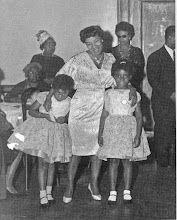
Barbara, MJ, Michele and Mom in the background in sunglasses at a fashion show in the early 60s