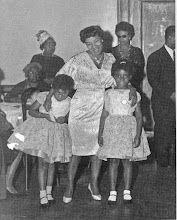
The Final Stage of Soul Pictures--translating the amorphous process of scanning pictures, tracking events, photographers, proper names and dates for the lives of the women in my family into a series of specific, finite projects which may, in turn, become a chapter or chapters or even book projects of their own--will be protracted. I don't know how long it will take, except that I would like to finish at least one book project from it during my sabbatical, just because that's the measure of a successful sabbatical. If you come out of it with a book ready to deliver to the publishers, you had a good one.
It's been a few weeks since school more or less ended (it never really ends) and I have begun to imagine completing the book faster than I had once imagined it. My sense is that it could consist of a series of chapters as follows:
The Introduction will be devoted to Dr. Baby Faith, my neice, her birth in 1982 and the series of paintings Mom did in her honor: Willi and Baby Faith, a series of lovely abstractions. This section will be composed of the photographs of Baby Faith, her photographs and Faith's art in this period, including the Dah Series and Emanon--all abstract paintings on canvas.
In each section of the book, the overarching theme will be provided by a particular set of Faith's art work. In this section the rubric will be provided by We Came To Jones Road.
Chapter One will be devoted to Faith and Burdette's experience purchasing a home in Englewood and their struggle to build a suitable studio combination house for herself. In 1999, Faith also initiated the activities of the Any One Can Fly Foundation, including the Garden Party, the Lifetime Achievement Awards and the Scholars Grants.
Chapter Two will look at the origins of the Posey family in Rocky Grove, SC.
Right now the way I am thinking is in terms of a set of discreet projects named after the focus of research and the available documents. Each has to do with questions I wish to pose to the sources. Most would focus on African American family life in a series of locations:
Rocky Grove, SC Project: Apparently, my great-great grandfather, the grandfather of my mother's grandfather was named Free Posey. He is named the head of the family in the 1880 Census, born about 1813, which would make him 67. His wife Matilda was born in 1830, making her about 50. There may have been another wife before her since Free Posey apparently had so many children, maybe 22, quite a few of them older than my great-grandfather Professor Benjamin Bunyon Posey.
I am assuming that both of them were former slaves, and guessing as well that they are living not too far from the location of their enslavement. A brief period of researching the Posey name in cemetaries in that county would seem to indicate that Posey was a very strong and widespread name both among whites and blacks in that particular location and that a site visit would be likely to render some insight into how this name functioned locally.
It looks as though Rocky Grove has experienced a county name change but that it remains a fairly small community, which should be good for tracking ancestral history, and getting a sense of what it was like from 100 to 200 years ago.
I have gathered the names and locations of the various Posey siblings, their spouses and from subsequent papers, letters written on the occasion of the death of Lawrence O. Posey, who was living in Washington D.C. early in the 20th century. Also apparently Benjamin Bunyon Posey, Mom's grandfather, were among those former slaves and their children who were most eager for education and opportunity and travelled in search of it. So this story should be an adventure I think, another chance to explore the mysteries of the rural South and how my ancestors fared in this strange place. I love South Carolina anyway because of its rich history as the earliest states where slaves outnumbered free, also the state that was the first to succeed from the union and to join the confederacy. They were instigators and a place where they liberally continued to import slaves from Africa long after it was illegal to do so in the entire U.S. It may be possible that Free was an African. What a name.
Washington, D.C. Project: A branch of the Posey family settled in Washington D.C. Benjamin Bunyon Posey (my great-grandfather, MJ's father) lived with a branch of this family in order to pursue the education that prepared him to be a teacher and to start schools in Palatka, and other places in the South. I would like to track the fortunes of the Poseys in Washington D.C. after the Civil War, and the manner in which D.C. became the hub of Reconstruction and the first place in the country to see widespread efforts to educate the former slaves.
When I was a little girl, Mom took Barbara and I to visit Lottie Bell and Junior who had moved their from Atlantic City. We spent perhaps a month with them on a quiet little residential street when we were 5 and 4 I think. It's the first trip I can remember taking in the summer. Lottie Bell, as I recall, was the very stuff of which life is made, a joy to be around. We played with lots of black kids and had a fabulous time. This would be in 1957.
I adore Washington D.C. I attended Howard there briefly in the fall of 1969 and had a completely unforgettable time. I would like to understand this very African American place's link with my family history. Who were the black people who built this magnificent city? Were some of them Poseys? It must have been a fascinating place after the war. Also, apparently my stepfather's grandfather also named Ringgold was in Washington D.C. after the war, possibly a soldier in the Civil War. I had thought before of Washington D.C. being a transitional space in the fortunes of African Americans but I think it probably was crucial.
Hampton/Tuskegee Project. As part of this project, I would like to go to Tuskegee just to get a better understanding of the role of these two institutions in the development of the struggle of HBCUs for self-definition. Of course, there were many other schools--Spelman, Atlanta, Morehouse, Fisk and Lincoln--which were very different from Hampton and Tuskegree but I am interested in the geography and the landscape of such places since their patterns must have impacted all the rest, regardless of whether the pattern was followed. The idea of an educational system having to be formed under such prohibitive constraints as segregation and apartheid is deeply intriquing to me. I have no ancestral links there so far as I know, only that B.B Posey and all the other Posey probably admired Booker T. Washington's work there.
Mother often mentions that Uncle Cardoza Posey, MJ's oldest brother was a Republican. He graduated from the Florida Baptist Academy in 1915, three years after the death of his father BB. Posey, and he often participated in reunions there.
He moved to Orange New Jersey as a young man and proudly participated in the 369th in France during WWI, emerging from the military with the rank of sargent. Born in 1892, he was active in the NAACP and a number of other organizations, including the Masons. He worked in the Post Office all of his life, maintained a vigorous correspondence with family and friends, and spent his vacations hunting down Poseys across the country. My Mom has inherited his papers and his photographs. His role in the family that Mom grew up in is as chief advisor and patriarchal figure to his sister's children. He never had any children of his own although he was married three times. The home he lived in when he died in 1968 is still there and occupied his stepdaughter by marriage who is a teacher. Been meaning to get over there to Hempstead to see what she's got for at least a decade. The last time I spoke to her, she said there wasn't much left. Mea culpa.
Provincetown/Martha's Vineyard Project--Almost every summer from 1957 until 1966 my Mom sister and I spent in Provincetown as part of the artist colony there or in Martha's Vineyard with the Goldsberry family. The Cape Cod summers were a crucial aspect of my life growing up.
Camp Craigmeade Project--Every other summer we spent at Camp Craigmeade and all black, very rustic camp in the Catskill Mountains run by a lady name Helen Meade with her husband and her two older sisters. We called all of them Aunts and we had so much fun that usually we didn't want to go home. Mom would come up and spend a long weekend with us up there along with the other parents. She painted many beautiful paintings of the landscape around Camp Craigmeade. I long to relocate this camp and the family who started it. This all black camp gave me great strength and resilience throughout my life in integrated schools where being black was never the best thing to be.
Palatka/Jacksonville, Florida Project--These two places are the starting points for a substantial portion of family history in the 20th century, in particular the Poseys, who lived in the little town of Palatka, which my grandmother MJ remembers and describes so well in my interviews with her, and Jacksonville, the place of the Binghams, the family into which B.B. Posey married. There were also other Poseys and Binghams who were not my direct ancestors. Both places had racial segregation and yet MJ seems either unaware of it or very reluctant to talk about any firsthand experience of it.
From the reading and map gazing I've done, it sounds as though Palatka is or was a beautiful place with a natural water link with Jacksonville. Also it is very near both historic Eatonville and Daytona Beach, as well Orlando. This will be a visit, and to some degree a search for surviving family and insight into the family's choice of location there. My husband was Naples Florida and I just love the place anyway--the swamps, the aligators, the palm trees and so forth.
Atlantic City Project: In the summer, MJ took her children to Atlantic City where there was a thriving black resort community. They watched black movies all summer and luxuriated in the black section of the boardwalk and the beach. Their visits were always with Lottie Bell, a very close friend of my grandmother's and her son Junior, who was a life of the party type. I look to visit this place and learn all I can of this lovely community and what became of it.
the Bronx Project: A few members of our family, in particular my Mom and my sister and myself lived in the East Bronx for about six years in a building known as St. Mary's Projects, Mitchell Lama housing I believe. We also attended a Lutheran School in the Bronx on Williamsbridge Road. What became of this house and of this school?
The Harlem Project--Needless to say, this was everybody's destination on both sides of my family. And they lived within a one mile radius pretty much for the entire time of their existence, Edgecombe Avenue, St. Nicholas Avenue, and St. Nicholas Place from 145th to 155th Street. As a child to me it had all the qualities of life in a small village of black people. I loved it and miss it still.
Other Possible Location Projects:
the San Diego Project
the European Tours Project
the West Africa Project
the Brooklyn Project
the Englewood NJ Project
Also, there are some topics focused on institutions:
WWI Project--Uncle Cardoza, Uncle Fred and probably Thomas Morrison were soldiers in WWI. This is a fascinating war from the point of view of issues of race. Black soldiers had to go through so much just to even get into the battle. The other kinds of "household" and "maintenance" services they rendered have always been belittled and dismissed, although I am not sure why. Anything anybody did in WWI automatically placed the soldier in harm's way.
WWII Project--Uncle Hilliard was a soldier in WWII and would serverely wounded, ending up with a metal plate in his head and also maintained a close relationship with the Veteran's Hospital in New Jersey for the rest of his life. Mom's Dad Andrew Jones volunteered to fight in WWII and cried when they said he was too older. Grandpa Andrew was an emotional man. It may also be that Uncle Cardoza was in the national guard or saw some kind of service in WWII. He was very patriotic.
the Addiction Project--my Dad, my Uncle Andrew and my cousin Jimmy died of drug overdoses of heroine all in the 60s before any insight into the treatment of addictions had come. The family assumption has always been that racism killed them but with all this work on genes, I am beginning to wonder if there might not be some insight there. Afterall the death rate in the family has been truly astounding. It includes my paternal grandfather and my Aunt's deaths related to alcoholism.
the CCNY Project--Mother went to CCNY, Grandpa Bob briefly taught chemistry there, and Barbara, myself and my former husband attended their as undergrads. I now teach there and have done so for almost 20 years. Have been asked to supervise the writing of the formal history of the English Department, which should allow me to master the history of the school, some of which would be relevant to Soul Pictures. I am curious about the link between Max Bond, Keith and Mamie Clarke (who were responsible for the research which contributed to the defeat of the Separate But Equal decision), the Northside Center and New Lincoln where I went to school.
the New Lincoln School Project--both Barbara and I went to school here from 1963 through 1970. The impact on my life is incalculable. Also, my neice Faith went their briefly when they incorporated with Walden.
the Public Schools in New York Project--mother taught in the public schools of New York for 17 years while I was growing up in the 50s and 60s. Aunt Barbara also taught. MJ attended Wadleigh High School in the early 20s. Mom and Aunt Barbara went to P.S. 136, Stitt and Morris High School in the 30s and 40s. Uncle Andrew went to the same schools. Dad went to George Washington High School in the 40s. My sister Barbara taught in the public schools for a number of years. I, myself, never attended or taught in a public school. As such, I find them fascinating to consider. Most schools have rich histories which are largely neglected.
The Marriage Project--the key occasions would be Aunt Bessie's marriage in Jacksonville in the teens, MJ's marriage to Andrew Jones in Harlem in 1923, Aunt Barbara's marriage to Jo Jo in 1950, my Mom's elopement with Earl (Dad) in the same year, my mother's subsequent re-marriage to Burdette Ringgold in 1962, my sister Barbara's marriage to Glen Gadsden in 1980, my marriage to Gene Nesmith in 1989. Marriages are fascinating events drawing together all sorts of people who would otherwise have nor reason to associate with one another. A wedding is the only event I have ever given where the attendance rate is very close to 100%. It was 20 below the day I got married and yet everybody I asked to come was there. It was crazy.
the Howard University Project--I attended Howard University in the fall of 1969.
My Mom received a lifetime achievement award from the Porter Colloquium there about three years ago. In 1963, James Porter, Art Historian at Howard University, was the first person to buy one of his paintings. The Bridesmaid or Bride of Martha's Vineyard was painted the summer we spent in Martha's Vineyard.
the Wallace Family Project--the topic here is the families of my father, Robert Earl Wallace, who died in 1966 of a heroine overdose. Before then, he had an interesting life. He was a master classical pianist and jazz pianist but apparently without the ambition or drive to succeed at anything. He is and was an interesting person himself, somebody whom I saw on many occasions and spoke with although I cannot say I knew him well. I was forbidden to see him but my grandmothers conspired together to make it possible for us to see one another. Afterall, my two grandmothers lived right next door on Edgecombe Avenue.
In addition to Earl himself, there is another whole cast of characters made up of my grandfather, Grandpa Bob, my grandmother, Momma T, and my step-grandfather Chiefie who was Momma T's second husband. All of these people were originally from Jamaica, W.I. although in Earl's case, he had no trace of an accent. Like his own father Grandpa Bob, he ewas a brilliant man who loved to do intellectual things. Each grandparent brings with him or her a rich array of subsidiary figures. My father's father's people are among the ones I know the best at this point. They educated people so this is extremely helpful.
NAAFAD Project: National Association of Fashion and Accessories Designers
the Black Feminism Project
The intimate memories project--this section will focus on topics related to my intimate personal life. Sex, married life, personal emotional stuff that doesn't belong anywhere else. Herein would also belong my reflections on issues of mental health and their impact on my family.
I am currently working with a chronology encompassing all relevant events in which the main women in my line have been engaged from roughly 1900 to 2000. Both of my grandmothers were born in 1903. Both grandfathers were born slightly earlier, which gives me a nice frame for the century, and the story their lives and the lives of their descendants can tell about the culture and civilization in which we participated. A major theme is the Great Migration and its outcomes.
A major focus of the project is to render most things in a visual form and to search for language that can further assist the images in characterizing the times for a book reading public. The blog form, as far as my concerned, is a means through which to endlessly explore possibilities for the book. This book will also be for me my first, most sincerely intend book with its own structure of self-sufficient narratives.


 Posts
Posts