This photograph is used on the cover of Dark Design and Visual Culture, Duke University Press 2004. The picture was taken in 1950 and it forms the thematic basis of my writing on photography since the year 2000, which forms a continuation of my work on African American visual culture since the completion of my dissertation on the topic: Passing, Lynching and Jim Crow: African American Visual Culture, 1895-1927 in Cinema Studies in 1999.
This event takes place in 1950 outside of Abyssinian Baptist Church where my Aunt Barbara is about to be married. This collection of people is composed of Mme. Willi Posey, my grandmother, and a fashion designer who had designed her own dress as well as all of the dresses of the other participants in the wedding; Aunt Barbara, her oldest daughter, is the bride; her youngest daughter, Faith, 18, is on the right and wearing glasses which she will not wear in the portrait shots. Also in the shot is a rented limousine, which they are getting out of. Brownie who was MJ's best friend immortalized in Faith's mask series as "Mrs. Brown," is engaged in some business with Aunt Barbara's dress. Andrew Jones Sr., the father and the only man in the picture, has been resurrected in his role as patriarch for this occasion.
MJ and he are already divorced owing to his drinking and his fondness for the sporting life and she has already begun to use her maiden name, Willi Posey with Madame on the front, as her professional name. In the lower right hand of the photo is Cheryl, MJ's first grandchild, the daughter of her oldest son, Andrew Jones. She is dressed as a flower girl.
MJ must have paid dearly for this wedding because there was never to be another one like it in the family. She was a woman who knew how to stretch a dollar until it screamed and these wedding pictures serve as the ultimate verification of that skill. On exhibition here is not a casual, bourgeois wealth but rather the serious discipline imposed by a standard of chic, style and glamour which Harlemites of my grandmother's ilk simply took for granted. MJ was also no doubt celebrating the fact that she had successfully ushered Aunt Barbara through her college graduation at New York University the spring before. The first college graduate in two generations.
This is a candid shot taken perhaps accidentally at the spur of the moment by MJ's favorite photographer, D'Laigle. It never made it past the proof sheet, which happened to survive. I cut it out, mended it and had it restored for the picture it presents of the state of my family of origin in 1950.
I love the way the personalities are revealed by it. Everybody is on a different wavelength. Aunt Barbara is tiny (she weighed less than 100 pounds and the dress, which survives, looks like it is for a 12 year old) and has assumed almost the character of a madonna through the mystery of the veil. Faith has a look of anticipation and expectancy, perhaps indicative of the plan that must already be evolving in her head of eloping with my dad later that same year. Grandpa Andrew seems to me charmingly tipsy. The surprised, sort of caught in the headlights elegance of MJ reminds of some of the Weegee photographs of the rich on their nights out. That's another thing. It appears to be a night photograph but am not sure if it is.

Wednesday
Photo-Essay: The Judson 3 and The 1970s
Jean Toche,Faith Ringgold and Jon Hendricks
The Judson 3 in front of the Federal Court Building. Feb 16, 1971. Photo by Jan Van Raay.
It is difficult for me to imagine that anyone who knows our family could be unaware of the events surrounding the Judson 3. It became so crucial to who we would become as a unit, what the future would hold, particularly after MJ's death. In any case, MJ never participated in events like this and did not approve of Faith's arrest. MJ was somebody who thought that being a mother over-ruled all other activity on the planet for women. It may have been that Barbara and I were brought along on mother's protest activities as much because she needed to keep an eye on us as for any political perspectives or inclinations of our own. Protests with Art Worker's Coalition and Lucy Lippard and the Judson 3 formed our family outings, and some of the times that I can remember we were happiest together.
In 1970, a People's Flag Show was given by a Committee of artists at the Judson Memorial Church on Washington Square Park. The show included all kinds of artists all of them lampooning the notion of the American flag as a sacred symbol. John Hendricks and John Toche, who formed the Guerrilla Art Action Theatre and the Belgian Government in Exile, were also involved with Faith in the planning of the Flag Show.
There was a poster that was designed by Faith and made to commemorate and advertise the show. I wrote the words on the poster as a representative of WSABAL (Women Students and Artists for Black Art Liberation), which Faith and I had founded a black feminist art activist group. The show opened. Faith, John Hendricks and Jon Toche were arrested by the District Attorney's office for desecration of the flag and the show was forced to close. Thier case was known as that of the Judson 3.
The pictures assembled here are by the photographer Jan Van Raay of various events linked to the case: protests outside the court house, benefits to raise money for the Civil Liberty's Union which took the case, and an evening during the show itself. My sister Barbara and I are in several of the ones I have chosen to reproduce here. There are many more Judson 3 photos and photos of other art world activism at the time at Jan Van Raay's photostream on Flickr, which can be found at http://www.flickr.com/people/janvanraay.


Photo Collection: Mom and Barbara with Judson 3
Mom in mink hat and coat by MJ. Barbara in sunglasses behind her. Photo by Jan Van Raay.

Photo Collection: Michele at Federal Court Building

Michele in a Judson 3 Protest. Photo by Jan Van Raay.


Barbara with a Flag Pocketbook

Judson 3 in front of Federal Court Building, Feb. 5, 1971. Photo by Jan Van Raay.

Kate Millett at Leo Castelli Gallery

414-24-020472 Judson 3 Lottery Benefit for NYCLU at Leo Castelli Gallery--Kate Millett & Jon Hendricks, originally uploaded by Jan van Raay.
Judson 3 Benefit in 1972. Michele in background. Photo by Jan van Raay.
Michele and Faith at Leo Castelli Gallery

415-25-020472 Judson 3 Lottery Benefit for NYCLU at Leo Castelli Gallery, originally uploaded by Jan van Raay.
Benefit for the Judson 3 in 1972. Photo by Jan van Raay.
Michele and Faith at the Whitney
Jan Van Raay records this as a protest demonstration of the Black Emergency Cultural Coalition at the Whitney in 1971. They were a group of black artists founded by Benny Andrews, and this was one of several different black demonstrations that were held at the Whitney in those years.
Mom and I were there representing the issues of WSABAL (Women Students and Artists for Black Art Liberation). Or in other words, we were there as feminists but in the context of a predominantly black male group although Vivian Browne and other black women artists are included in the pictures. Really really interesting set more of which are visible at http://www.flickr.com/photos/janvanraay/sets/72157602103798348/

Critical Essay: 1960s--Barbara Ann Teer & NBFO
http://xenba.blogspot.com/2008/08/beloved-dr-barbara-ann-teer-1937-2008.html is the address for the Barbara Ann Teer Funeral Procession as photographed by Xenobia Bailey, whose blog is a great source of information on Harlem in general.
Here are my notes upon first learning of Teer's death:
I find it more and more difficult to take in the deaths of so many people who have been so important in my life. When MJ, my grandmother, died in 1981 I began to wonder and continue to wonder what does life mean once you've lost your major signposts? In any case, the longer I live, the more it seems as though everybody who really matters is gone but I remember laughing at the elders who I heard say such things when I was in my twenties.
I use to love to hear them say it, and the attempt to imagine where it was they had gone in their thoughts when they said such things. I pondered the names they would call as the ones who were gone and who would never return in any form. And now here I am myself at 56 mumbling names and hoping that the young ones will have some idea of the spirits that existed behind the names because it is becoming clearer to me that some of them are not coming back in any form, at least not in the orbit I am in. Maybe in India or in Saigon or in Moscow somewhere where they desperately need such spirits, by the way.
So today getting this news that Dr. Barbara Anne Teer had transitioned out of my orbit brought me suddenly back to 1968 when I was 16 and the tumultuous and turbulent times in Harlem in which I first met her, studied under her and simply adored her. After I passed on to other things, she continued to be there, to fight the very best kind of fight for the soul, spirit and culture of Harlem. And it is the Harlem she imagined that is rising like a phoenix as I write this.
How ever some of us may subsequently regret the excesses of black cultural nationalism in the Harlem of the 60s and 70s, I don't think we can ever afford to forget how much fun we had, how much we all learned about one another and ourselves in the course of that intoxicating moment of full body immersion into the folkways of the African Diaspora.
I've since begun to gather that some of the larger distinctions between how others of my generation may remember it have to do with the fact that I was particularly lucky in that my home was in Harlem in the household of one of the emerging leaders of that generation (my Mom Faith Ringgold). As a result, our brand of black cultural nationalism was stylish, sophisticated, anti-racist and cosmopolitan. Political people sometimes make the mistake of thinking that style isn't political but when other forms of power are questionable, style can be the ultimate public protest.
And in Harlem we were stylish indeed, with both Mom and Dr. Barbara Anne Teer serving as role models along with Sonia Sanchez, June Jordan, Nikki Giovanni, Michele Murray and the stunningly beautiful Amina Baraka for all of us who happened to be born female.
I don't think I need to mention the gorgeous men who are better known to the general public and who were everywhere--such as Don L. Lee, Clayton Riley, Archie Shepp, Charles Lloyd, Amiri Baraka, Rap Brown, Stokely Carmichael, and the various Last Poets (Kane was my particular favorite) who shared a space on 125th Street with the NBT (National Black Theatre) and who were often in and out during my classes there.
I won't get into the hairstyles and the clothing and the accessories and jewelry because without lots of photographic illustrations it would be pointless. Suffice it to say, that I can't hardly look at a music video or a film or a television show from any country on the planet in which that style doesn't resonate.
As for music, which was always at the core of everything we did, our everyday choices for live entertainment might range from Aretha Franklin at the Metropolitan Opera House to Nina Simone at the Filmore East to Marvin Gaye at the Apollo to whoever was gigging at the local club just around the corner. To this day, I still feel as though recorded sound is an insufficient second best to the vibrations of live acoustic music.
When Fidel Castro visited the city, he stayed at Harlem's Theresa Hotel resulting in traffic jams on 125th Street in every direction. But it was also absolutely normal because it was Harlem. There is so much more that could be said and not enough time.
These following words come from a press release I just got on her transition:
Dr. Barbara Ann Teer, Founder and visionary of the National Black Theatre Inc, made her transition peacefully at home Monday, July 21, 2008. Dr. Teer was an icon in the healing art of Black Theatre. Leaving behind a lucrative show business career in 1967, she came to Harlem in 1968 and founded the National Black Theatre (NBT). This began a 40-year passion that changed the cultural landscape of the theatrical world. She created a new cultural art form by blending cultural appreciation, performing arts and community advocacy. In 1983, she expanded that vision with the purchase of a 64,000 sq ft building located at 125 Street & Fifth Avenue. There she created a thriving cultural and business complex housing the largest New Sacred Yoruba Art collection in the western hemisphere. Through a commitment to her vision and purpose, the National Black Theatre is a world-class institution that inspires cultural transformation, social change, human re-development, historic relevance, and futuristic innovation.
Throughout her life, she was always on the cutting edge as the world paced one step behind her trail blazing vision and provocative stage productions. As a former dancer, actress, producer, director, writer, cultural entrepreneur, and more recently officially an African Chieftain, she has won countless awards and received numerous Honorary Doctorate Degrees. However, what mattered most to her was spiritual, self-empowerment. She was known for providing a cultural incubator and training forum for artists in all walks of life. Her commitment through the National Black Theater was to offer an alternative learning environment where she attracted people from around the world whose work she impacted and showcased.
Dr. Barbara Ann Teer loved Harlem and took a stand for it against the odds. As much as she loved Harlem, she loved her birth home, East St. Louis, Illinois . Dr. Teer leaves in spirit and love two children: Sade and Michael Lythcott and a host of long-term staff, friends and family. Owens Funeral Home will host her transition in New York. She will be released in perpetuity when returned to her home town for her interment with her family who preceded her.In her own words: "The only thing you can take to the bank is love." Love is the currency, the vibratory frequency that Dr. Teer's spirit leaves for us to continue. She's given the world her legacy as a treasure chest of authentic, unprecedented achievements that will stand forever as a tribute to her vision and tireless work. Now and forever more, her legacy and love will live on to impact generations to come.
Contact: Pat Faison, National Black Theatre
For More information: www.nationalblacktheatre.org
Thursday
Michele and Faith Outside the Whitney in 1971
Photograph by Jan Van Raay who holds the copyright.
Although Jan says this is a photograph from a demonstration by the Black Cultural Coalition in 1971 but I think it is actually a picture of a demonstration of Feminist Artists protesting the exclusion of women from previous Whitney Biennales in maybe 1969. It is possible to check Faith's autobiography WE FLEW OVER THE BRIDGE, republished by Duke University Press, 2004.
We certainly look happy!
Critical Essay: Palatka, Florida
Willi Posey was born in Palatka, Florida in 1903. She describes it as a very small town in which there was little formal segregation, or so it seemed to her from the perspective of her early childhood through adolescence when she moved to New York to join her sister Bessie and her husband Henry in Harlem.
In the series of autobiographical texts I have from my grandmother (two interviews in 1978 and 1980 respectively, and an autobiographical essay 19 pages in length), some of her most fascinating observations and remarks are made concerning this place of her birth and early upbringing. She describes in detail her memories of the day in 1912 when her father, B.B. Posey, died of appendicitis. She was fascinated by her most visual memory in which the doctor arriving at her house in a horse-drawn carriage with the dirt in the road flying up in the air around the hoofs of the galloping horse. Her sister Inez (who would have been about 16) was taking her for a walk, she tells me. Her memories of this day, as well as the events that preceded and followed it, are highly elliptical and fragmentary. That she couldn't tell me when he died or how old she was (her guess that she was about 6) made it difficult at the time to imagine what it was like for her. But now that I know she was nine, it is perhaps a coincidence that I, too, had a harrowing experience with death at the same age when I was travelling in Italy with my grandmother, Mom and my sister, and we received the news that Uncle Andrew was dead.
So I can compare MJ's memories to my own in terms of fullness and/or precision. I can remember a lot of things about being nine, and before I was nine, very clearly. For instance, I can remember the day we received the call at the hotel in Rome. But at the same time, there are other things which are totally blank, such as the content of conversations that my mother and my grandmother had. I don't think I can remember anything MJ ever said to me during that trip although I shared a room with her, and my sister shared a room with Mom.
MJ can remember little of a personal and intimate nature about her father. She was nine when he died although I wouldn't have known that when I was interviewing her in the late 70s and the early 80s because she was most insistent that I not mention her age in anything I might write about the family.
But she needn't have worried about that then since I was so completely disoriented by her description of her life in Florida. In particular, her total lack of a sense of hardship, either racial or economic, came as a complete surprise to me, given the literature that then provided my understanding of her historical period. When I interviewed her, I had no knowledge whatsoever of this period of history, the turn-of-the-century, which has become my favorite. For black people in particular these were difficult times, especially in the South where the largest number of blacks were congregated. My sense of this difficulty was only in the vaguest terms and based upon the generalizations that most people my age took for granted, which was the Civil Rights Movement was the most important thing to happen for black people in the South since the Civil War.
I knew there was a Reconstruction period but I had not yet become a student of DuBois's Souls of Black Folk (1903) and his cogent historical account of how black people had fared since the Emancipation Proclamation. DuBois work had endured a kind of blacklisting and neither he nor his writings were back in fashion yet. When I did finally begin to read Souls a few years later while I was teaching at the University of Oklahoma, I found the language and the assumptions nearly inpenetrable, mostly again, I think because I had had so little previous exposure of how black folks got from 1865 to 1965.
So the period my grandmother was born in was closed to me, especially the part having to do with the South. The furthest South I had ever been at that point was Washington D.C. when I attended Howard University or one semester in 1969. Then I had taken a short trip to Tupelo Mississippi to do a story for Rolling Stone about a supposed resurgence of the Civil Rights Movement in 1980. They cancelled the assignment before I could begin to write it.
Images of Palatka in the teens: http:/www.fcit.usf.edu/FLORIDA/3d/palatka/palatka.htm
Friday
Photo Essay: Invisibility Blues, Excerpts from New Introduction

Barbara, Mom (Faith Ringgold), Michele and Willi Posey, probably a birthday celebration for Mom, October 8, 1981. Photo taken by Dad, Burdette Ringgold. Photo Collection of Faith Ringgold.

Faith Ringgold with John Hendricks and Jon Toche, The Judson 3 at the Judson Memorial Church, Washington Square Park, 1970. Photo by Fred McDarrah for The Village Voice. Reprinted in Dancing at the Louvre edited by Dan Cameron, University of California Press, 2001 with essay by Rick Powell.

Faith Ringgold, THE AMERICA PEOPLE SERIES #17: ARTIST AND HIS MODEL, 1966
Oil on canvas, 30" x 24," Collection of the Artist
New Introduction by Michele Wallace
Englewood, New Jersey 2007
When I first conceived of doing Invisibility Blues in 1990, the intention was to draw together all of the major writing I had done, beginning in my college years in 1969. Such a thing seemed to be particularly important to do after the success of my first book, Black Macho and the Myth of the Superwoman, and the controversy it had aroused. Of greatest concern to me was the notion that had been circulated that I was not actually a writer, a feminist, or an activist, or even serious about the topics brought up in that book. The point was, though, that I was serious and had not been put up to my deeds by white feminists of any description, as dear friend and colleague Ishmael Reed lovingly suggested in his book Reckless Eyeballing. (I addressed his suggestion in the Village Voice in 1984, and that essay appears here as “Ishmael Reed’s Female Trouble.”) So, with Invisibility Blues, my aim was to establish my feminist bona fides by providing the reader with a context for the writing of Black Macho.


Englewood, New Jersey 2007
When I first conceived of doing Invisibility Blues in 1990, the intention was to draw together all of the major writing I had done, beginning in my college years in 1969. Such a thing seemed to be particularly important to do after the success of my first book, Black Macho and the Myth of the Superwoman, and the controversy it had aroused. Of greatest concern to me was the notion that had been circulated that I was not actually a writer, a feminist, or an activist, or even serious about the topics brought up in that book. The point was, though, that I was serious and had not been put up to my deeds by white feminists of any description, as dear friend and colleague Ishmael Reed lovingly suggested in his book Reckless Eyeballing. (I addressed his suggestion in the Village Voice in 1984, and that essay appears here as “Ishmael Reed’s Female Trouble.”) So, with Invisibility Blues, my aim was to establish my feminist bona fides by providing the reader with a context for the writing of Black Macho.
Harold Bloom’s Anxiety of Influence taught me that the person the writer credits least may be the one most heavily borrowed from. My most significant mentor, teacher, co-conspirator and guide had been my own mother, also known as Faith Ringgold. Which brings us to another purpose broached in Invisibility Blues as constructed in 1990: my failure to properly thank my mother. Let’s get it said that in those days feminists were, at the very least, ambivalent about the importance of the maternal role particularly in regard to their own individual mothers. Adrienne Rich’s book Of Woman Born helped me to become more conscious of this double standard in feminist thought, as did the time I spent with Rich when she received an honorary doctorate from the City College of New York in the 90s.

Faith Ringgold, THE AMERICAN PEOPLE SERIES #18: THE FLAG IS BLEEDING, 1967

Faith Ringgold, THE AMERICAN PEOPLE SERIES #18: THE FLAG IS BLEEDING, 1967
Oil on canvas, 72" x 96," Collection of the Artist
It was just in the normal course of things that if you were black, female, and young, and had managed to wiggle through the door of publishing success, you entered without family or baggage, and were booted out the next door just as unceremoniously when you were no longer young. But what could I have known about such things then? I was 27. At 27, nothing is actually known. Actual knowledge requires information sifted through experience. You sleep on it. You walk on it. You roll it between your thumb and your forefinger and then maybe, just maybe, in 30 years something will occur to you as known. But much more stunning still, at least to me at 56, is how much larger and larger the unknown seems to yawn into the eternal abyss.
Faith's art has shaped all of my life. It is impossible to imagine life without it in the background or sometimes in the foreground. So I include it often in my writings because it truly belongs there. But I also use the work in order to pay tribute to her undeniable gifts and importance as a black feminist artist.
Faith's art has shaped all of my life. It is impossible to imagine life without it in the background or sometimes in the foreground. So I include it often in my writings because it truly belongs there. But I also use the work in order to pay tribute to her undeniable gifts and importance as a black feminist artist.

Faith Ringgold, THE AMERICAN COLLECTION: WE CAME TO AMERICA, 1997
Acrylic on canvas, painted and pieced border, 74.5" x 79.5"
Private Collection
In Invisibility Blues there are three illustrations used of Faith’s paintings. The first is “For the Women’s House” (1972). It is a painting I slept with and daydreamed over during its creation in 1971 when I was all of 19, attending City College as an undergraduate and living with Faith in Harlem. It is a large, perfectly square, painting organized by the principles of BaKuba (of the Congo) design, and greatly influenced by Faith’s growing interest in African art. The mural was made for the Women’s House of Detention on Riker’s Island, and during its creation Faith and I talked endlessly about the concept of a feminist vision designed to enlighten and enhance the lives of women of color in the prisons.
Faith went to see the prisoners several times to talk with them about what they would like to see in a mural; what would give them hope and help them dream of their future. I never went with her on those occasions but we reflected endlessly on their comments, and these reflections resulted in my interview with Faith, which was first published in Women and Art—an underground feminist publication of the early 70s—and appears here as the piece titled “For the Women’s House.”
The celebration of the installation led to the formation of a group called Art Without Walls, which turned out to be another those times in which all three generations collaborated--MJ, Mom, Barbara and me. All of us were in the group and led workshops along with other sundry artists and writers.
Another of my mother’s works, “Who’s Bad Painted Quilt” (1989) fronts the section on popular culture. This section includes my essay on Michael Jackson, which ends with a discussion of Faith’s painting of Jackson. The painting was donated to an auction sponsored by Jackson himself to raise money for Bishop Tutu.
A third image, “The Flag is Bleeding” (1968) fronts the Culture/History section most particularly in relation to an essay called “Reading 1968: The Great American Whitewash.” In this piece, I tried to bring a more diverse perspective to some of the dominant Liberal interpretations of 1968.
In addition to the reproductions of Faith’s art, there were many other ways that I sought to recognize and acknowledge my Mom’s contribution to my work as a writer. Within the autobiographical section, the first part of the book, each essay mentions Faith and her work generously, or so I imagined in 1990.
Today, my favorite among the autobiographical pieces are “The Dah Principle: To Be Continued,” and the “Baby Faith” essay. “The Dah Principle” was written for the catalogue I edited for Faith’s twenty-year retrospective at the Studio Museum in 1985. The essay was about three series of Faith's paintings, all abstractions: The Emanon Series, The Dah Series and "Baby Faith and Willi" These paintings were all done in tribute to the passing of MJ, my grandmother.

In this photograph, MJ (my grandmother) is in her prime in 1950, 50 years old herself, divorced and with her youngest child over 18. This was at the same time as Aunt Barbara's wedding, in the apartment on Edgecombe Avenue. Part of a series taken by her boyfriend, Mr. Morrison, of her modeling her own fashions, this work, together with a series of projects she did on weddings and cotillions for her friend's daughters and her own daughter's wedding seems to have provided the transition to her emergence as a full-fledged Harlem dressmaker and designer who had clients, supported a coterie of professional models and gave seasonal fashion shows. Mom inherited her professionalism, her capacity for hard work and dedication to her craft from MJ. Living in MJ's world prepared me well for living in my mother's world.
These three generations of my family, my grandmother MJ, my Mom and her sister Aunt Barbara, and my sister and I had formed the nucleus of a closely knit circle of people and children who gravitated around MJ's extraordinary energy, elegance and joie de vivre. For some time, I am not sure beginning when exactly, she had been a dressmaker and someone who greatly admired well-made clothes, having learned to sew from her mother Ida Mae Bingham, her grandmother Betsy Bingham and her great-grandmother Susie Shannon. Apparently, Betsy, who was also a former slave, maintained a profitable dressmaking business out of her home in Jacksonville. Ida Matilda Bingham, who had been a teacher when she met and married Prof. B.B. Posey, also a teacher, continued her sewing once she began to have her children and taught her daughters Bessie, Willi and Edith to sew as well, a skill that would come in handy in the garment factories when the family moved to Harlem and New York.
MJ arrived in New York still a teenager after her father died of appendicitis in 1912 in Palatka, Florida, her birthplace and the location of her early education. Coming to New York to live with her sister who was married to a seaman who was away on long voyages, she attended Wadleigh High School. Born in 1903, she must have graduated by the time she was about 18 or so and married Andrew Jones, my grandfather who drove a sanitation truck. From the outset she and her children were always impeccably turned out in clothing of her own design and making. After WWII, MJ went to work making Eisenhower jackets in the factories downtown and got involved in the formation of a black fashion network of aspiring designers called NAFAAD, the National Association of Fashion and Accessory Designers which began under the auspices of Abyssinian Baptist Church where MJ was a lifelong member. The first fashion shows they held were also at Abyssinian. Her children Andrew, Faith and Barbara, as well as many of her fashion designer friends such as Margaret Floyd and Barbara Mayo modeled in those first shows. Later on they developed into a finely tuned national organization with branches in many major cities, conferences and events taking place at the leading hotels such as the Waldorf Astoria, the Hotel Theresa and the Americana Hotel in New York.

Aunt Barbara, Allan (a boyfriend), Johnny Rainbow (Singer at many of the fashion shows) and Mom (Faith) on the couch at 363 Edgecombe Avenue circa 1956. MJ is just visible in the mirror on the left.

This photograph provides kind of a window on what had become another common pre-fashion show scene. Aunt Barbara who is at the center is rehearsing some kind of dance that she and the models who are fanned out around her will do for the show. The scene is in MJ's living room, a space which I would not have thought would be large enough for a dance rehearsal but rehearse they did, nonetheless. I am right there in the background curled up on the couch, dreaming of being a dancer myself and enjoying every minute of it.

Mom and Aunt Barbara, and MJ herself made exquisite models. The life we lived with MJ when I was a little girl always seemed to me highly theatrical in a way that kept me on the edge of my seat in anticipation of what might be said or done next. Waking up the next morning to discover that I had fallen asleep at some point the night before I often experienced as a kind of defeat over the fascination I felt for the people who swarmed around my grandmother, whom I thought of as a minor celebrity until the day she died.
When MJ died in 1981, I had just begun to embark upon my studies for a Ph.D. in American Studies at Yale. To lose what had been the most crucial person in my life besides my mother at that time was profoundly disorienting. Although by then many of her siblings had died and I was becoming an old hand at funerals, it had not ocurred to me that MJ would die so soon. If it had, I like to think that I would have taken a leave-of-absence from Yale and spent as much time with her as I could have. There was a part of me that wanted to do that anyway.
I called her often from New Haven, spoke to her often. Even as the publication of Black Macho had really tested my relationship with my Mom, I had grown that much closer to MJ. Her house had always been my one refuge in my sometimes stormy young life. She had always been profoundly supportive of everything I did from the time I first began to publish in the early 70s. She read my work, bought my books, entertained my friends, attended all of my book parties and events, especially if my mother was unable to come.
When Ebony Magazine decided to do a profile of me, MJ received them and all the rest of the members of the family who were willing to attend at her house. The story never appeared but I still have the photographs they took and I will never forget her unfailing hospitality. She also encouraged me to make peace with my mother as frequently as she could. Indeed, in the extended interview I did with her in 1980, she spoke of the importance of making peace with my mother over my first book.

This photo which shows MJ relaxing with two of her best women friends also at the same time as Aunt Barbara's wedding illustrates another important principal MJ lived by, the importance of friendship. On her right is Lottie Bell, who kept the household in Atlantic City where MJ and her children spent their summers, and who later moved to Washington D.C. where we went on the first summer vacation I can remember when I was about four. Lottie Bell was a great cook and kept a crowd at her place. On the left is another good friend I don't remember. Afterall, I am not even born yet.
When she died and then Aunt Barbara died the very next year, it was not a good thing at all. In fact, it was devastating. I don't believe I will ever get over how different the world has seemed ever since then without them.
The “Baby Faith” essay, which is also included in Invisibility Blues, helps to provide an introduction that followed the exit of MJ and Aunt Barbara, which centered around the birth of my neice (1982) whom we called Baby Faith and who was named after her grandmother. The essay was written for Ms. magazine in 1987 when Baby Faith was 5 and already had a little sister Teddy who was then 2.
In the Pop section, which follows, there is an essay about the reception of the movie The Color Purple in Norman, Oklahoma where I was teaching when it was released (1987), and an essay on the reception of Michael Jackson in his then most recent video, “Bad.”1 The title essay “Invisibility Blues” is a meditation on the intersection of media and multiculturalism in the 80s. Also in this section are essays about Spike Lee’s “She’s Gotta Have It” and “Do The Right Thing.” Both films, along with The Color Purple would help to shape the future of blacks in the film industry in the 90s, and certainly shaped my enduring fascination with film: they ultimately influenced me to pursue a Ph.D. in Cinema Studies at New York University. “Entertainment Tomorrow” is a meditation on the impact of popular culture across a broad range of cultural phenomenon, from Jesse Jackson’s speech at the National Democratic Convention in Atlanta in 1988, to the Broadway production of “Sarafina” with the unforgettable, unstoppable music of South African expatriot musician Hugh Maskela. The final piece, which first appeared in ArtForum, briefly considers Clint Eastwood’s massively crucial “Bird,” and “Mississippi Burning,” yet another not-quite-entirely-successful stab at portraying the Civil Rights Movement on the silver screen.

The Culture and History section begins with “For Colored Girls, the Rainbow is Not Enough,” a profile first published in the Village Voice on Ntozake Shange and her play’s debut at Joe Papp’s Shakespeare Festival Theatre. “Slaves of History” is an essay on Deborah Grey White’s groundbreaking history, Ar’n’t I a Woman: Female Slaves in The Plantation South, and on poet and playwright Sherley Anne Williams’s historical novel about antebellum slavery, Dessa Rose. “Slaves of History” first appeared in the Womens Review of Books (1986).
There is also a short profile of Wilma Mankiller, then the first female chief of the Cherokee Nation in Talaquah, Okahoma (1987), which was published in Ms. Magazine (1988). “Twenty Years Later” is an essay on my own experience as a teenager living in Harlem at the time of Martin Luther King Jr’s death in 1968. It reflects upon the confusion and the riots which followed, and the amnesia that had descended on places like the University of Oklahoma where I was teaching on the twentieth anniversary of his death.
“Who Owns Zora Neale Hurston? Critics Carve Up the Legend” is a piece of feminist literary criticism stemming from the rediscovery of the Harlem Renaissance writer Zora Neale Hurston, which was first published in the Voice Literary Supplement (1988). “The Great American Whitewash” was my way of naming the retrospective whitening of the revolutionary world event collectively known as “1968” and an attempt to make a correction restoring the recognition of black participation. This essay was first published in Zeta in 1988. The last chapter in the Culture/History section is an essay about the work of Tim Rollins and Kids of Survival, which I wrote for their catalogue in conjunction with an exhibition at the Dia Center for the Arts.
Tim Rollins was an artist who had helped form Group Material (a radical deconstructive/historical artists’ collective in the 80s and the 90s), and a junior high school teacher in the South Bronx. He started an after school art program and worked with a promising core of Latin kids to make large, mostly public art installations. They were always stunning, the kids brilliant and striking. I had such a great time visiting them.

From the time I was about five years old, which would have been in 1957, my sister Barbara and I modelled in all the fashion shows. Here I am modeling in one of the last of MJ's shows in 1970. I was 18, in college at CCNY and actually painfully shy but really enjoying this dress. Feminism was already very much in my life.
Finally, we arrive at the theoretical section of this manuscript composed of the two long reflective chapters that formed my M.A. thesis in English and Literary Criticism at the City College of New York. In retrospect, I think they are too long and too reflective for the times we are currently living in. The purpose of this writing was to substantiate through critical analysis something I still believe to be a fact: that a certain portion of the population—women of color, mostly— can not be heard, understood, or adequately recognized by dominant mainstream culture. The considerable wisdom and knowledge of this population remains unincorporated, even as it is indispensable to the survival of the smaller and often marginal communities where women of color participate and provide crucial leadership. What I said then about mainstream culture in the U.S., I would now enlarge to a global perspective.
Brilliant Third World feminist intellectual Gayatri Spivak refers to this population as the subaltern. The difference between her analysis and mine (at least since I last checked) is that I would include Spivak and myself in the group whose knowledge is chronically trivialized. As for the notion of a public intellectual, when it comes to the likes of us, it is an oxymoron.
I wish the writing in “Variations on Negation and The Heresy of Black Feminist Creativity” and “Negative Images: Toward a Black Feminist Cultural Criticism” was less dense and circular. But I still haven’t found any better way to express the invisibility that haunts women of color; intellectual, determined-to-be-useful women of color in particular. Despite the fact that many of them are now famous and a few are even rich, it continues to astonish me that nothing much has changed in terms of inequality in America.
I wish the writing in “Variations on Negation and The Heresy of Black Feminist Creativity” and “Negative Images: Toward a Black Feminist Cultural Criticism” was less dense and circular. But I still haven’t found any better way to express the invisibility that haunts women of color; intellectual, determined-to-be-useful women of color in particular. Despite the fact that many of them are now famous and a few are even rich, it continues to astonish me that nothing much has changed in terms of inequality in America.
And yet the desire to preach this sermon has entirely left me. At 56, perhaps the key is the realization that, yes, my grave will occupy the same six-foot depth as everyone else’s, but I don’t have to spend the rest of my life staring into the pit, waiting to fall. Black feminism doesn’t work well—at least in the United States—as a collective perspective or an organizational tool, but I still believe that it is real, useful, and functional. It only occurred to me recently that a progressive perspective need not recruit thousands of people in order for it to work the way it should. Perhaps it works best when it enhances the individual woman’s depth of understanding, the woman who can’t bear the idea of an unexamined life. It makes me happy to be the way I am, to think the way I think. And it may make you happy too.
1 The subway fight in “Bad” was actually filmed in the subway station on 145th Street and Nicholas Avenue above which I had lived since we moved back to Harlem in 1962.
1 The subway fight in “Bad” was actually filmed in the subway station on 145th Street and Nicholas Avenue above which I had lived since we moved back to Harlem in 1962.
Tuesday
Photo Essay: The Wedding Pictures: Series I

MJ, Brownie (Mrs. Brown), Aunt Barbara, Grandpa Andrew, Faith and Cousin Cheryl as Flower Girl in 1950 just arriving at Aunt Barbara's wedding. I guess I was intriqued by my Mom in glasses, still a teenager not yet contemplating the possibility of my existence. Also the clothes, all of which MJ made and Grandpa Andrew who so rarely figures in the photographs we have collected. I have heard so many stories about this particular wedding.

Meandering and quandaries in words and pictures. A quandary is a difficult situation, a practical dilemma. Meandering implies a circuitous journey, an ornamental pattern of winding or interlocking lines as in a mosaic. This is the picture of Aunt Barbara's extensive train, hand embroidered by her sister Faith.


And there are so many other pictures surviving of this marriage that didn't last, including my favorite, the picture of Aunt Barbara, Mom and their friends in (Mme. Willi Posey) Momma Jones' living room at 363 Edgecombe Avenue in the month of June and the year of 1950 serves to introduce Soul Pictures as a project, the meandering path of documents and photographs, the quandary of ongoing difficult situations in America. Being black in America. Being a woman in America in the 20s and the 30s and the 40s and the 50s.
This particular image is part of a collection of wedding photos taken at the time of Aunt Barbara's wedding to Jo Jo Knight. The unforgettable thing about the event of Aunt Barbara's wedding for me is that it was a wedding produced and designed by Momma Jones, my most beloved grandmother, my mother's mother. For the purpose of this project, I refer to her as MJ for short. MJ designed and made all of the clothing for the wedding, including Aunt Barbara's wedding gown, which still exists as part of Mom's archival collection of MJ's designs. Mom who was still a girl helped MJ to hand embroider the train, which is unlike any I have ever seen.
Sitting cross legged on the floor with a beautiful smile is my father-to-be, Earl Wallace, 23 years old and living then with his mother at 365 Edgecombe Avenue. Earl was a jazz pianist by profession and would play at Aunt Barbara's wedding with a combo composed of Edgecombe Avenue playmates Sonny Rollins and Arthur Taylor.
The handsome man to the left of Earl with his hands folded at his knees, staring off into the distance is Jo Jo, the groom to be. The union with Aunt Barbara would not turn out well and so I would never know him. The woman standing behind him laughing is Aunt Barbara, the same age as Earl, 23, and enchanting. On the right just behind the first male (who may have been a friend of Jo Jo's since no one seems to know who he is now) in the picture is Faith not yet 20 years old. Not married yet to Earl although they would marry quietly later that same year. Barbara, Faith, Earl and Jo Jo are encircled by their friends, their Sugar Hill, Edgecombe crowd.
Everyone is beautiful, young and transparently happy although these are by no means your usual carefree people. These are young black people in the 50s, not the bourgeoisie but what was the difference? Wherein lies the difference? I still have no idea how to pose that question, much less to respond to it but it has something to do with being black in Jim Crow America.
These pictures, Aunt Barbara's wedding pictures and all the other pictures which compose the photographic collection MJ left to Faith and which Faith has so carefully preserved, epitomize for me the scene into which I was born--the mood, the philosophy, the aesthetic, the concept of the self as an extension of a coherent community, albeit nonetheless largely invisible to the dominant culture of white supremacy.
Also in this picture is something else, which Amiri Baraka refers to in his Autobiography (1984) as "Black Brown Yellow White." As he writes poetically, "The brown was my family and me, half real and half lodged in dream and shadow."
Baraka writes so much wonderful stuff in this book, which together with Claude Browne's Manchild in the Promised Land, has helped me to imagine more fully the scene that existed around my vague but intoxicating memories of Edgecombe Avenue in the 50s when I was a girl.
The browns had to weave in betwixt and between the harshest disasters, getting cut in the street, locked up by police, living in places with smelly halls, having hair 'standing all over your head,' being 'Blue' (a nickname) or 'liverlips' or having a drunk father or mother or a falling-down house, or a tiny apartment decorated with rotogravure covers. Or failing in school, being left back, put back for being from the South, dropping out to go to work, having parents that couldn't speak 'good English.' Browns barely escaped all of this and actually had to be tested by yellows and whites or yellow and white 'reality' to see if they passed.
The way Baraka writes about his family and the streets and the music seems related to what I can remember too of Harlem in the early 50s although my own memories are comparatively the shadowy, elliptical recollections of a little girl who was not yet born until 1952 and Baraka was born in 1934 across the George Washington Bridge (which opened in that year) in Newark, New Jersey. The pictures the photographs and the music speak it as well as words ever could. At least to me.
Monday
Critical Essay: Invisibility Blues, New Edition

Invisibility Blues is being reissued by Verso Press in July of 2008 with a new cover shown here.
For The Women's House is a a mural painted by Faith Ringgold in 1971 in response to the riot at Attica Correctional Facility in Attica, New York in 1971. which resulted tragically in the deaths of both prisoners and guards. Ringgold's project was funded by CAPS, which no longer exists. The mural was installed in 1972.
But years later, one of the guards at the prison came to tell Ringgold that her painting had been moved from a corridor to the cafeteria in what had subsequently become a male facility and then painted over, and put in a basement. Ringgold then contacted the authorities in the prison system only to discover that there was a new program in charge of refurbishing and maintaining the prison system's vast art collection. This program refurbished her mural and re-installed it in the present women's facility on Riker's Island, the Rose M. Singer Center in a safe place where it is visible to everybody who wants to see it.
I always really liked this mural, and the ordeal that went into its composition-- the decision to portray only women and to show them in what were then unusual roles in society. The bite of the painting has not dulled with age over the past 28 years, yet its intrinisic sweetness continues to lingers. As Ringgold's other works become more famous and well known, I am proud to reclaim this particular work which so many fewer people have ever had a chance to see.
But years later, one of the guards at the prison came to tell Ringgold that her painting had been moved from a corridor to the cafeteria in what had subsequently become a male facility and then painted over, and put in a basement. Ringgold then contacted the authorities in the prison system only to discover that there was a new program in charge of refurbishing and maintaining the prison system's vast art collection. This program refurbished her mural and re-installed it in the present women's facility on Riker's Island, the Rose M. Singer Center in a safe place where it is visible to everybody who wants to see it.
I always really liked this mural, and the ordeal that went into its composition-- the decision to portray only women and to show them in what were then unusual roles in society. The bite of the painting has not dulled with age over the past 28 years, yet its intrinisic sweetness continues to lingers. As Ringgold's other works become more famous and well known, I am proud to reclaim this particular work which so many fewer people have ever had a chance to see.
Sunday
Photo Essay: Hide Little Children by Faith Ringgold
This painting was done by Faith in 1964, the year after we had begun school at New Lincoln in Harlem. It is called Hide Little Children for many reasons I am sure. Among them my mother's concern for our safety in the context of integration in the North. When this painting emerged and she explained that it was about us and our white friends, it gave me a good feeling because I read its message as highly protective. Our play and thus our relationships were hidden from view in an idyllic landscape, but as in William Blake's notion of childhood and innocence, it wasn't going to be possible to grow up, venture out and hold on to that innocence at the same time. That was just about right.

The American People Series #15: Hide Little Children 1964
(Oil on canvas) 36" x 32" Private Collection.
Thursday
Photos: Willi Posey Collection--Photos, Etcetera

The Willi Posey Collection consists of the photographs, family documents and fashion designs of Mme. Willi Posey (1903-1981). These are presently held by the Faith Ringgold Archives, which is owned by the Any One Can Fly Foundation. Posting information in progress.
Sunday
New Lincoln Reunion
These are two pictures of me in Starbucks with my feet up briefing my neice Faith (Ph.D. candidate in Microbiology at Tufts University) on the New Lincoln reunion at the old building on 110th Street. Barbara and I had just stopped there after the little after-party at David Formanek's mother's apartment.


For those of you who may not recall, David's father was once principal of New Lincoln, and he spoke about his father's time at New Lincoln during the ceremony at what is now a correctional facility.
These are a few of the pictures from that event taken by Barbara F. Wallace, my sister.

Beryl (former teacher), and Carla Goldberg (69)

Debby Offner and Rebecca Eddy, both class of 1969

David Formanek, Class of 1969, wife and two children

Henry Weisman, Michele Wallace, Class of 1969 and Barbara Wallace, Class of 1970

Rebecca Eddy, Class of 1969
Today Barbara and I participated in a reunion of the class of 1968 at New Lincoln, the private progressive school I attended from 1963 through 1969, from 7th through 12th grade. The building, located on 110th Street between 5th and Lenox Avenue at the gateway to Harlem is now a low-security prison superbly well run by what I assume are mostly African Americans, a small and dedicated staff of corrections officers and kitchen staff who made for us what looked to be a tasty meal (not so much as a spoonful ever cross my lips perhaps because of the excitement so I don't know) and gave us a courteous, even warm welcome.
Happily we have located a wonderful document, a B.A. thesis in the Department of Afro-American Studies at Harvard University written by Michaela O'Neill Daniel.


For those of you who may not recall, David's father was once principal of New Lincoln, and he spoke about his father's time at New Lincoln during the ceremony at what is now a correctional facility.
These are a few of the pictures from that event taken by Barbara F. Wallace, my sister.

Beryl (former teacher), and Carla Goldberg (69)

Debby Offner and Rebecca Eddy, both class of 1969

David Formanek, Class of 1969, wife and two children

Henry Weisman, Michele Wallace, Class of 1969 and Barbara Wallace, Class of 1970

Rebecca Eddy, Class of 1969
Today Barbara and I participated in a reunion of the class of 1968 at New Lincoln, the private progressive school I attended from 1963 through 1969, from 7th through 12th grade. The building, located on 110th Street between 5th and Lenox Avenue at the gateway to Harlem is now a low-security prison superbly well run by what I assume are mostly African Americans, a small and dedicated staff of corrections officers and kitchen staff who made for us what looked to be a tasty meal (not so much as a spoonful ever cross my lips perhaps because of the excitement so I don't know) and gave us a courteous, even warm welcome.
The emotional, psychological bridge was palpable in the course of the day's events between the present life of the building as a low security correctional facility for what is surely mostly brown and black male inmates of poor or impoverished background and our own relationship to the building some 40 years earlier when the school was a predominantly white, definitively bourgeois institution surrounded by a not yet gentrified black and Puerto Rican community.
During the speeches of today, I heard more than one former New Lincoln student speak of thier bruises as outsiders in Harlem with pride, and with a sense that New Lincoln white students had thus earned the right to think of themselves as pioneers of integration. I can agree with that and it certainly seemed as though those in attendance had made it a lifelong commitment on some level or other--lots of social workers and other kinds of mental health and therapeutic professionals it seemed at least to me. Cheerful, fiercely smart and well intentioned people.
Among the predominantly white crowd, or maybe even predominantly Jewish crowd there was a considerable sample of black students, a fairly strong representation of those who had attended the school at the time, or so it seemed to me: David Carter, Linda Ward, Steven Boyd and Roslyn Burks, all as charming as ever.
These festivities were but one event in an entire weekend planned for the class of 1968. The program at the prison was moderated by Marc Aronson (who picked me up at my house in Englewood still wiping the sleep from my eyes at 9 a.m.), and organized largely by the Solow twins, Jennie and Peggy. My sister Barbara handled the powerpoint, which was shown throughout the visit. There were videotapers and reporters and god knows what all. Verne Oliver, our sturdy leader, was there and every bit as much a force to be reckoned with as she was 40 years ago.
But I felt fortunate to be reunited with the small sample of my class who came to the prison (Steve Rustow, Henry Weisman, Debbie Offner, David Formanek), as well as those who turned up later at David's mother's house for our after-party including Carla Goldberg and Rebecca Eddy. A small group of the 1970 class, whom I know less well, including my sister Barbara joined us along with Jonathan Barnett (who was somebody who I hadn't remembered at all but who had fascinating things to say), Carla's younger brother, and I am not remembering that well who else besides David's wife, his daughter and his son. The food was good, the conversation even better and the cheese exquisite.
If I hadn't been so exhausted by the blistering sun, the heat and the whole early morning ordeal aspect of it, I don't know how I might have contained my pleasure about the whole thing. Especially since this is the summer I plan to spend really kicking into gear the project of Soul Pictures and its effort to organize the family archives of documents and photographs into something of general interest to the public and for posterity. I realized in the course of this thing that New Lincoln was in some ways a glaring hole mostly in my sense of my own formation. Although I have written on a number of occasions about the time spent at New Lincoln, it has been I think now always in an instrumental sense as a background for other issues-- my education, my adolescence, my racial identity.
I couldn't have known all those many years ago just how unique a New Lincoln education has turned out to be. I also don't know how the others who gathered have come to the same conclusion, or even if the large number who gathered were of the same mind about this or simply fulfilling a social obligation.
I hadn't yet really allowed myself to emotionally revisit the time I spent there. Having to go through the protocols of entering even a very low security detainment facility were helpful in making the mental pause needed to traverse the boundary between the remotest reaches of my consciously recollected past life and the present. Handing over my cell phone and my ipod to a zip lock bag labeled with my last name and then being essentially locked in until I was carefully and deliberately ushered out of the building again was something I found deeply moving for more reasons than I can count. I had forgotten how truly long ago it was that I had roamed those halls and thus begun, in a profoundly material sense, the journey by which I became the person I am today.
As I said to Debbie Offner, by the point at which I graduated in June of 1969 I was doing "angry," which prevented me from taking in vital information concerning my own personal development and growth at the time, much less that of any of my other mostly white classmates. There was I thought a Black Revolution either about to begin or having already begun, even though I have never seen myself as a major revolutionist. It was the collateral affects, the cultural and social aspects of it that were of most interest to me, which also made me completely uninterested for a time in where my classmates of 1969 might be headed.
I was so wrapped up in what I was doing and who I might be doing it with that I had not even yet made up my mind that I wanted to go to college. (I had convinced myself that it was some kind of sell out strategy). My decision making process during this year was deeply flawed. I guess I was having one of those walking nervous breakdowns. I mean I was 17, for god's sake and before that I was 16!
I don't remember participating in any aspect of the decision as to where I would go to college except that I said I wanted to go to Howard (because it was black and it had a student take-over in 1968 that was in the newspaper). I applied, or perhaps Verne applied for me and I was accepted. I went there in the fall although only after having spent half the summer in a commune in Mexico and the other half of the summer in the Sisters of the Good Sheppard Residence, a home for wayward girls, on 16th Street across from Beth Israel. I wrote about all of this in my first book Black Macho and the Myth of the Superwoman although all these years later, I can' remember very much about it at all. One day I hope to retrace my steps, which may help me to recollect more.
Actually I had kind of a marvelous and instructional time in both places is the part I do recall. In Mexico, I decided pretty quickly, under the influence of more marijuana than I had ever smoked before or since, that I wanted to spend the rest of my life there. It was both ridiculous and indefensible but as it happens I never had to think the whole thing through since I was 17 and had only been able to travel to Mexico in the first place because my Mom had given me special permission along with my passport. Once she rescinded the permission, I was ordered by the Embassy to return to the U.S. Which was just as well I guess. I mean there would be lots of American kids who would have a very difficult time getting home from Mexico. I don't know how I would have made out if I had been forced to join them, or maybe it was one of those situations where you know it isn't real because you aren't legally an adult yet. I know one thing. When I crossed the marker of my 18th birthday, my whole attitude about taking chances of this kind changed forever.
But I don't want to not do justice to the manner in which I was absolutely smitten by my impressions of Mexico. The air, the landscape, the culture, the language, the food, the people--all seemed utter perfection to my untutored eyes. I guess it was the sweet smell of absolute freedom I was sniffing too. This idea of spending some portion of my life in another country was nurtured early in me by my Mom who took my sister and I and my grandmother with her to Europe in 1961 and then proceeded to entertain the possibility of moving us all to France and sending Barbara and I to boarding schools in Schwitzerland or some such. In the end, we didn't do it of course but rather married my stepfather (whom we had known all our lives and who was a close personal friend of my birth father a classical and jazz pianist who died when I was 14) in 1962 and the very next year we left our previous school, Our Savior Lutheran School in the Bronx and came to New Lincoln School.
Which brings us full circle to many happy, fun filled, intriquing and educational days. At first I felt totally out of my depth, somehow much younger than the other students amidst the freedom and intellectual stimulation of New Lincoln's classrooms. The informality of the teacher/student relationship threatened and terrified me horribly, as if somebody had just thrown me into the deep end of the pool and I no longer had any idea how to swim. I could do what I wanted, come and go from the classroom whenever I wanted and yet there were sometimes endless discussions about what it all meant, if not with my teachers than certainly with my mother once she had been to the school and met with my teachers.
I grew to absolutely hate the evenings after those damn teacher/parent conferences in Middle School or High School. I just couldn't seem to manage to adjust my behavior or my academic performance in school to produce the report to my mother I wanted. I think that in some ways, as may be the case with kids who act very differently at school than at home, school was some kind of release for me from the very different pressures of our home.
In fact, I think I felt a great deal less pressure at home but at school I felt always on display, even on stage sometimes as a black female, sometimes no matter what. It may have had something to do with having eczema and being self-conscious about my skin and the fact that I was a late bloomer so far as secondary sexual characteristics.
I can remember whole periods in which the way I wore my hair was of vital concern, or the whole thing of when or if I would develop substantial breasts was just horrifying. By the time I was in ninth grade, I had become so shy that I could hardly open my mouth. My school work really suffered too. Some brand of gender conformity that I was still groping with was still uppermost in my mind. My best friend through the best of this was Debby Offner who shared my interest in dance and performance. Sometimes we went to dance classes together and often performed in New Lincoln shows together, which could sometimes generate endless rehearsals taking the whole question of a social life off of my hands for months at a time as I recall.
Two of my classmates who were not there today but who were, nevertheless, important to my development were Stanley Nelson, who was my boyfriend for awhile in 12th grade or maybe it was 11th grade, and Chris Rauchenberg, who was even then turning into the masterful photographer he would subsequently become. Today I love Chris's work and I look back on him as someone who knew even then what he would be, despite what must have been the pressures of having such a famous artist as a father, and a mother who was an artist as well.
To see Chris's wonderful work, which helps to confirm my increasingly expansive sense of what qualifies as important in photography, go to www.christopherrauchenberg.com.
Since I am mentioning Chris's work, I should mention Stanley's work in film (http://www.firelightmedia.org/flash/mainflash2.html), as well, all of which I adore, but most particularly his documentary on Sweet Honey and the Rock: Raise Your Voice and A Place Of Our Own, a personal film he did about the importance of his family's summers in a black community in Oaks Bluff on Martha's Vineyard.
Okay so I think this is now beginning to qualify as a major exhibition of self-absorption and I have only begun to scratch the surface. And it is getting late but I was just energized by the whole thing.
I know that the schools I've attended and how they intervened in my life has been critical to the person I've become. Also, what I learned today was that we were really really kids when we were 17 and 18 in 1968, 1969 and 1970. And as such, whatever we did, no matter how bad it may have seemed at the time, it just wasn't really that bad. There are kids in the place where we were today who never did anything worse than any of us, that aren't any worse than any of us, whose lives are already permanently crippled, caught up in a massive detour around the fruits of their own generation into an institutional framework which may deny them the vote, their freedom and gainful employment for much of the rest of their lives.
It is just crazy and it is all because we had parents who cared enough to dig deep into their pockets (especially those of us who were on half scholarship) to make sure that things went better than okay for us from the very start, despite whatever else our parents were trying to achieve and trying to deal with because they had lives too. And so it goes: kids with parents and kids without, or rather kids with parents who can't set much aside for their futures because they are too busy trying to ward off the hawk from the door right now.
See my blog on the Wire for more on this topic, especially pertaining to the fourth season dealing specifically with how the local junior high schools feed and support the drug market in the neighborhoods in urban Baltimore. Very compelling stuff. Important too.
Happily we have located a wonderful document, a B.A. thesis in the Department of Afro-American Studies at Harvard University written by Michaela O'Neill Daniel.
Entitled RACE AND PROGRESSIVISM AT THE NEW LINCOLN SCHOOL: TEACHING RACE RELATIONS THROUGH EXPERIENCE in 2003. The document includes the fascinating history of the birth and development of New Lincoln while located on 110th Street, from 1945 through 1974 as one of the few progressive schools in which questions of interracial integration in education were deliberately put to the test. I am sure we all suspected but how many of us actually knew.
The problem was that for much of the history, the goal of administrators and the board was the "color blind" approach, which is more likely to work for white students than black. Or rather let's say it just doesn't work at all, except to destroy people.
In any case, to read Michaela's clearly written history of the school, explaining both its birth and decline, is deeply moving after all these years. Apparently there was considerable documentation of New Lincoln's racial mission in the press and some photographs from such publications are included here.
In any case, to read Michaela's clearly written history of the school, explaining both its birth and decline, is deeply moving after all these years. Apparently there was considerable documentation of New Lincoln's racial mission in the press and some photographs from such publications are included here.
Just a priceless document, which can be found along with pictures and lots of other information at the New Lincoln Website at http://www.newlincoln.org.
Subscribe to:
Posts (Atom)
Subscribe


 Posts
All Comments
Posts
All Comments
Michele Wallace: Talking in Pictures
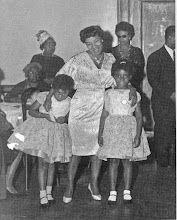
Barbara, MJ, Michele and Mom in the background in sunglasses at a fashion show in the early 60s