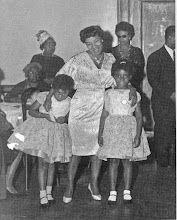
This blog is composed of images and writings related to the life and work of Faith Ringgold, her mother Mme. Willi Posey, and her daughters Michele and Barbara Wallace. There are pages with links to blogs composed of the materials arranged by decades. The blog, itself, will ultimately be composed of materials related to the life of the family in the 90s and the 21st century.

Saturday

Photo Collection: Faith Ringgold's Change 1980s VII


Faith in La Jolla, California.  1987.  Photo by C. Love


More of the performance of Change by Faith Ringgold.  In the foreground, plastic bags filled with water equivalent to 100 pounds of weight. Celebratory dance at the end with Barbara and her two children, Faith in the dress and Teddy in her arms.  1987.


Faith reading from her text in the Change Performance (1987).  Seated in the audience is Lisa Yi, her artist assistant and collaborator then.   Photograph by Clarissa Sligh.  All rights reserved. 


Faith in La Jolla, California at an earlier stage in her weight loss program.  Perhaps 1986.  Photo by Lind Shlecht.  All rights reserved. 

Tuesday

Photo-Essay: Michele on The Terrace in 1978


Terrace09, originally uploaded by olympia2x.  Photograph by Barbara Wallace.  All rights reserved.  Michele Wallace Collection. 


These pictures were taken by my sister Barbara in the summer of 1978 when I was still teaching Journalism at NYU and had just completed the manuscript of Black Macho and The Myth of the Superwoman.

It was a lovely little apartment, a studio with a kitchen, a bathroom and a rather extensive dressing room with shelves and closets with shutters that I particularly liked. All parket floors. I could have remained in the apartment well after having left the employ of NYU but foolishly sublet the apartment to a real clown when I moved to New Haven and he simply walked away from it without paying the rent, without telling anyone. When I discovered what had happened, I had already been evicted. It was all I could do to pay the outstanding rent and achieve financial closure so that debt would not be hanging over my head. I lived at WSquare Village for about 3 years and there were many adventures, many parties, quite a few romances, about which the less said, the better.

Introductory: Facebook, Soul Pictures and Michael Jackson

Interestingly, I don't have any photographs to illustrate anything I am about to say.  Yes, there really is an entire conceptual universe beyond illustration, photography, images in general.

Gotta get some stuff clear about facebook now that I have discovered that I can actually post an entire blog in my notes on facebook. Still struggling with the advanced notes so I won't say anything about that right now.

In any case, Soul Pictures is now imported or exported, which ever the case may be into a note on my facebook, which is then broadcasts to the people whom we call "friends" on facebook. As I guess everybody has realized by now, even me, facebook has nothing to do with what we use to think of as friendship. The flow of it seems to have been largely determined by young people and current concepts of friendship, about which I won't comment since I don't understand it and don't have time to study it. It's their business. We had a chance to experiment with new forms of affiliation when we were young. Now it is their turn. Hopefully they won't make the mess of it that we baby boomers made of it.  Affiliation, that is.

But that isn't my topic. For me facebook has nothing to do with friendship. Not really sure what friendship is anymore, only that I don't have any friends in the true sense in which I regarded friends. There are many reasons, not sure about all of them, but I am content that this is as it should be for the time being. I don't have friends because I am otherwise occupied in deep work of the soul which takes up all of my time at the moment. I don't feel like I am missing anything. I don't feel like this is the way it will always be but people need hibernations, hiatuses, sabbaticals, vacations, retreats, whatever you want to call them. But this is not a vacation either. Rather this time and everything I am doing in this time is the chance I have been waiting for, planning for, dreaming about for at least twenty years, maybe more.

That's how long it has been since I have had a time of months long in which all I had to do was write and plan to write, research and plan research, and string it all together. I had such time after I wrote my first book Black Macho with the royalties I got from that book but I didn't yet have the skills or the research abilities or the spirit to know what to do with it. Instead I went back to school and I read and I studied which is pretty much what I have done with every other sabbatical or free moment since then. My last sabbatical since I have been a tenured professor I spent doing my Ph.D. in Cinema Studies at NYU, and believe me that was no vacation. I tried to make it as much about writing as I could but being a student just isn't the same thing.

So you see I am writing Soul Pictures as my sabbatical project. I am organizing the materials or that project via the resources of this blog, coordinated with several other blogs I use to coordinate and organize subsidiary materials to Soul Pictures, one on the culture of blues people which is how I refer to African American history and culture, the music of blues people, which is what it is all about, another blog on personal, emotional stuff I don't plan to pursue in the book but which might get in the way if I didn't have a chance to get it off my chest. There's a blog on African American photography and visual culture, which bears a symbiotic relationship to Soul Pictures. That is it is my study of the accomplishments of others in African American visual culture and American visual culture that has prompted my reading of the visual culture of the women and men in my family.

As for facebook, it has gotten rolled into the project because there were two reasons I thought blogging might be a good way to organize materials for facebook. First, because at the same time you are formulating your ideas, you can also be helping to formulate the audience for your ideas. Because I don't have an audience. Or rather if I have an audience, it is not an organized, identifiable niche audience. There isn't any way that I know of to make a living serving or speaking to that audience and that has to change. Otherwise the discourse, the exchanges, the languages, whatever you want to call it, will die out from lack of reinforcement. So blogging is audience development as well as tangible progress and work that you can track in its accumulation. It's also like a scrapbook in that you can actually show it to people, even to perspective publishers should the occasion arise. Facebook can conceivably fulfill the same purpose if you handle it right, which in my view it is possible to do best in the form of the notes application, which seem to have no length limits or time limits.

As for audience development, the opportunity of facebook seems crucial. Your first thought is well how many people are you actually talking to, how many pay attention, etcetera and so forth. But what could be more useful to the development of an audience tailor made for your material than to concentrate on a carefully selected group of people whom you already know and who have expressed some interest in accessing your daily, weekly or monthly development?

So this is the deal. Sorry if you want to be friends but for me facebook has nothing to do with friendship. I am 57 years old. I don't know how to make friends with anybody on a machine. More than likely all the friends I am ever really going to have, I already have. In any case, the development of new ones is temporarily suspended. This is about the work.  And while the work is for career purposes, it is first and foremost the labor of the soul, the stuff I recognize I need to do before I go one step further into the future.  If I were religious, I would say it is between me and God or me and my maker, or something like that, but I am not religious, so I will just say it is between me and me, or me and whatever there is beyond me and you.  It is between me and the planet.  Me and the vibrations of the universe.  Because I think vibrations might be real, which is where the music comes into it.

These remarks I address in particular to my nieces, my sister, my Mom and Dad, and to my friends. It's about the work right now. Whatever you see me doing, that's what it's about.  In the beginning, I conceived dance, drumming and music as the entertainment aspect of the whole thing-- but I have known for some time now that entertainment doesn't interest me right now.  For awhile I thought well maybe it is the physical exercise but as I progress, I realize I can't take a step without this Blues People culture because it was the culture that produced my grandmother, Momma Jones, the patron saint of this project.  

Every moment I ever spent with her was spent hip  deep in the Blues tradition.  I am realizing now that the experiences Mom had with her going to see shows and listening to music in the 30s and the 40s in Harlem was much like the experiences I had with her as a child except that I was her companion of the 50s and 60s.  She was constantly taking me to a church, or a show, or a concert, constantly playing music, dancing with me or for me, and encouraging me to dance.  Her first ambition was to be a dancer but she wasn't allowed to continue to pursue it by her family.  She pursued it until she got married though.  She talks about winning every dance contest she ever entered with Mr. Morrison, her second husband, and performing in shows at the Lafayette Theatre or wherever she could get on.  MJ's youth was in the 20s and from her pictures you can see that she was a real flapper, body and soul.   We think that when she died that Mr. Morrison took the scrapbook with her dance pictures in it, since he probably took a lot of those pictures and was probably also in those pictures.   I am going to try to find his family and see if these pictures survived somewhere.

When I was quite small, before I entered grade school, and we were still living with MJ on Edgecombe Avenue, she use to take me to church at the children's church in the basement of the Convent Avenue Church on the corner of 145th Street and Convent Avenue.  In the Baptist Church, Baptism is reserved primarily for adults.  In the service, the congregation is encouraged with music and prayer at a certain point in the service to come to Christ, that is to come to the front of the church and accept Jesus.  Well, I watched this ritual every Sunday in the children's church with fascination, wondering what happened to the people who came forward.  I resolved that I would find out by going forward myself.  I had noticed that only adults did so (many young adults attended church downstairs with we children), which made it all the more interesting I guess.  

But once I had done this, the result was some consternation, which everybody was careful to keep from me.  The dilemma: I was 5 years old, surely too young to understand what I was doing, what coming to the church and being baptised really meant.  But with MJ's support it was decided that if I had come forward it was because I had been called, and to interfere with that would be to get in the way of something that was little understood by the adults who ran our lives.  My grandmother told me shortly before she died that I was questioned by the minister to test my comprehension of the process and apparently I passed the test.  This was the last conversation I ever had with MJ and she told me how proud she had been of me when I had chosen to be baptised. 

What happened then was one of the fondest, most exciting series of memories of my life (and I don't know why it is I remember all of this stuff).  A special white garment was made for me and I was prepared in various ways for the baptism ceremony which would take place in the big adult church upstairs.  That day, my grandmother accompanied me into the changing room with other adult women (or maybe Mom did or maybe they both did--it was a big deal!).  The thing I remember was how shocked I was to see an entirely naked female body for the first time and to learn that adult women had hair down below because needless to say, I had none.  Then I can remember I was briefed on the baptism itself, getting dunked and everything.  I was handed to the minister who was standing in a pool of water and then he lowered me into the water, backwards which was a  bit of a shock, three times I think.  I'll never forget it.  I was well and truly baptised not only into life but into the Blues People culture.  I have always felt like I was somebody special from that day to this.

Maybe five or so years later, I was baptised once again, this time into the Lutheran church, confirmed perhaps, where they sprinkle a few drops of water on you and call it a baptism.  We attended a Lutheran school.  During the week we were Lutherans, on weekends we were Baptists.  God I loved religion when I was a kid.  I always say I had enough of it growing up to last me a lifetime.  I love it all but I loved most the music.  

With that proviso, I turn now to Michael Jackson and the show I am about to do with Joyce Jones on WBAI-FM (99.5), Women and The Blues Part II, Suga in My Bowl, next Monday from 9 to 11 p.m. Mostly there will be music. Joyce and I will talk for a half hour one half hour into the show. If it goes well, we'll talk again for another half hour. Otherwise, there will be music, which she and I have chosen as a discussion between us. Music that we care about. This last Sunday we spoke about the fact that both of us wanted to insert the voice of one male among the women. The voice of Michael Jackson, for a lot of reasons, which I am sure we are both trying to formulate in words. In the meanwhile, let me direct your attention to one work of Michael's that I have been listening to since his death.

It is a piece called "They Don't Really Care About Us" that he did in 1991. And it is worth a listen I think. The video is good too. In the work of this period of History, Book II, Jackson gets a nice little soulful groove going with large groups of people singing, dancing, playing instruments. It is very Baptist Gospel Church Choir in its inflection and mood, which I find irresistible. Ironically, I also find it very bluesy.

And I am thinking this. Words I could live with out. Or let's just say I could live a long time with anybody speaking directly to me. Sometimes I crave that particular kind of silence. But music I would die without. And there is nothing better than being in the presence of a large group of people singing, dancing and playing instruments. Failing being there live, it is not a bad thing to listen to on a recording or watch on a video. I've been around large groups of people singing and dancing all my life. It has been an essential aspect of the culture that made me, Soul Pictures, Blues People, Blues Music, all of that. I have been up to my neck in it all my life and I try to keep it that way as much as possible.

So let's see how this reads. I've probably left some stuff out. But I can start with this. All I wanna say is they don't really care about us. You ain't never lied about that!

Monday

Photo Essay: Faith's 6th Grade Graduation in 1942


Faith Ringgold, then Faith Jones, graduated from P.S. I86 then located on 145th Street between Amsterdam and Broadway in 1942. This is her class picture. She was 11 years old (her birthday in October). The principal she can recall was Dr. Bernath. Her best friend was Catherine English. Catherine and she went through Elementary, Junior High and High School together. Faith describes her teachers as mostly Irish Catholic, not racially progressive but excellent teachers nonetheless. The students, she says, were immigrants from China, Puerto Rico and Germany.

Their graduation ceremony in 1942 was suspended for fear that there might be an air raid during the ceremonies. WWII was still in progress.

Faith reports that the classroom instruction was often racist in its interpretation of history and culture but Faith had a mother (Willi Posey, Momma Jones) who was vigilante and attentive who accompanied her to school every day and who often interacted with her teachers in order to straighten out various misconceptions of African American history. She also says that all the teachers adored her mother who had a winning personality.

Although the student population was racially integrated, the neighborhoods they lived in were not. On the other hand, the neighborhoods were also smaller and probably all in direct proximity to the school. Faith says she never had any white friends until she went to college at the City College of New York which was right there in the same neighborhood.

Faith also describes the WPA Murals that decorated the auditorium. We all wonder what happened to them. P.S. 186 has stood vacant and in decrepit condition for decades now. Owned by the Convent Avenue Baptist Church, something prevents this magnificent building from participating in the architectural renaissance going on in the rest of Harlem, not sure what. Partly because of her experience of teaching in the public schools, Faith decided to never send my sister and I to public schools. The City College of New York was the first public school I ever attended. I began classes there in 1970 after a first semester spent at Howard University in Washington, D.C.

Sunday

Photo Essay: Halloween at 409 Edgecombe Avenue 1980s


"Time Out" by Faith Ringgold.  All rights reserved.  Copyright Faith Ringgold.  Collection of Michele Wallace

How old is Teddy in this picture?  Perhaps three.  Dad, who was then about 59, took his second granddaughter Teddy to a Halloween party in the lobby of 409 Edgecombe where he had grown up and his Mom was still living.  So my guess is this is either 1988 or 1989.  It has always been one of my favorite pictures of the two of them.  Mother Faith accompanied them and took this picture.  

In fact, I wanted to use this picture on the cover of my most recent book Dark Designs but it was ruled out immediately for reasons that completely escaped me since nothing was ever articulated but over the years I have formed an opinion of what was being seen here that others found objectionable and inappropriate, but that I found highly seductive and irresistible.  Of course, it has everything to do with race, and the perception of what is expected of a person in terms of conforming to expectations of race, especially in terms of skin color. 

Not the least of which has me thinking about these matters lately has been the controversy over Michael Jackson's recent death and the difficulty people seemed to have with accepting him as he was or as he had become.  Also, the ongoing discussion of who and what our President is, mostly generated by the fact that he is of biracial birth and that his father was African and Muslim.  Clearly it makes people crazy.  It's his blessing but it is unsettling for some.  Not me but for some.  Is he or was he or will he ever be a real black man?  If not, what is he?  Answer: he is the President of the United States but that doesn't satisfy some. 

I cannot remember a time when I didn't know Burdette Ringgold.  We called him Daddy long before mother and he were married.  Not sure why but he was a close friend of my real father to begin with.  He was also good friends with my grandmother Momma Jones.  He knew Earl's mother as well, Momma T.  They were all Edgecombe people, as was my mother.  Almost a tribe they were.  He use to take us out a lot to the zoo, Coney Island, the circus (which he adored), walk us to death, babysit with us, help my Mom out, etcetera, which was part of the thing that made us all feel that he would make a good permanent addition to the family.  

But at a certain point, not sure what our age was, Barbara and I began not only to notice that he could be mistaken for white, we also began to ask him point blank in the manner that children will, "Are you white?"  I would imagine that this would have been soon after we had begun to notice that there were different races, which I can recall was not obvious to me from the very beginning.  But I can remember us asking him again and again, determined to get an answer, and he never answered.  

We could see that he was flustered and disturbed by the question but he brushed it off pleasantly and tried to distract us.  We discussed it among ourselves, what to make of it and could come to no satisfactory conclusion except to ask him again.  But he mentioned it to Mom and I don't recall how she got us to stop but I know she told us he was black, or rather Negro or colored as we use to say in those days (this is in the late 50s) and we finally lost interest in the question. 

 Before we get too deep into this, you need to know that both of his parents were racially black.  Obviously of racially mixed descent but all sorts of racial mixtures are by no means unusual in the Afro-American community mainly because we are descendants of slaves and the slavemasters had their choice of the women in the quarters, just generally.  The outcome was slaves who were biracial.  Sometimes the master freed such slaves or adopted them.  But obviously this was unusual as we can see from the variety of shades among Afro-Americans who were around when slavery finally ended in the first half of the 1860s.  

So the thing is this.  While this picture encapsulates my fondest memories of my family, to others the picture is both inconceivable and unacceptable.  It matters if you are black or white and looking white or not looking black enough if you are actually black is not one of the options.  So I am writing this as a present to Teddy who is the little girl in this picture.  This is your birthday present Teddy, something educational, constructive, character building, not pleasure seeking in the childlike sense because you are 24 years old now and I would like it very much if you were to point your nose in the direction of growing up.  If you were to really work at it.  Part of it is to understand your unusual legacy, having a grandmother who could take such a picture and a grandfather whose greatest joy was to take you to such a party.  In this picture you are having a time out because you had been having a little too much fun with those balloons.  I guess we should call this picture, Time Out.  

I love it.  We keep it in a silver frame that mother received as an award from Ms. Magazine in 1983 long before you were born.  


Saturday

Photo-Essay: More with the Cake 1980s


More with the Cake, originally uploaded by olympia2x. Photo by Corinne Simpson.  All rights reserved.  Collection of Michele Wallace.

Marrying Gene was complicated. He ended up pretty much fully occupying the social aspect of my life from the time I first met him, which was in 1985 in California through 1999 when we began to live apart. We didn't actually get divorced until maybe 3 years after that so that's a total of about 18 years right plunk in the middle of my adult life. My best years, as some might put it.

Hearing him say that he wanted a divorce was one of the worse moments of my life. It came as a complete shock to me. I immediately asked if he would do a double session with my therapist. My hope was that it would turn into couples therapy and a healing of our marriage, that she might talk him into staying with me and giving it another try. But as I would subsequently realize, he had already given it several tries and I had not been able to make the compromises he needed me to make to make it seem worth his while.

I could not see a bit of that then, even after the double session with my therapist but I can see it much more clearly now. Maybe I am wrong but I think I was an impossible wife to have for a man like Gene (traditional, Southern, proud, gregarious and fun). Also, the situation we were in as a married couple, particular vis a vis my fairly frequent bouts of illness (lupus) were bound to run through the marriage and make it untenable in a decade or so.

Most importantly, I had manipulated him into marrying him. I say this with no shame at all. I thought this was what a woman was supposed to do. No man in his right mind would ever get married I thought so you had to prod him a little. We had been a couple for five years, during most of which we were living apart.  For the first two, I was living in Norman, Oklahoma teaching at the University of Oklahoma and he was doing his MFA in Theatre at UCSD in San Diego.  That was from 1985 through 1987.  Then in the winter of 87, I returned to UCSD to do a second stint as Visiting Professor in English in Sherley Anne William's position while Gene completed his degree and went for a season to the Milwaukee Repertory Theatre.  Meanwhile, I had procured a post as an Assistant Professor in Women's Studies at SUNY Buffalo.  We decided that he would next move back to New York where he had a small apartment.  So then the two of us drove my car across the entire country from San Diego to New York City, with a stop in Norman, Oklahoma to say goodbye to everybody there and pick up my things in storage.
Another two years passed during which I taught at SUNY Buffalo, finished my M.A. with Professor at CCNY, and he did the actor thing in New York.  We were together either in Buffalo or New York as often as possible.  Then in the fall of 1989, I had landed the job at CCNY, with the first year at the Center for Worker Education running the Life Experience Program.  We got an apartment together in Brooklyn, and I've been at CCNY ever since.
When we married, I was the breadwinner. He was a freelance actor, caterer, a little of this and a little of that and very happy about it. He had learned how to be an actor in New York and live on very little and he had just finished his MFA in Acting at UCSD. His goal I think was to have a woman with full employment who had benefits and insurance while he pursued the more creative task of cobbling together a reputation and a living in the theatre, television and/or film.

Except the work was extremely unsteady and I simply was not convinced that acting was the right career for him. Arrogant I know but that was me. I didn't do boundaries well at all.  I pushed him and prodded him into teaching as an adjunct at CCNY and then pursuing a full time position as a professor. We masterminded the counter-job offers at SUNY Buffalo. If CCNY didn't hire him, they would lose me to SUNY Buffalo. I actually wanted to go to Buffalo. I hate New York but as an actor, New York was always the preference for him for obvious reasons.

As I see it now, once Gene had the full time job at CCNY, he didn't need me the way he had up until then. Added to this he wanted to buy a little house somewhere, a fixer-upper. But I knew I was not the fixer-upper type. I have very sensitive skin and I can't live in any kind of dust or filfth. Gene was a procrastinator. A broken metal bed frame laid by the side of our bed waiting for him to fix it until the day I left. When the housekeeper came, she would have to dust it.  It was a permanent part of the furniture. Which made me so mad I thought the top of my head was going to blow off? Just let me throw that crap away. But no. Mr. Green Jeans never wanted to throw anything away. These are the kinds of things you want to check before you marry somebody.
Also, he wanted to have a baby and as it turned out given that I was already in my late 30s by then, I couldn't get pregnant.  With the lupus, which I didn't fully realize I had until 1993, it might have been a disaster.  Then in 1994, I went back to graduate school, this time in pursuit of a Ph.D.  I was not then aware of the impact advanced degrees have on relationships and libido.  It's disastrous.  Soon he was also pursuing a Ph.D. but there was never any doubt I was going to get there first.
In any case, once Gene had the job and the pension and the paycheck, my behavior issues did not get better, they got worse.  School is stressful.  The discipline concentrated in one area isn't likely to lend itself to greater discipline in other areas.  First, I like to shop and I was controlling the bank accounts because he would never pay bills on time. I needed my bills paid on time so I could shop. He didn't think I ever needed to buy anything new, so I lied and hid new items.

Everything we ever bought I had to cajole and manipulate him into allowing it in the house. I often thought about how if it had been left up to him we would have had a bed and a chair and no other furniture because we couldn't afford it. He was right of course but I was somebody who believed in using credit, unwisely but with conviction.

Moreover, in a social context I was unpredictable, intrusive, nosy and often downright rude to his friends and family. I didn't mean any harm, most of it was good natured and in fun but he didn't like it.  In my family we are more confrontational and humorous and loud.  I realized this the day we met with my therapist when he complained about incident after incident in which something confrontational had ocurred with his friends or his family. Something or other he had begged me not to do or to say, which I had done or said anyway. As far as I was concerned, I had won every one of those debates but it seemed the point with the friends and family of the partner was not winning the debate but avoiding the debate to begin with. That day the scales began to be lifted from my eyes and they have continued to fall away to this day. I still don't like what I see but I know that that was, is me and that I probably can't change. I still find myself so amusing.   And I am thinking, more often than not, husbands just get in the way.  At 57 I feel comfortable admitting that.  God bless those who are willing to work with the brothers.  I gave it 18 years of my life.

So Gene was a darling, remains a darling. He stood by my side in sickness and health and we had a fabulous time most of the time. He also got me through my craziness for which I will always be grateful but I know I wore him out.  I kind of feel sorry for whoever follows me because I think I got the best of him. Not sure where he is now or who he is with but God bless both of them.

Wednesday

Divorce Follows Marriage Sometimes 1990s


Photograph by Eugene Nesmith.  All rights reserved.  Collection of Michele Wallace

This is sometime after 1993, after I had been diagnosed with lupus.  Totally covered in black and with a sun hat to protect me from the Florida sun at my mother-in-law's house in Naples, Florida.  I am not sure what year this is but we're getting close to the end of our union (1999). I can't say this little dance helped but I think I look marvelous, and I know I was having a good time.  Oh well. 

Photo-Essay: When I Got Married--1989


Photograph by Corinne Jennings. All rights reserved.  Collection of Michele Wallace.

It was December 1989. And almost everything about that wedding was a complete surprise to me, never having gotten married before. As soon as it began, I regretted that I hadn't held out for something much bigger but then my groom was quite skiddish. I had to reel him in when I could. My only advice is this: never marry a man who doesn't want to get married to you, no matter how much you think you love him. When one person isn't doing what he or she wants to do, it gets thin real quick. Actually, I have lots more advice but I will save that for another time.

In this picture from left to right is Dad (Burdette Ringgold), Mom (Faith Ringgold), Michele Wallace the bride, Gene Nesmith the groom, and Virginia Nesmith, the mother of the groom. Picture taken by Corinne Jennings.

Sunday

Photo Essay: Black Macho and The Myth of The Superwoman 1970s


The inside first page of the cover story in Ms. January of 1979.  The double excerpt from BLACK MACHO AND THE MYTH OF THE SUPERWOMAN (The Dial Press 1979).


The picture by the celebrated and brilliant black photographer Anthony Barboza.  I have always wondered why he never exhibits this picture.  I guess he is ashamed of it.  But it is one of my prized possessions.  I got the people at Ms. to give me the print they used and one  day I gotta get Tony to sign it or whatever photographers do in a case like that.  The only stupid thing is that it was 11 x 14 which seemed to me awkward.  So what did homey do?  She cut maybe an inch or two off the bottom.  Stupidly, I think they call it these days. 


    In the summer of 1978, my first book BLACK MACHO AND THE MYTH OF THE SUPERWOMAN was at the publisher, receiving the final touches from my editor Joyce Johnson at The Dial Press and n search of a marketing strategy among the sales force. Meanwhile, MS MAGAZINE had purchased the first serial rights for a double excerpt that would (if I played my cards right and my hair, as it turned out) be featured on the cover of the magazine in January of 1979.

The way the game played out from then on until the publication was largely determined by two opposing forces, as I now see it 30 years later. On one side were the feminists at Ms. Magazine, and on the other were the anti-feminists at the Dial Press. Ms. Magazine was then run by an editorial collective which included most significantly for my cover, Gloria Steinem, Alice Walker, Robin Morgan and Mary Thom. That summer or perhaps a bit earlier Ms. Magazine hired Susan McHenry, fresh from a position with the editorial staff at Harvard University Press. She was young, about a year older than me (I was 26) and most importantly she was black. At the time, MS had no high level black editorial staff who was fully participant. Alice was crucial editorially for me and lots of other people but she was first and last a writer who was in the office maybe a day or two and always held herself far above anything ugly or pedestrian. 

Unfortunately, I wasn't quite wise enough to follow her judicious careful lead. In any case, Susan worked closely with me as I recall (and became from that day to this a close personal friend) along with in particular my old friend and associate Robin Morgan (but whom I haven't seen or spoken with in years).

Gloria also wasn't involved on a day-to-day level but I had lunch with her and Alice at least twice during this period. Moreover, they both generously participated in an advance public reading to the feminist community at The Feministfw Salon, which was then located at Wesbeth. Gloria was there as was every other significant luminary on the then New York Feminist scene. My good fortune was that my sister Barbara Wallace took meticulous pictures of the gathering and as such I have a perfect visual record of the whole event. Most of the people there I didn't know at the time. Over the years I've met them all.

Alice and Robin Morgan introduced me and I read excerpts from my book. At the time, Alice wrote me several deeply encouraging handwritten letters of support (which I still have) in which she did, however, give me some crucial advice about last minute changes I should seek in the final draft of the book.  As I recall the two particulars were to seek more knowledge of the history of struggle in African American communities via Vincent Harding in particular.  The other piece of advice was to write more about black women writers, in particular such figures as Pauline Hopkins and Frances Harper who were virtually unknown.  This advice was not followed although it has shaped my career as a writer, a feminist and intellectual ever since. 


The celebrated cover from the book which shaped my 80s and indeed all the rest of my life until this day.  

Not to excuse myself at all from responsibility for what was and was not in the book but the power struggle between these two constituent elements of feminists (white actually) was a determining factor in the kind of reception I got. The other side of the equation was the anti-feminists at The Dial Press, in particular one brilliant anti-feminist named Joyce Johnson who was my editor and who all but breastfed me through every stage of the writing and the completion of the book for publication. I call her an anti-feminist not out of any malice but I don't know how else to put it. She and the others opposed the use of the word feminist in connection with the book, on the publicity materials, on the book jacket, and in every aspect of the packaging or promotion of the book. Feminism they said would kill the book because feminism was finished and done with. 

There weren't going to be any more important feminist books so there wasn't any point in dooming my project to abject obscurity in this manner. The feminist movement was over, not that it didn't have some merits but the represenatives were clueless about everything that mattered. Women would find another way to pursue their rights, if at all. 

These white women seemed to be as convinced they were already liberated as a lot of black women I knew. Of course everything black, black women, black feminism, black whatever was sure death to a book because as everyone in publishing knew, black people did not read and they did not buy books. I was told this by one and all repeatedly.

The average reader and buyer of books was the little old lady from Pasadena, I think it was.. In any case, she was white. And to show you what kind of shape we were in in 1979, nobody really could prove otherwise. Blackness had come and gone with the popularity of black cultural nationalism, just as feminism had come and gone. Of course they were right about feminism, which I still don't understand. 

Blackness they seriously got that one wrong. And indeed my book would prove it. I probably had the largest black reading audience anyone had ever had for a first nonfiction book by an "unknown." Nevermind for a "black feminist." I was one of the people who broke that wall. I went out on one tour for the little old ladies in Pasadena. Then I went on another one that stretched out for six months to every major black reading market.  Nobody in the publishing industry seemed to know that there was even such a thing but they continued to clamour for me. The only bestseller list I ever really had traction on was the Washington Post Bestseller List, guess why? It got so I felt like I was practically living in D.C. I went there so much.  I often appeared at black venues generally. I almost never said no so that was no problem. 

I had quit my job teaching journalism at New York University at the end of the spring 1978 semester.  I had some vague idea that I could make it as a freelancer.  My Mom's lecture agent, Lordly and Dame, who was then handling her, black feminist Flo Kennedy and a hot set of black luminaries, got me lecture dates which from that time provided at least half of my income until I began teaching full time at the University of California at San Diego as a Visiting Lecturer in 1984 as companion to my Mom who began her stint as Professor of Art there at the same time. But I am getting ahead of myself.

From the summer of 1978 through the spring of 1984, I would go all the way from alpha to omega.

Everything after that up until the initial release of the book was influenced by this fierce struggle, which at 27 and black, I felt powerless to address or to contain. Later on there got to be a third component in the struggle (my Mom) and almost immediately after that a fourth (the men I was dating) but that's completely in Act 2.


This is a polaroid from a story that a black hair magazine did on my hair, which was at the time pretty unique (I think it was just me in Bo Derek--I am kidding, no e-mails!).  My mother designed this hairstyle for me and the fixtures that made it possible.  These were my braids wrapped in that waxy black cord that African women use to make their twists with a bead knotted at each end.  I taught my favorite hairdresser who came to my house to do it.  I felt safest when my hair was like this but none of the publicity people of either camp like it.  Take it out!  Take it out!  The other thing I liked to do, which they hated was to wear a scarf over it.  Hate it!  I wore a scarf on the Today Show.  Okay so I was also chewing gum.  So shoot me.  I was interviewed by Tom Brokaw.  I bought my first tv so that I could watch it and my other television appearances.  It was my first book promo and it was crazy but I am getting ahead of myself. 

Anyhow I've kept these pictures all these years.  I love these polaroids.  Photographers always made them on shoots so I started asking for them because they usually threw them away.


This polaroid is from the Essence shoot.  There was a major story in Essence written by Marcia Gillespie who was then editor-in-chief.  Little did I suspect that she was going to tear me a new one.  She's somebody I had lunch with all summer before the book came out too.  (At least she didn't drop me after it was over like some.  Dropped me like a hot rock, like my sister likes to say).  But the pictures were great.  For some reason they shot me both in black and white and color and in two different dresses.  I forgot to say, Essence liked the braids.  In fact, the black folk liked the braids.  Thank god. Of course, I had my own make-up person who was also then doing Natalie Cole's make-up.  That was the most fun shoot I ever did.  We balled (as Aunt Barbara would say), at that shoot.  Was the photographer black or white?  Gotta check that.  Essence always used the best unlike our friends at Ms, who could be uneven.  

    Meanwhile here comes this excerpt, which I actually think is excellent now that I am re-reading it for the first time in 30 years, I mean really reading it. It's tight, it is to the point and I pretty much agree with everything in it. They shaved many a rough spot from the actual book, including a diatribe or two about this and that which I sincerely wish I had never written. Either that, or that somebody had prevented it from being included in the final book, including the crazy quote on the cover of the book with the statement about how black man and women hated each other. Yes I wrote it, but that damn cover design and everything on it was the nightmare vision of the cover depart, the sales force and publicity. More about the quote later.

But the cover of Ms. with the cover lines about the book that would shape the 80s, as well as the quotes from Robin Morgan, Alice Walker, and Alice Walker which graced the back of the book were Ms.'s brilliant invention all alone. Joyce and the others at Dial did what they did to slow it down. The first blurb that came in the door was from somebody I didn't yet know but who would become a pretty good friend, Ishmael Reed. He loved the book for all sorts of reasons including the fact that he was then raising a real homegirl daughter who he was trying to keep on the straight and narrow. He wrote the blurb from that emotional place and with that inimitable energy that is Ishmael Reed's alone. It came in the door first and The Dial Press wanted to go with it alone, a one shot blast covering the inside leaves, the back of the book, everything. He was Joyce's kind of writer and Joyce had been editor to Amiri Baraka's HOME ( collection of essays), Eldridge Cleaver's SOUL ON ICE and Harold Cruse's CRISIS OF THE NEGRO INTELLECTUAL. We spent many an afternoon when I was blocked with her telling me the stories about working with these guys, in particular Cruse whose book fascinated me then.

She was sick and tired of their crap about women and so was I so when I wrote BLACK MACHO first, which took me maybe a month or two (it just poured out) to write, she took one look at it and announced that instead of the 10 chapter book on black women I had planned, this essay would be the key and title essay with perhaps one other companion essay on black women. I called it The Myth of the Superwoman, and it took me the balance of two years to finish it. Rather Joyce finished it for me because she kept insisting that it wasn't finished and that it needed more work in this manner that editors will always do. More work, more work, more work. She wouldn't write a single word. This was her way of showing her respect for my writing abilities she said. In the end, I cried so hard about not being able to go on one day that she did a massive edit in particular on the second part of Myth of a Superwoman, which was one of the historical sections.

Joyce oversaw and supervised the battle against the citation of my sources in either a bibliography, footnotes or even an index. I still don't know whether they were just cheap or whether they were trying to destroy the rest of my life on purpose. But in any case, this was as it would be. But she would not have her way on the characterization of me a black feminist on either the publicity material or on the book jacket. The media did the rest.

Final story, although there is a million others. when we shot the cover for Ms., it was understood that I had only a rat's chance of ever seeing the color. I was nobody, black women were rarely featured on magazine covers then and my book had no news hook so it likely wasn't going to happen unless I followed every instruction and did exactly as I was told. At the shoot, instruction one. Take those braids out of your hair. They will ruin the cover. This the hairdresser did. But I didn't know what to do with my hair under such circumstances so you see instead that unruly hair style I had where my hair is being I am not sure what. If it looks like my face is covered with makeup, it is, as the makeup artist applied layer after layer of a various assortment of foundations trying, I can see now, to somehow brighten my hopelessly olive blackness. People say this is a beautiful picture but I can't see it. I hated it.

But there it was in December of 1979 on every newstand in New York with that inflammatory announcement that it would be the book to shape the 80s. I am not sure I will ever live that down but then I didn't say it. The person who did say it, Gloria Steinem, found a way to publically withdraw it by blurbing my Mom's autobiography, WE FLEW OVER THE BRIDGE with Little Brown in 1990.

And thus begun the craziest most exciting time of my life, the year of 1979. At the time, I had no idea whether it was going to be like that from then on or how whether it was going to be different, less more or what.


This is one of a series of pictures of me taken by the photographer for Emerge in January of 1979 in connection with a piece on the book written by Paula Giddings.  She tore me a new one too and then went on and wrote the definitive book on black feminism, WHEN AND WHERE I ENTER.  Still the classic I think.  Don't remember the name of the photographer but he was black and he said let's just go over the park (Washington Square Park--I lived in the village then) and shoot some stuff for the fun of it. It was cold as you know what and my hair was blowing.  I am thinking, this guy has got issues but let's just get through this.  It took about 15 minutes for him to shoot about a 10o pictures, the prints of which he gave me and which I still have.   Fun and this is me with normal make-up then, which was no make-up, or just mascara, eyeliner and lipstick.


Mom and Dad at Mom's surprise birthday party at 345 in Harlem.  October 8th, 1979, in the thick of it.  


Thursday

Photo-Essay: MJ, Mr. Morrison and Mom at the Lenox Terrace 1970s


MJ with her husband, originally uploaded by olympia2x.
This picture taken by my sister Barbara in 1977 during our usual family gatherings for the holidays captures very much what my life was before 1981 when my grandmother died. She served as an anchor for the kind of life I had and somehow imagined I would always have. From 1979 when Black Macho was published until 1981 when she finally died, that world shattered all to pieces never to assume its former shape again. The absense of just a few people can alter your life forever. This is the thing one must learn and know about death, that it is constantly altering the shape and reality of the world we live in. One must constantly leave a place for it, be flexible about its constant arrivals. I know it sounds a little miserable but actually it isn't. 
It is just real.

Wednesday

Photo Collection: Excerpt from my Ms Cover of 1979


Photo by Anthony Barboza, originally uploaded by olympia2x.
The excerpt is a thing of beauty to read.  Perfect in every respect except that it softens a number of the rougher edges, in particular the critique of white women.  The other edge it softened, which was much appreciated, was its critique of various black writers including Nikki Giovanni and Angela Davis.  I love both of these ladies, always did in truth.  They are  fierce. The picture is heaven although  I know it wasn't heaven for Mom.  She felt like she got the shaft.  I KNOW I did.

Friday

Photo Essay: Aunt Helen Died at 51 in 1962


This is a picture of the side of the big house at Camp Craigmeade and this lovely lady is one of the campers, not me but somebody who didn't mind having her picture taken. I don't know why we have her picture or who she might be but suffice it to say that when I was at Camp Craigmeade I knew who everybody was.

Just today realized that the summer Aunt Helen died at camp was in 1962. Barbara and I went to Camp Craigmeade for the last time in 1962, also the first summer of Faith and Burdette's marriage. Didn't know it would be the last year but it makes sense now that without Aunt Helen's determination to make it work, the camp could not survive. There were many kids there who went to the school she ran. I was ten and Barbara was nine. Yet another thing was about to change forever subsequent to our new life with Dad (Burdette).

Her name was Helen McIntosh Meade, as I have learned from her obituary in the New York Times (August 15, 1962) as unearthed by my sister Barbara today. The headline reads "Mrs. N.T. Meade, 51, Led Private School." She was the owner of Camp Craigmeade, which was described as "an interracial camp" in Roxbury, New York. It says she died of a heart attack on a Saturday, although nothing about her illness while at camp. The biggest surprise was that she was only 51 when she died when I thought her to be much older. She was the wife of Nathaniel T. Meade, who was also a founder of their school the Little Brown School House in 1934 in the Bronx at 1177 Hoe Avenue. I also thought the other two Aunties, who were perhaps relatives of hers, were much older too but they too were probably at most in their early 60s. Afterall, the hygenic conditions at the camp--no running water, no hot water, no heat, no plumbing to speak of and outhouses, no paved roads--were certainly challenging for anybody not ambulatory and strong.

I had always suspected that Aunt Helen was highly educated and progressive and this is confirmed by the obituary, something about the way she wore her hair, something about the way she talked that I could already see even though I was only ten. She had graduated from New York Teachers Training College in New York in New York in 1931, and later received her B.S. and M.A. degrees from Teacher's College at Columbia University. After teaching briefly in the public school system, she founded her own school and operated summer camps for many years. She was national recording secretary of the National Council of Negro Women and the President of its Manhattan Chapter. Meade was also a member of the National Association for the Advancement of Colored People. She was survived by her husband, Nathaniel, her stepmother and her brother Eugene E. McIntosh, Jr. I am perfectly thrilled by this discovery.

She gave me one natural fit about my bedwetting which must have been particularly bad in that last year, I am not sure why.  

Easter Outfit 1967


Easter 1967, originally uploaded by olympia2x.

By this time in my life, I was 14, extremely shy and self-conscious. Lots of things had happened to move me in that direction. Probably the most important was that I had gone from being an ugly duckling to a beautiful swan, thanks to the invention of the hydro-cortisone creams pioneered by my personal dermatologist Dr. Norman Orentriech, a really famous doctor from then to now, which meant the males of the species were noticing for the first time in a big way.

As part of participating in the lab work for the new product, I had to collect my urine all day in bottles in my locker and take it to the doctor's office downtown. I lived in mortification that somebody would catch me with one of these bottles. I am sure it built space between myself and my fellow students. The process was over in the course of a month as I recall, or maybe from time to time I had to collect urine. Who can remember. I just know I lived in my own world in my thoughts, which I had no idea how to express in words. I was in Tenth Grade.

That summer Barbara and I would go to Europe with MJ while mother stayed home in New York and put the finishing touches on her American People Series. In this picture we are with MJ visiting with Uncle Cardoza and his wife Esther in Hempstead.

I remember these stockings and that coat and that i was wearing a garter belt to hold up the rather shiny, light colored stockings. The coat was creme colored and made my MJ as were the shoes, which I adored. The mini-skirt was in. I wore it at all times unless I was wearing bell bottoms, which were also in.

Photo Collection: Marion, My Counselor 1960s


MarionCamp, originally uploaded by olympia2x.
This lovely lady was my first counselor at camp and I adored her. She was sweet, gentle and pretty.

Photo-Essay: Aunt Helen 1960s


Aunt Helen, originally uploaded by olympia2x.
This is Aunt Helen in the white shorts (always wore white shorts) with the other two aunties who ran the camp. They did the cooking. Back in the 50s. We first went to Camp Craigmeade, an all black camp in the Catskills between 1956 and 1958, and we went there another four summers until one summer Aunt Helen died when we were in residence, which was the end of the camp. The location was a mountain site about a mile outside of Roxbury, New York and I have always meant to return there just to see if the outhouses and everything is still as I remember it. The story of who these black people came to own this camp is of interest to me as well. Were we not welcome at white camps? I don't know. I do know that Aunt Helen Meade was a maverick in everything she did, unlike any person I've ever met. Behind them stands the stone wall where we often gathered at the camp, or walked along on top of it. Childhood was heaven indeed.

Wednesday

Photo Essay: Momma T, MJ and Michele 1950s


Momma T, MJ and Michele, originally uploaded by olympia2x.
What are the chances of anybody having such gorgeous grandmothers in 1952. They are stunning, glamourous women like two great actresses who effortlessly outperform one another. The competition between them, the awkwardness of the fit between the two families--one Jamaican and one from Florida, both spearheaded by young women who fled their homelands for New York City while they were still in their teens. Both women pretend to be wryly thrilled about the arrival of their baby grandchild to persons who have no job or security.  My mother is 22, my father 25 but being a woman of this age myself and then some  (both were born in 1903 and were therefore 49 years of age pushing 50) , I can recognize the signs of their delight that their granddaughter is so fit but also that they are worried about what will become of my future. These are not women who stand back and let things go as they might.  Momma T has only one child, my father, although I guess you would have to say she had abandoned him for her second husband in a time of great need.  Momma T is on her way back to Guam with her second husband who is in the military. MJ is probably deeply wondering when or how her daughter and her grandchild will be removed from this apartment where things are not going well for her own daughter.  From what I understand, the uncertainty of their relationship was plain from the very beginning.

Photo Collection: Baby Michele 1950s


Baby Michele, originally uploaded by olympia2x.
This picture of Aunt Barbara represents very much the way she was, somebody who confronted the camera, who was there to meet it. She adored me from my birth, she had told me endless times. In 1952 on Edgecombe Avenue in Harlem, what a beautiful baby I was with a beautiful aunt. Beauty was a pretty big thing for Aunt Barbara and God had blessed her with great beauty for much of her life. Here she is, somehow, very much as I remember her from the 50s. And me as the fat faced, big headed baby, alert and alive to the attentions of these beautiful women. This may have been the day upon which I was christened at Abyssinian Baptist Church with Mr. Morrison as my godfather and Aunt Doris as my godmother. Momma T had come from Guam in particular to see me. Everybody know a man's child, my mother reports she said upon seeing me. My mother was only 22 and already in need of a divorce from her musician husband, Earl Wallace, 25 years old.

Monday

New Lincoln Picture 1960s


New Lincoln Picture, originally uploaded by olympia2x.
This was  me in the school year I graduated (1968/69), the fall of 1968 I believe but now my hair is in an Afro.
It was Revolution time in New York, in Harlem, at New Lincoln and everywhere else yet I  would go from studying dance at Arthur Mitchell's new school of ballet in Harlem to studying acting at the National Black Theatre on 125th Street.  Martin Luther King must have already been killed by this time because as I understand it, Arthur Mitchell had been motivated by King's death to start his Dance Theatre of Harlem.   It had always been his dream to start a black ballet company.  King's death was the wake-up call he needed not to put it off any longer, I discovered somewhat later when I had a chance to interview him.
The classes were held in the former or still present Harlem School of the Arts in the buildings of the little church still standing on the corner of 141st Street and St. Nicholas Avenue.  This institution was and is still called the Harlem School of Arts.  At first, Mitchell used this space and he had two classes, one for all the children who were beginners and one for the more advanced group which either had previous training or talent and physical grace to burn.  By obvious background in ballet, I was placed in the beginner class.  The first day was one of the most pleasant days I had ever experienced in my aspirations to study dance.
The teacher whose name I can't recall (maybe it was Walter, very good looking) was a young black male who was either already an important dancer himself or on the verge of being one.  He immediately separated me from the others and used me to demonstrate correct positioning of the body in the barre exercises, in particular simple exercises including tendu and demi and full plies in first, second and fifth position, releves, ronde de jambe tendu and developee.  I had a great pointe at the time, and a good background in basic ballet, which I had worked on very diligently on my own.  I even took ballet classes during our summers in Provincetown.  Dancing ran in the family and nice feet with good arches were a family trait so my ability to point my toes and to perform the basic leg movements made me stand out as more competent than a rank amateur.
Also, I was 16 so that's pretty old to be a beginner in ballet.  The rest of the beginner class was composed largely of children, under 13 I would guess.  Not only was I 16, although I was only 5'2" at the time, I prided myself on appearing sophisticated and as adult as I could muster.  I now know in retrospect that I probably could have succeeded in transforming myself into a passably competent ballet dancer because of my physical abilities.  I was strong and graceful in the athletic sense although I was shy and withdrawn but the shyness would not have necessarily been a hindrance in the corp if I had been willing to do as I was told and follow the group.   But there was at the time a tremendous glass ceiling facing the black female dancer in ballet and ballet was actually the only form in which I felt entirely comfortable.
You could say that I loved ballet and longed, in the deepest sense, to be a ballet dancer.  New York had a lot of ballet dancers and it was $2 to sit in the cheap seats  at the ballet.  Dance classes were also very cheap, maybe two to four dollars as well.  But I lacked both the discipline and the determination to really make good on Mitchell's opportunity.  You might say we were on a collision course with me heading someplace else entirely.  I was there more for the exercise, the physical training, the beauty of the music and the other dancers, and had accidentally stumbled into an express train when all I really wanted was to see the sights.  The early days of Arthur Mitchell's school was a terribly exciting, inspiring and uplifting environment.
Through the years of my adolescence I had been taking advantage of the array of dance classes available in New York.  These had included classes at the Joffrey School, with Valerie Bettis and with John Wideman in what would now be considered NoHo.  Besides taking classes fairly frequently at the Harlem School of the Arts before Mitchell's arrival, I also took dance classes at Leroi Jones Black Arts School in the summer of 1965 along with my sister and my Mom who took printmaking with Ed Spriggs.  It was at Jones' school that I first took African Dance I believe when I was 13, which was a real revelation.  In those days all dance classes were taught with the most magnificent live music.  With my love for music, the live music alone would have been enough to keep me coming for more.
I found young (adolescent) ballet dancers and their mothers the most fascinating creatures in all the world of Manhattan.  I found the dramas unfolding in the classes, the dressing rooms, the hallways and performances absolutely riveting.
At the conclusion of that first day in the beginner class, Walter took me to the more advanced class, introduced me to the teacher Arthur Shook, Mitchell's wise ballet master.   He told me that from now on I should attend the more advanced class, which was the end of my happiness.  In the advanced class there were a full range of people, including people who were obviously already professional dancers, people who had come in from Europe just for this opportunity because a door that had been closed was getting ready to creak open (although it took at least another 30 years for the deed to be well and truly done, I think black ballet dancers have finally arrived and are here to stay).
Morever, Shook was not the type to give false praise, or any kind of praise at all.  He spotted me for a slacker I think from when we first saw one another.  As I know all too well these days that the desire to avoid hard work is the first thing a teacher is inclined to notice about a young person.  Meanwhile,  Shook was into slow arduous painstaking technique, lots of sweat and fore bearance.  Work was his first, middle and last name.
I don't know whether I imagined them but it seems to me  I recall, as well, a number of parenthetical lectures about the shortcomings of the training of American ballet dancers, the lack of discipline, the mindless and shapeless fluttering of the arms.  Mitchell was a product of Balanchine's training which he brought from Russia and France and Shook, who I think may have been a European of some variety and was much older than Mitchell, obviously came from hell.  Or at least I felt like he did often enough.  If Shook's class was slow and painstaking then Mitchell's class was like being asked to fly without benefit of elevation.  Mitchell raced through the barre and moved on quickly to lightening combinations, leaps and all sorts of crazy stuff that you had to pick up and do faster than you could think about it or be left in the back of the room staring.  And it's not like he would just ignore the people who were lagging.  He would taunts you and make funny cracks about you to his own considerable amusement.  He had a wonderful bright charismatic personality.  He was one of the most handsome men I had ever seen and he frequently performed in class for benefit.  He held nothing back.  What strikes me now is how available he was to us, how much time he took.
The schedule was two classes every afternoon and evening after school during the week and all day Saturday.  It was an absolutely grueling routine.  I was always hungry, as I recall, always sleepy.  It was clear to me from almost the start that I wasn't going to last.  The back of the room was not a viable place to remain in the forthcoming company class.  It was no place to relax.  And shyness was not anything Mitchell seemed to respect. In my case, I was taunted and chastised for every move I made or didn't make.  I think I was vaguely aware that I was receiving all this attention because they were both interested in my possibilities, but in my heart of hearts I think I always knew that it could never work out.
I know at some point I decided to abandon the classes there, in the middle of Karl Shook's class one day.  It may have been a pointe class, which I had looked forward to all my life but which I hated in actual fact, and he had just demanded that we do something I knew I could and would never do. So I just grabbed my stuff and walked out.
There are some other things related to this.  First, I was attending a real and seriously challenging school, a school in which the aspiration to be a dancer was regarded with thinly veiled contempt.  Also, my mind was very much on the revolution in the streets, the transformation and revelation of my black identity, and I was greatly disappointed by the generally low intellectual level of the conversation and aspirations of the other future dancers.  The only people who really seemed to like me were the young men in the classes who were also the only ones who encouraged me and told me how beautiful I was because Mitchell and Shook were always complaining that I was too fat.  The Anorexic thing was really in in the dance world at that time.  It only made it worse that I had never heard the word anorexic or bulimic yet.
The other thing that must have happened somehow in coordination with my straying away from Mitchell's school was that at some point I decided to apply at Julliard as a dance major.  Modern dance.  I dared not speak the holy name of ballet. Encouraged by the dancer I had worked with at Music and Art High School during the summer, I had applied and was scheduled for the day of interviews and the audition.  My plan was to use the routine that I had performed that summer at Music and Art at the final performance but once I left Mitchell, I didn't do much preparation or rehearsal I suspect.  As I recall, the way they did the interview process was that you were called in for the day with a number of other girls, maybe three or four and the group of you toured the facilities, were acquainted with all the teachers and the way that Juilliard did everything.  Everybody was encouraging and sweet.  It was like being in heaven.
 The final event of the day was the audition, which I was dreading because I knew I was not prepared for it.  I don't know which order I performed in but I remember that there was a panel of reviewers which included Jerome Robbins and Agnes DeMille.  The room was chockablock with famous dancers whom I had been reading about in Dance Magazine.  Rarely can I recall ever having been so afraid in my life.  I wanted to run away again but I was determined I was not going to run the way I had run from Shook's class.  Being a coward did not feel right.
I don't know where my mother was but I don't recall anybody else's parents being there either.  We were treated like adults, it seemed to me.  So I performed my dance.  It seemed to me that I had done so so poorly, that I was trembling and that I was a fake, somebody who had gotten into their midst on false pretenses.  I was embarrassed, humiliated and ashamed, but then going to Julliard was really the only college I had ever dreamed of attending.  This was enough to convince me that I never should or could be a dancer.
But I will always remember that Jerome Robbins encouraged me to try again, to continue training.  At the time, I was so completely convinced that he didn't mean it, that he had said it out of pity and contempt.  Of course being black in a room in which there were no other black people along with the implied assumption that serious modern or ballet was not our world didn't help the situation either.  But I was only 16 and probably a good deal better and full of potential than I imagined.  I didn't know then that there is almost nothing you can't do at 16 but it took moxie to go through with the audition given the odds of not being successful.  The reviewers would have to be full out racists not to have admired me a little.
Not too many years after that, I saw a movie with my mother called FAME, which was about a performing arts high school.  I watched the interviewing and auditioning process eagerly, gratified to see that not having a ghost of a chance or not having adequately prepared for an audition was not the most far out thing in an environment like that.  One has to let these things go eventually.  Also, I had  the great pleasure of getting to visit my niece Faith during her time as a student at Bryn Mawr, a small private women's college where the Dance Department is extensive and well run.  I attended a dance concert put on by their dance department. It was a Department in which I would imagine few of the students were expecting to have careers as dancer.  But Bryn Mawr, like a lot of private colleges, had the view that instruction in dance could help to build character, taste, vision, good health, all the fine qualities that make you a wonderful human being.
Faith performed magnificently in an African dance troupe that was part of the classes offered at the college.  We have the performance on dvd somewhere. Even more gratifying to me was to see the warmth and intimacy between Faith, the rest of the girls and the Dance Department at Bryn Mawr College.  Once again I silently thanked the saints for leading Faith to Bryn Mawr and for making it possible for her to procure such a generous scholarship there.
More than 40 years ago.  On a bench just outside of Central Park.

This was my yearbook picture, one grabbed on the fly by a patient student photographer.

Photo Essay: Michele in Anything Goes 1968

This is before I got an Afro, which means I was 16, maybe still dating Stanley Nelson, my boyfriend.  I can hardly recall.  I remember being that girl doing that routine but what else was going on in my life is fuzzy.  Anything Goes was a New Lincoln musical production and great fun in the doing.
The summer before in 1967 Barbara and I had gone to Europe with MJ for two whole months while Mom Faith concentrated on producing her great murals DIE, THE FLAG IS BLEEDING and THE UNITED STATES POSTAGE STAMP TO COMMEMORATE BLACK POWER.  During the day she painted at the Spectrum gallery on 57th Street with her friend Jeannine Petite, and in the evenings she avoided her own apartment where Dad was and went instead to MJ's smaller, less demanding apartment.  Dad was effectively abandoned for the summer and eventually wondered away to establish his new apartment in 409.  Faith tells me and tells everyone that this was the first time ever in her adult life that she had ever been entirely on her own, entirely alone and free to do whatever she wished without having to consider the wants and needs of her family.  She was 37 years old and it had been a very long wait.

The sacrifice she made was that at the end of the summer, Dad and her were no longer living together.  After the fall out from two month trip to Europe (to Paris, Rome, London, Florence and perhaps Nice) with MJ the summer of 1967, we were considered incapable of taking trips with adults. We had been rude with MJ, a problem we had never had before. I was consumed with guilt at the time because as I recall my one abiding thought in every beautiful European city we visited was how to get away from MJ so that I could have a cigarette. Barbara and I were both mildly addicted to cigarettes at this point. 

Both of our parents smoked at home.  Unfortunately, many of the kids at New Lincoln smoked. Cigarettes were easily procured from other students. We had a student lounge in which the major activity other than playing cards, was smoking and we had a little hangout down the street where the smoke was so thick you could cut it with a knife. 

The kids at New Lincoln were very worldly and sophisticated, disrespectful and disdainful of both religion and authority, terrifyingly so in fact, and I am afraid it had a negative impact on my regard for MJ's more homespun style of childrearing and instruction.  It was she who had given me my initial training in religion, deportment, manners, morality and ethics. I had always taken her very seriously, loved her food, her cooking, her clothes, everything about her.  When we moved away from her house on Edgecombe Avenue to the Bronx, I had even tried to run away to go live with her, for which I got the only whipping that I can clearly remember. 

We had only great times at MJ's house and even once we had gone to live in the Bronx or in 345, weekends, sick days and holidays were all spent with MJ.  We were always welcome at her house.  I often accompanied her wherever she needed or wanted to go.  My relationship with her had always been easy, completely loving and warm.  At MJ's house there was no housework and cooking, no holding back on the childcentered quality of the environment she provided. You were woken up early in the morning with a day of fun planned for you and then it was early to bed.  Unlike my Mom, MJ could somehow easily manage this, all her housework, the cooking and her sewing too.  Mixed in as well were delightful surprises of entertainments you had not imagined, foods you loved to eat but rarely saw in the Bronx and just the greatest fun you could possibly imagine.  

Sometimes when it was warm, it was still light when we were put to bed. I know I would not have gone to bed so early for my Mom and Dad but for MJ, you did anything she wanted. So it was all the more surprising and unacceptible that we were starting to laugh behind MJ's back and keep secrets from her, sneaking away to grab cigarettes in the bathroom down the hall (in Europe we stayed all three of us in a single room in a pensione with a bathroom down the hall. Kids are not good at sneaking but we had to sneak to buy the cigarettes, sneak to smoke them, and sneak to keep them hidden from her finding them.  It must have been truly terrible for her. All the time, i assumed she knew we were smoking although she never accused us of it.  Years later my Mom told me that she never said we were smoking, only that we had misbehaved.  I'll never know whether she knew or whether she didn't know that smoking was at the root of the problem.

So Barbara and I both spent the summer of 1968 in an arts program in Harlem at Music and Art, which was then located on the City College of New York campus. Given my superior training and maturity, I was soon drafted by the teacher as her demonstration assistant. Mom was chasing the Art World after the opening of her first one-woman show at the Spectrum Gallery in the fall of 1967, to which we invited all our friends from New Lincoln.  We drank champagne and danced as the adults made a circle around us.


Friday

Photo-Essay: Willi Posey, Faith, Barbara, and Andrew 1970s

"Primitive is a word I use in a positive way to explain the completeness of a concept in art.  I like to layer and pattern and embellish my art in the manner of tribal art, and then, like a blues singer, I like to repeat and repeat it again.  Fragmented, understated, or minimalist art forms frustrate me.  I want to finish them.  In the 1960s there was a minimalist aesthetic advocating "less is more."  To me, less is even less and more is still not quite enough. "
Faith Ringgold, WE FLEW OVER THE BRIDGE: THE MEMOIRS OF FAITH RINGGOLD, Bullfinch 1995.
These words written to amplify her use of beads, feathers and embellishment on her masks inspired by her trip to Nigeria and Ghana the summers of 1976 and 1977, are also stunning to consider in relationship to much of the soft sculpture and painting Faith did in the early 70s.   For instance, these soft sculptures which were part of an extended series of masks with costumes made by MJ in tribute to the memories of the families she knew growing up in Harlem, are relevant as well to her approach to primitivism as an aesthetic concept in which one would deliberately overdo, underscore and emphasize.
Many of these masks were of people no longer living and may have been in part inspired by the series of deaths of many older members of Faith's immediate family in the 60s and early 70s, as would be more strongly referenced in THE WAKE AND RESURRECTION OF THE BICENTENNIAL NEGRO.  This particular sculptural group is of MJ, Mom and her siblings as children.  All these years later, now that the others are dead (Aunt Barbara and MJ) as well as Uncle Andrew, these sculpture have a commemorative feeling to them.  For me I had always thought of their faces as masks of death.  The faces are placid like corpses displayed in an open coffin at a funeral, of which there were many we attended at that time.
As for the sculpture themselves, it is as if I had grown into the acceptance of them over time in replacement of the lost family members.   At the time, when I would visit Faith, I remember the house slowly filling up with them and wondering what it might mean for the future.

One needs to be reminded that these soft sculptures (also masks with costumes attached) are designed to be abstract representations of MJ (Faith's mother), herself, her sister and her brother as children. Photograph by Barbara Wallace at ACA gallery earlier this year.

Thursday

Photo Collection: Mom and Dad in 2009


Mom and Dad in 2009 at IHop.  Pictures taken by their loving granddaughter, Faith Wallace Gadsden.  Just brilliant!

Friends of Soul Pictures

Michele Wallace

Post Archive

Michele Wallace: Talking in Pictures

Michele Wallace: Talking in Pictures
Barbara, MJ, Michele and Mom in the background in sunglasses at a fashion show in the early 60s